A Coast Already Marked
Around 1800, a girl was born into the Tommeginne clan, whose territory ran along the northwest coast of the island Aboriginal people called Trowunna. The Tommeginne were a maritime people; their land centered on the Table Cape peninsula, and the sea was central to how they lived. By the time of her birth, European presence in the region was already a recurring fact: the Dutch explorer Abel Tasman had reached the island’s shores in 1642, and British ships had been moving through Bass Strait since the late 1790s.
In 1803, Britain formalized its claim by establishing a colonial administration and renaming the island Van Diemen’s Land. The Aboriginal population at that moment is estimated variously by historians, with figures ranging from 3,000 to 15,000 depending on the source and method; a commonly cited range places the number between 6,000 and 10,000. Whatever the precise figure, it is the baseline against which everything that followed would be measured.
The girl’s name was Tarenorerer.
What Captivity Taught Her
Sometime before 1825, Tarenorerer was taken captive and enslaved by sealers operating in Bass Strait. The exact year and the precise circumstances are unrecorded; sources differ on whether her captors were European sealers or whether she was sold by Aboriginal kidnappers to British colonists, and the discrepancy cannot be resolved from surviving evidence. Several of her siblings were enslaved alongside her.
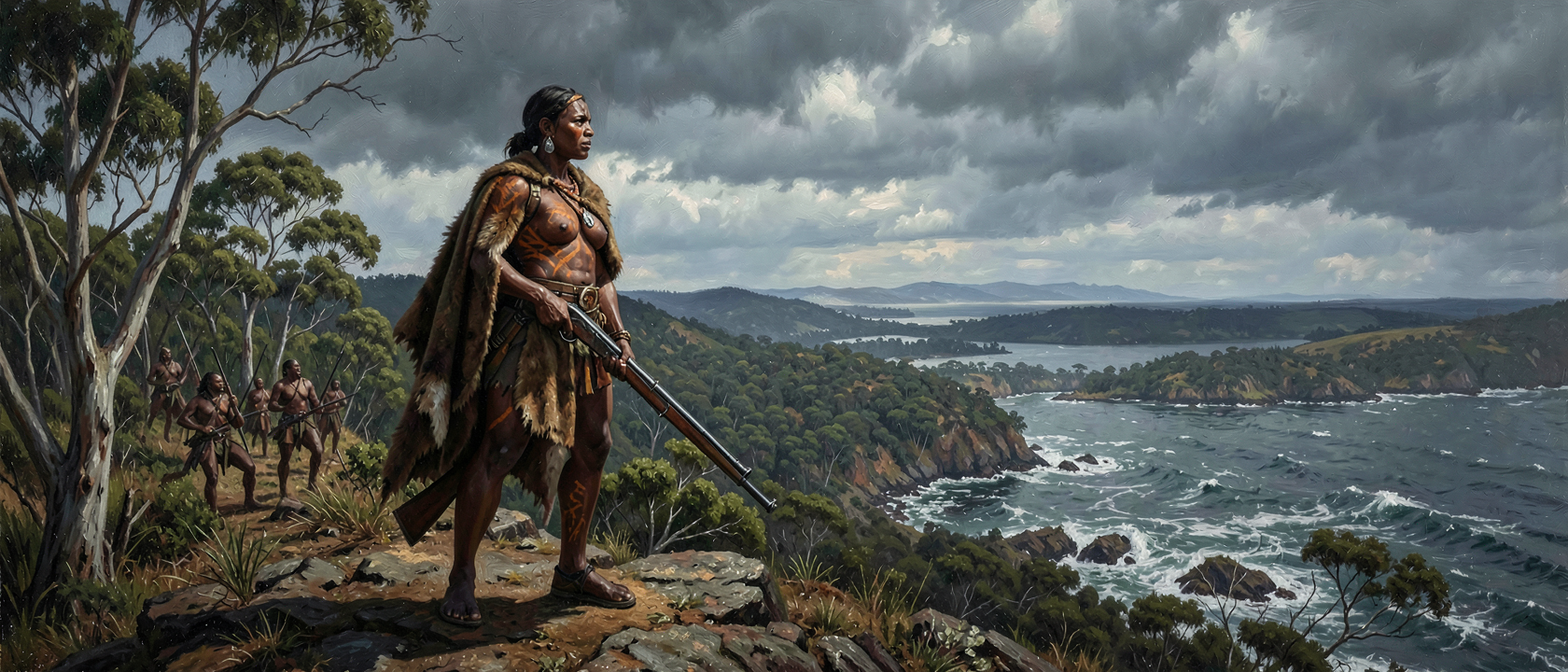
During that captivity she acquired two things her captors had not meant to give her: spoken English and a working knowledge of firearms. The firearms knowledge had a specific tactical dimension. She learned not only how to discharge a musket but how long the weapon took to reload, and that reload interval became the basis of her tactical doctrine. A discharged musket is, for a brief window, useless. She would make use of that window.
The Arithmetic of the Black War
By the mid-1820s, what had been a series of individual confrontations had hardened into a sustained conflict historians call the Black War. Sheep farming was the engine of dispossession: as grazing runs expanded across Van Diemen’s Land, clan territories contracted and clan structures fractured under the pressure. By 1829, when Lieutenant Governor George Arthur commissioned the builder and lay Methodist preacher George Augustus Robinson to pursue a negotiated peace, the Aboriginal population had fallen to approximately 1,000. That collapse, from thousands to roughly a thousand, happened within a single generation.
The Campaign at Emu Bay
In 1828, Tarenorerer escaped. She assumed leadership of the Plairhekehillerplue, a multi-clan group near Emu Bay (today Burnie) in the northwest of the island. She applied what captivity had taught her: she trained fighters to advance in the interval between a musket’s discharge and its reloading, using that gap as the moment to press an attack. Robinson would later attribute the bulk of colonial casualties in the war to her leadership.
Sealers gave her the name Walyer; colonists called her “the Amazon of Van Diemen’s Land.” The reasons they substituted a different name for her own are unrecorded.
After challenges from rival clan leaders, she withdrew with her siblings to Port Sorell on the northern coast. Robinson’s own journal records that on September 20, 1830, his party was tracked by members of her clan near the Rubicon River. He concluded his circuit of the island on September 30, 1830, without having come face to face with her.
Capture, Confinement, and the End of the Campaign
In December 1830, sealers captured Tarenorerer and delivered her to Swan Island, Robinson’s reservation off the island’s northeast coast. Robinson identified her only after her dog and other Aboriginal women gave her away. She immediately began inciting unrest among the people held there, warning them that Robinson intended to shoot them. He had her sent away with a sealer named James Parish, but she returned before the end of December and resumed her efforts.
Robinson transferred her to Gun Carriage Island, present-day Vansittart Island, a roughly 1,977-acre (800-hectare) granite island in the eastern Bass Strait, to contain her influence. She died there of influenza. Her death date is disputed in the sources: some give late May 1831, others June 5, 1831. Robinson’s journal records that he felt relief. Within weeks, organized resistance ceased.
Her burial almost certainly did not follow Aboriginal tradition.
The Final Ledger
The Black War’s casualty count was radically asymmetric. Colonist deaths are recorded at roughly 219 to 225, depending on the source; Aboriginal deaths are estimated at between 600 and 900. After January 1832, no further organized violence between colonists and Aboriginal people was recorded in settled Van Diemen’s Land. By 1835, Robinson reported that all surviving Aboriginal people had been relocated to island missions and prisons. The island was officially renamed Tasmania on January 1, 1856.
What the Record Cannot Settle
Tarenorerer’s birth year and clan affiliation are presumed, not confirmed. Parish claimed to have captured her single-handedly; historians treat that account as implausible, but surviving sources cannot disprove it outright. Robinson’s journals, the primary record of her existence, were not published until 1966, in a volume edited by N.J.B. Plomley for the Tasmanian Historical Research Association. They carry a paternalistic framing that historians regard as a structural problem for anyone trying to reconstruct her perspective, since his account shaped almost everything later writers could know about her.
In the 2016 Australian census, 23,572 Tasmanians identified as Aboriginal and/or Torres Strait Islander. As of 2023, discussions had begun about commissioning a monument to lives lost in the Black War; none had been built. The spiritual practices and oral records of her people were largely undocumented by colonizers, and the archive reflects that silence more than it resolves it.