
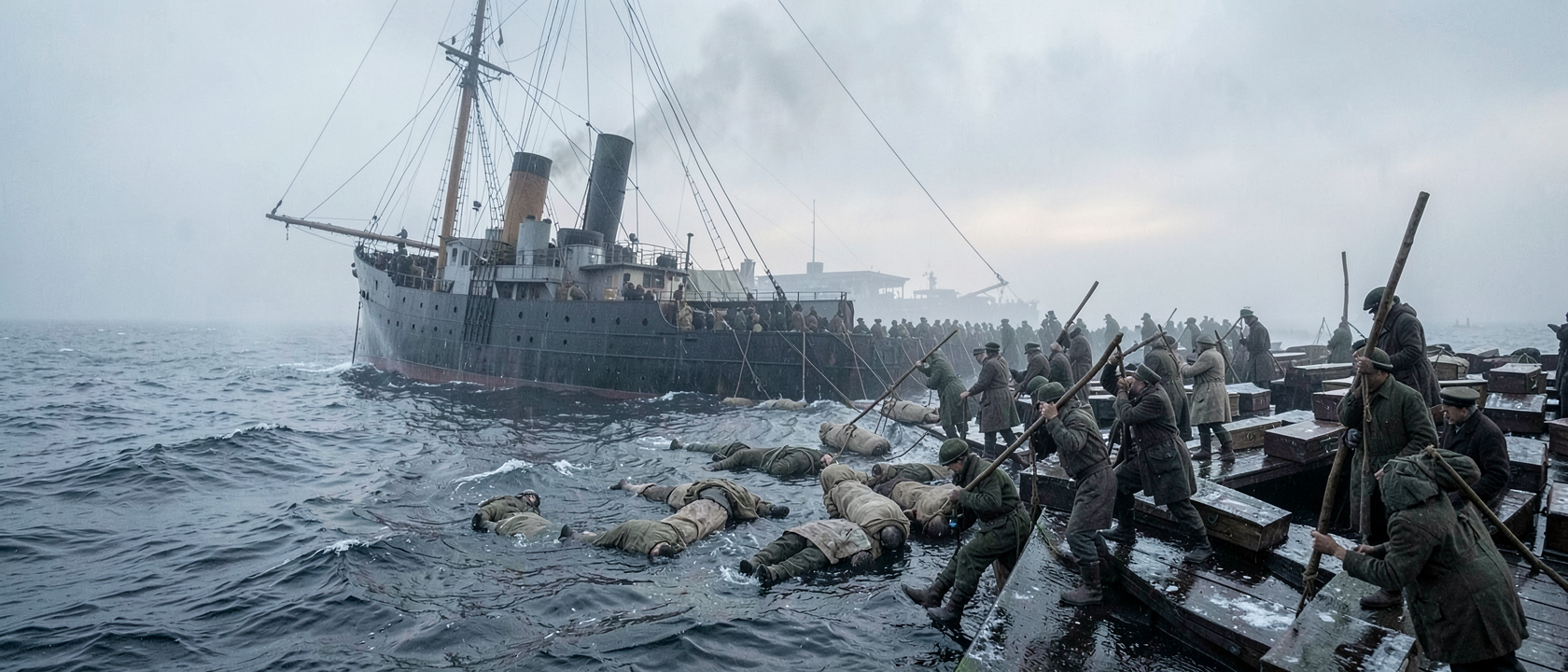
One Hundred Coffins
The cable ship CS MacKay-Bennett left Halifax, Nova Scotia, at 12:28 p.m. on April 17, 1912, two days after the RMS Titanic went under. In its hold: approximately 100 wooden coffins, 100 long tons of ice, all the embalming fluid the city could supply, and 12 long tons of iron bars to weigh down bodies designated for return to the sea. A chaplain and an embalmer were aboard.
The dead numbered roughly 1,517. One hundred coffins against more than fifteen hundred dead is not a logistical miscalculation, it reflects a deliberate set of priorities.
Captain Frederick Harold Larnder articulated the operating principle in economic terms. The phrase recorded in Jess Bier’s research, published in Social Studies of Science in October 2018, is that “no prominent man was recommitted to the deep,” though this has not been verified against an independent primary archive. What is documented is the reasoning: large estates, inheritance disputes, and life insurance policies all required an identifiable body on land before any legal mechanism could function. The ship reached the debris field on the evening of April 19 and began pulling bodies the following morning, recovering 306 before turning back.
Three Tiers, One Deck
Each recovered body received a sequential number; personal effects were catalogued under the same number. Then the sorting began.
First-class passengers received full embalming and a wooden coffin. Second-class passengers were embalmed and wrapped in canvas. Third-class passengers and crew received neither; they were wrapped in canvas and stacked on deck for group burial at sea. The criterion was perceived economic standing in life, not the condition of the remains or any difficulty establishing identity. Bier documents this as the operative logic of the entire recovery operation.
Approximately 114 of the bodies pulled from the water were committed back to the sea; other sources put the figure between 116 and 128 across all four recovery ships, with the MacKay-Bennett alone accounting for 116 sea burials. Whichever figure holds, it amounts to roughly one-third of everyone recovered.
Supplies proved insufficient almost immediately. Additional canvas arrived from the SS Sardinian on April 23; embalming materials transferred from the CS Minia just after midnight on April 26. The embalmer and chaplain had been provisioned for a hundred bodies. They found three times that number in the water.
What a Body Was Worth
By 1912, life insurance had established a practical monetary value for a recoverable body: a payout required remains that could be linked to a named policyholder. Wealthier passengers were far more likely to carry such policies. Burial at sea did not simply deprive a family of a grave; for any family holding a policy, it removed the one piece of evidence required to file a claim.
The ship’s own financial settlement moved faster. The Titanic carried a hull policy worth $5 million, placed with a Lloyd’s of London syndicate roughly two weeks before the voyage. The full amount, minus a $750,000 deductible, was paid to the Oceanic Steam Navigation Company within 30 days of the sinking. Survivors and victims’ families filed claims totaling $16 million; those were settled out of court in July 1916 for a combined $664,000. No figure appears in the sources consulted here for life insurance paid to the families of those buried at sea.
Halifax, and the End of the Objects
The MacKay-Bennett docked in Halifax at 9:00 a.m. on April 30, 1912. Its 190 landed bodies went to a temporary morgue at the Mayflower Curling Club on Agricola Street. Of the approximately 209 brought ashore across the whole operation, 150 were buried in Halifax: 121 at Fairview Lawn Cemetery, 19 at Mount Olivet Catholic Cemetery, and 10 at Baron de Hirsch Jewish Cemetery. The White Star Line paid for the headstones.
Personal effects recovered from bodies committed to the sea had been catalogued aboard and returned to Halifax. With no family present to claim them, they were subsequently incinerated as unclaimed property. This account derives from JSTOR Daily reporting on Bier’s research and has not been verified against an independent primary archive. No inventory of what was destroyed is recorded in the sources consulted here. The burial at sea took the body. The incineration took whatever had come with it.
What Standardization Came After
Bier’s argument is that the 1912 recovery was not simply a failure of resources. It was a founding episode in the bureaucratic identification of the dead, and its class-driven methods set conditions that later, more formal systems were built to address. Standardized forensic body-identification protocols began to develop after the Second World War.
DNA analysis was eventually applied to Titanic victims and, in at least one case, exposed an instance of identity fraud, showing the original triage records were not only incomplete but manipulable. Bier mentions the fraud case without naming the individual. The one confirmed DNA identification in the sources is Sidney Leslie Goodwin, a 19-month-old third-class passenger whose entire family perished; he was identified in 2007.
Despite his third-class status, the crew of the MacKay-Bennett kept his body aboard rather than returning it to the sea and paid for his burial and headstone out of their own pockets. The records that survived him were thin enough that DNA was required, nearly a century later, to confirm who he was.
The Gaps That Remain
Four ships conducted the recovery. Beyond the MacKay-Bennett: the CS Minia recovered 17 bodies and buried 2 at sea; the CGS Montmagny recovered 4 and buried 1; the SS Algerine recovered 1, a saloon steward named James McGrady, interred in Halifax on June 12, 1912. The total recovered is itself disputed, Bier uses approximately 337; the Nova Scotia Archives records 328 from the four chartered vessels, with additional bodies found by other ships in the weeks after.
The allegation that third-class passengers were physically locked below decks during the sinking is noted in Bier’s research as an allegation, not established fact. No life insurance payment to victims’ families appears in any source consulted here. Experts believe bone dissolves at the wreck site’s depth of approximately 2.4 miles (3.8 kilometers), and no identifiable human remains have been found on the ocean floor.
The recovery record accounts for, at most, 337 people. The other roughly 1,180 left no documented trace above the waterline. Their families received no body, no catalogued effects, and no insurance record linking them to any identified person.