
The Summons
In early April 1942, official notices went out to diamond merchants across Amsterdam. The instructions were straightforward: appear at the Beurs voor den Diamanthandel on the Weesperplein at noon on April 16, and bring the full stock of your company. The paperwork framed the visit as a routine inventory registration, the kind of administrative compliance Germany’s occupation of the Netherlands had been generating since May 1940. Both Jewish and non-Jewish dealers received the summons.
The German-controlled Rijksbureau voor Diamant (State Diamond Bureau) had been requiring merchants to register their stocks and seek written authorizations since October 1940. No diamond could be bought, sold, or processed without the bureau’s approval. Against that backdrop, another registration order read as ordinary bureaucratic maintenance. The summons gave nothing away.
What Diamonds Were Worth in 1942
By spring 1942, gemstones occupied a place in the wartime economy that bank balances did not. Currency could be frozen overnight by directive; diamonds, portable and internationally convertible, were much harder to reach by paper order. The Nazi regime was actively absorbing non-cash assets across occupied Europe, and gemstones moved across borders without the paper trail that securities and bank transfers left behind.
Amsterdam had been central to the European diamond trade since the 17th century. By the early 20th century, roughly 30 percent of Jewish men in Amsterdam worked in or adjacent to the diamond industry, making up approximately 70 percent of the city’s diamond workforce while constituting around 10 percent of its general population. That concentration made the trade a target on two grounds: its material assets were valuable, and the people who held them were already marked for persecution.
Noon at the Exchange
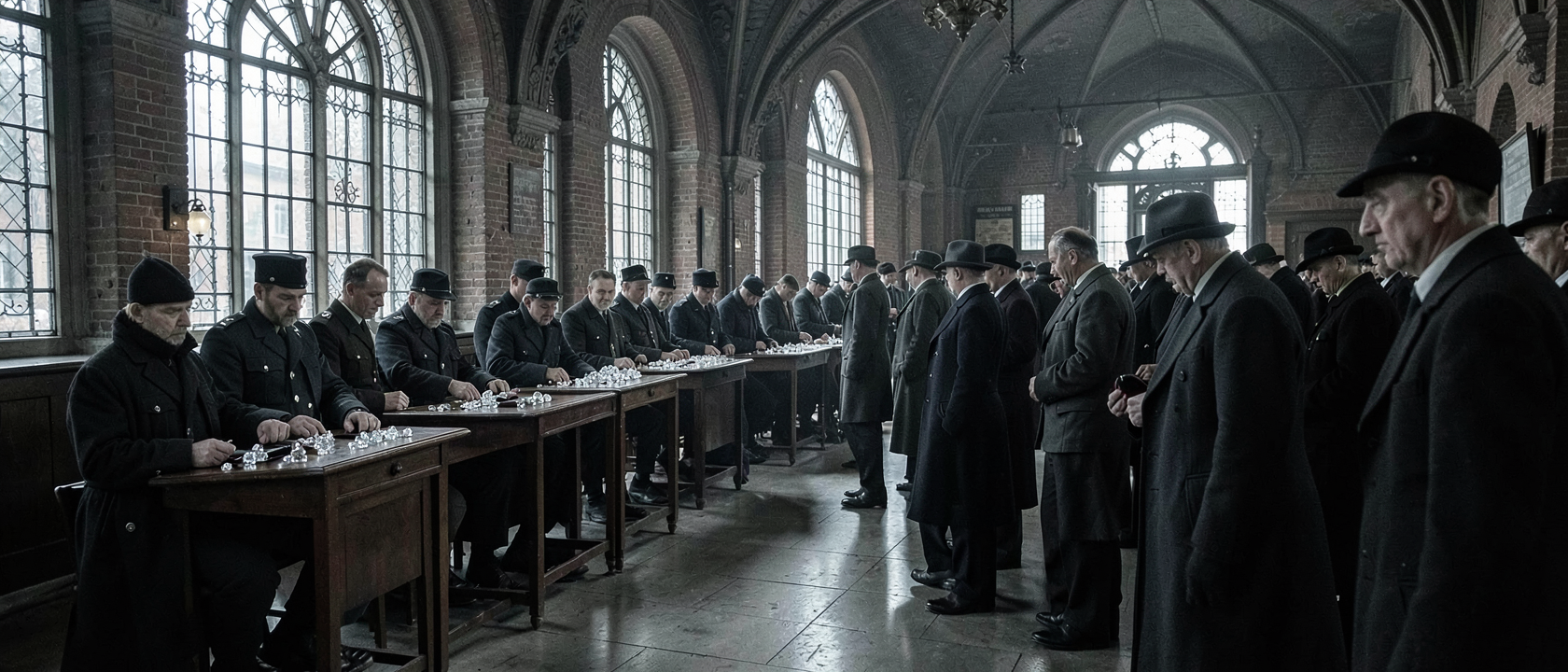
The Beurs voor den Diamanthandel, designed by architect Gerrit van Arkel and opened on September 18, 1911, was a familiar address. Merchants arrived at midday on April 16, 1942. As they entered the main hall, the exits were barricaded behind them.
Carl Hanemann, who headed the Rijksbureau voor Diamant, led the operation. Arthur Bozenhardt, a German mineral dealer, stood alongside him, as did the head inspector of the SS Devisenschutzkommando. Amsterdam police officers held the doors. Dutch detective Willem Klarenbeek moved through the crowd as a collaborator. The team worked through the room from small wooden desks, coercing each person into surrendering every carat they had carried in. The sources document no negotiation and no exceptions.
Bart de Kok, a Dutch photographer commissioned by the German occupiers and by Klarenbeek, documented the proceedings. Around 250 prints from his 1941–1942 work survived the war, hidden by Jozef van Poppel in Amsterdam-Zuid and discovered during a renovation in 2010. That collection is now held by the Stadsarchief Amsterdam.
On April 17, 1942, the operation continued. Klarenbeek led the Crisis Controledienst (Crisis Control Service) in body-searching the merchants for concealed stones. Personal jewelry, including tie pins, was confiscated on the spot.
What Each Person Lost
How many carats changed hands is disputed. Amsterdam municipal historical records place the total surrendered on April 16 at approximately 23,000 carats. The wartime diaries of Wim Post, who worked at the Rijksbureau during the occupation and whose observations formed the basis of Paul Post and Bies van Ede’s 2016 book De diamantenroof, give a figure closer to 71,000 carats for the operation as a whole. A third source suggests the seizure amounted to roughly 80 percent of total Dutch diamond stock. The discrepancy most likely reflects different scopes: the lower figure probably covers only April 16, while the higher figures include subsequent confiscations.
Whatever the precise weight, the mechanism guaranteed a complete loss: the summons had required merchants to bring their full company stock. The raid did not take a portion; it took the whole.
For Jewish merchants, timing compounded the scale. By April 1942, Jewish lapidaries and cutters were already being held in concentration camps or had obtained a Sperre, an exemption stamp shielding the holder from deportation, at the cost of large sums in money or diamonds. The industry’s workforce was being dismantled at the same time its material assets were stripped in a single afternoon. The two processes ran in parallel.
The seized diamonds were placed in vaults in Arnhem under the pretext of “safekeeping,” then transferred to Berlin and placed under the control of Friedrich Kadgien, a German businessman and Nazi official who served as special representative of the Four Year Plan. From September 1943, Kadgien arranged for part of the diamonds to move to Switzerland and onward to South America. Post-war investigation found a significant discrepancy between what had been sold and what was returned to the Netherlands.
In 1943, the occupation authorities recalled a group of Jewish diamond merchants from Westerbork transit camp. Under duress, twenty Jewish firms assembled gemstones then valued at 600,000 Dutch guilders as a gift to Hanemann, reportedly to obtain their release. Within days of handing over the stones, almost all of them were arrested and sent back to Westerbork.
Around 2,800 Amsterdam diamond workers were deported to extermination camps during the occupation; approximately 300 returned. Those figures derive from a single source and should be read as estimates. After the war, surviving Jewish diamond workers largely relocated to Antwerp. Amsterdam’s standing as the center of the European diamond trade did not recover.
What the Record Cannot Say
The documentary record for April 16, 1942, is solid on the mechanism: the false pretext, the sealed exits, the personnel at the wooden desks, the coerced surrender. It is much less complete on downstream questions. The monetary value of the confiscated stock at 1942 prices has not been established. The complete chain of custody after Arnhem is only partly traceable. What happened to the individual merchants present that day is not addressed in available published scholarship. The archive of the Rijksbureau voor Diamant, held at the Nationaal Archief in The Hague under reference NL-HaNA, Rijksbureau Diamant, 2.06.076.04, is open to the public and may hold answers not yet fully worked through.
The event acquired a Dutch name: Diamantroof, “diamond robbery.” Officials sat at wooden desks in a building whose exits had already been locked and took, person by person, whatever each merchant had carried in under the promise of a receipt.