
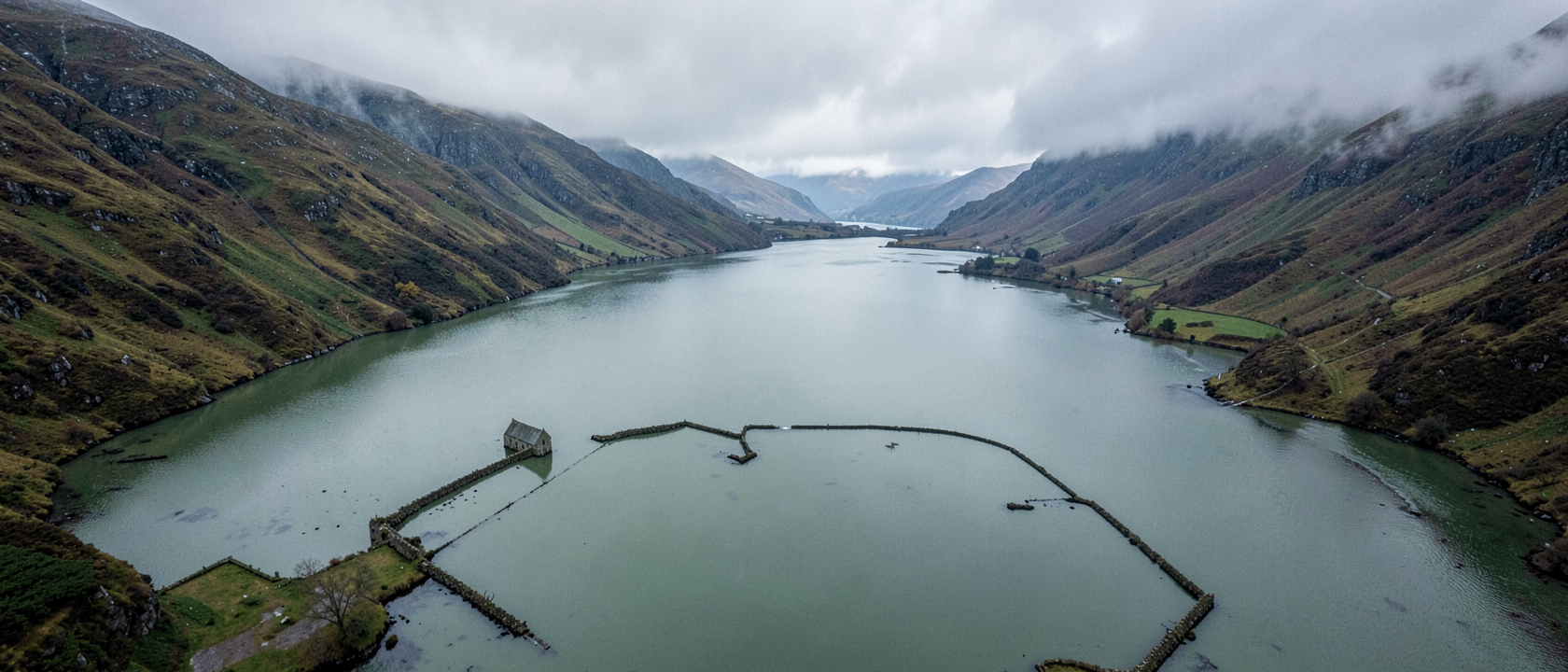
The valley that went under
In 1965, the Tryweryn Valley in Merionethshire (now Gwynedd) disappeared under rising water northwest of the market town of Bala. The reservoir that formed there, Llyn Celyn (Lake Celyn), covered land estimated at roughly 800 acres (324 hectares) that had belonged to Capel Celyn, a small Welsh-speaking village. Twelve houses and farms went under, along with the post office and the school. The chapel went too. Its cemetery did not go under with it: the graves were moved to higher ground before the water arrived. Estimates of how many people lost their homes in the valley range from about 45 to 68. All of it followed an act of Parliament passed eight years earlier, in 1957.
A bill Wales couldn’t stop
By the late 1950s, Liverpool’s growing population and industry needed more water than the city’s existing reservoirs could supply. Liverpool Corporation settled on the Tryweryn Valley and pushed the project through Parliament as a private bill rather than a standard planning application, a route that let it bypass Welsh local authorities altogether. The villagers had organized two years earlier: in 1956 they formed the Capel Celyn Defence Committee and marched to Liverpool twice to state their objections. None of it changed the outcome. All 36 of Wales’s members of Parliament opposed the bill or abstained; English votes carried it anyway, by a majority of 96, and it received Royal Assent in 1957. Eviction notices followed directly from that act, with no separate local consent required. The defeat is widely credited with building support for the nationalist party Plaid Cymru and for the campaign that eventually brought devolution to Wales, though control over water was not among the powers handed back.
Green’s longer map
Capel Celyn is one of eight settlements that writer Matthew Green traces in his book “Shadowlands: A Journey Through Lost Britain” (Faber, 368 pages, £20), reviewed by Robert Greer in the March 1, 2022, issue of History Today. Green’s other subjects reach back far earlier than the twentieth century: the Neolithic settlement of Skara Brae on Orkney, the once-thriving Suffolk port of Dunwich, and the Sussex town of Winchelsea, lost to the sea in the 1280s. Winchelsea’s disappearance was, for its time, ordinary. Between 1099 and 1570, an estimated 286 villages, parishes, and islands along the coasts of Western Europe were lost the same way, to flooding and the slow retreat of the shoreline.
A town built twice, sacked once
After Old Winchelsea went under the sea in the 1280s, King Edward I ordered a new town built on higher ground nearby. New Winchelsea, founded in 1288, was laid out on a planned grid of streets, with deep cellars dug beneath its houses to store wine imported from Guyenne, and it grew into one of the busiest ports in the medieval wine trade. That prosperity made it a target. On March 15, 1360, a French raiding force estimated at 1,500 to 3,000 men stormed the town and burned much of it, killing hundreds of residents, some of whom had taken shelter in the parish church. Winchelsea never regained its former size. Yet according to the review, for centuries afterward, a town reduced to roughly 100 people kept sending two members to Parliament, a right that survived on the books into the 17th century, long after the settlement it represented had shrunk past recognition.
Villages requisitioned for D-Day
During the Second World War, the Ministry of Defence requisitioned a cluster of villages in Norfolk, collectively known as STANTA, the Stanford Training Area, so troops could rehearse for the landings in Normandy. When the war ended, the land was not given back. In the decades since, the Ministry has instead rebuilt the villages as mock settlements, at times staffed with actors, so soldiers could train there against whichever enemy the period required: Nazi Germany, the Soviet Red Army through the Cold War, and Taliban fighters more recently. The people who had lived there before the war never got the land back.
What was actually paid
Green’s book never puts a price in pounds or dollars on any of these losses; the accounting he keeps is a different one. Capel Celyn’s price was a community erased outright, its houses, chapel, and school gone under the reservoir, its graves moved first so the water could take the rest. New Winchelsea’s price was a population that never rebuilt itself after 1360, shrinking to a fraction of its former size inside a town still laid out for thousands. Norfolk’s price was land the Ministry of Defence kept for good, decades after the war that had justified taking it. The causes varied, but in every case, what was lost was never restored.
What historians still argue about
Green does not resolve every question his book raises, and the review credits him for not pretending to. Why Skara Brae was abandoned remains disputed: one theory holds that Bronze Age advances simply passed the remote settlement by, another that a shift in climate made it unlivable, and no consensus has settled the matter. Closer to the present, archaeologist Stuart Wilson has spent years excavating a site in Powys that he believes is the lost medieval city of Trellech, following a discovery made by a local farmer in 2002. Other archaeologists who have studied that same stretch of countryside for decades disagree, and the dispute remains open.