
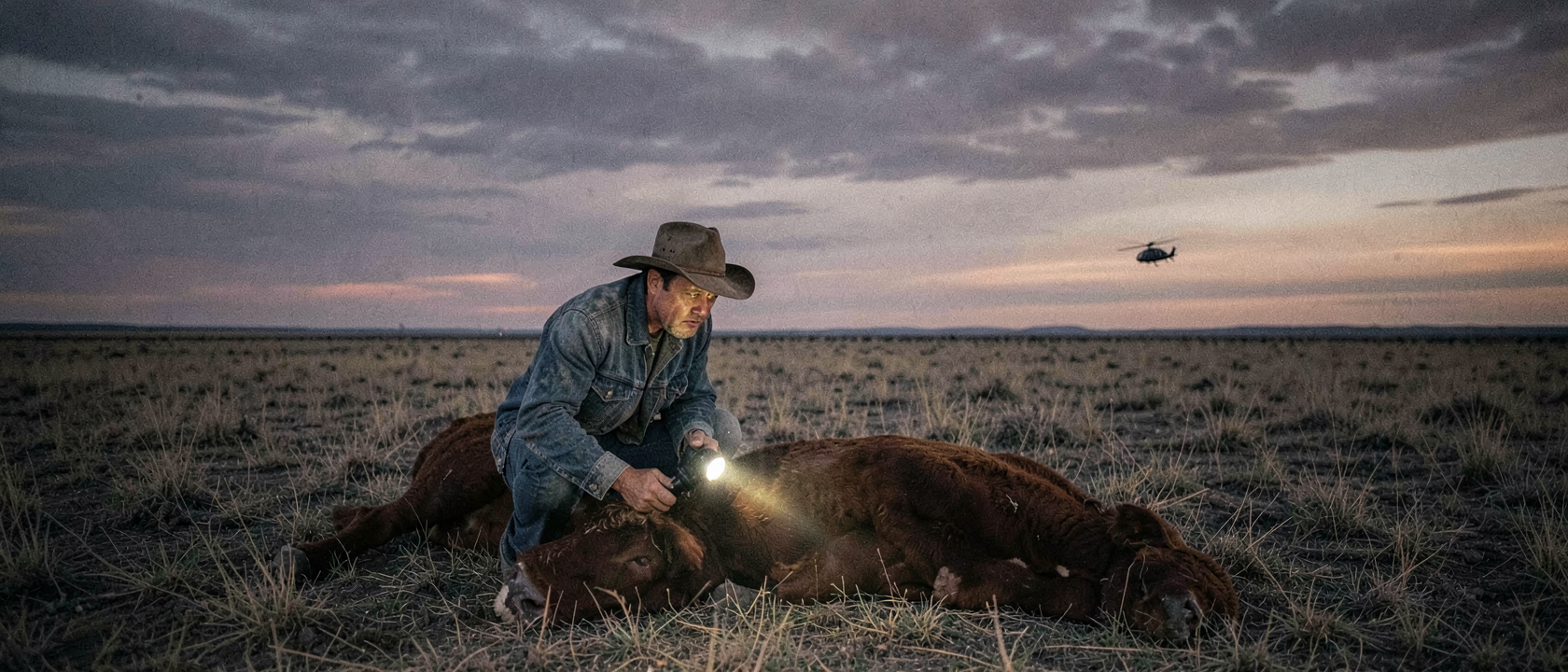
Beginning in 1973, ranchers across the American West and Midwest started finding cattle stripped of ears, eyes, and genitals, in cuts they called surgical. A few fired on helicopters, convinced Washington was behind it. The explanation a historian eventually settled on involved scavengers, not scalpels.
Dugway, 1968
On March 13, 1968, a nerve-agent test went wrong at Dugway Proving Ground, the Army’s chemical weapons range about 80 miles (129 km) from Salt Lake City, Utah. An F-4 Phantom released 320 gallons (1,211 liters) of VX nerve agent too high over the range, and it drifted into Skull Valley. Press accounts at the time put the dead at roughly 6,400 sheep; the Army’s own compensation tally, worked out later, credited the nerve agent with killing 4,372 outright and disabling 1,877 more that were then destroyed. Dugway denied running any chemical test until March 21, 1968, when Utah Senator Frank Moss released a Pentagon report proving otherwise. Full admission took longer still. A 1978 Army report calling the evidence “incontrovertible” stayed secret until 1998, thirty years after the sheep died.
It was one of the only documented cases of a secret government program killing American livestock. Five years later, it was the only precedent ranchers actually had.
The Wreck
By the early 1970s, small ranchers in the West and Midwest were being squeezed from every side. Federal conservation rules limited grazing on public land. Inflation, sharpened by federal grain purchases made to cover food shortages abroad, pushed feed costs up. Then the Nixon administration froze meat prices, cutting off the ranchers’ last way to offset those rising costs. In 1975, the president of the American National Cattlemen’s Association told a Senate agriculture committee that the industry was running at an operating loss. Ranchers called the squeeze “the Wreck.” It hit small operations hardest, since they lacked the lobbying power that let bigger ranches push back. No cattle had been mutilated yet. What existed was a population already primed to believe Washington was working against it.
First Carcasses
The first reports came in 1973, concentrated in Colorado and New Mexico, states with a high share of small ranches already deep in the Wreck. Texas, which ran far more cattle than any other state, reported comparatively few cases. Ranchers found cows missing their ears, eyes, rectum, and sex organs, in cuts local law enforcement often called surgical. There was no blood pooled near the body, no tracks leading in or out, and wound edges investigators described as clean. To operators already losing money on feed and grazing rights, it looked less like nature’s work than like someone’s.
The Count Climbs
Through the rest of the decade, the reports multiplied. Newspapers eventually tallied more than 10,000 incidents across 11 states, according to the New York Times. The theories grew with the count. Some in the press floated UFOs or cults, but among ranchers the dominant suspicion was a secret government weapons program, an idea the Dugway precedent had already primed ranchers to believe. Some reported unmarked helicopters near the sites and said the aircraft chased them; a few shot at the helicopters. The Nebraska National Guard, flying exercises over cattle country, raised its altitude from 1,000 feet (305 m) to 2,000 feet (610 m) to stay clear of the trouble.
What the Investigators Found
Agencies that examined the carcasses, including the Colorado Bureau of Investigation, found no sign that a person had been involved in any case. The FBI closed its own inquiry on January 15, 1980, stating that “none of the reported cases has involved what appear to be mutilations by other than common predators.” Skepticism had come earlier, though, and from a particular direction. Veterinarians doubted the theory from the start, and so did the larger, better-capitalized ranchers, who had more room to absorb a natural loss and less reason to suspect the government was singling them out. Doubt tracked with size and political access. The small operators already hurt worst by the Wreck had the least reason to believe an official finding of nothing.
Scavengers, Not Scalpels
The explanation came from historian Michael J. Goleman, who earned his doctorate in U.S. history from Mississippi State University in 2010 and later taught at Somerset Community College. In a 2011 paper in the journal Agricultural History, “Wave of Mutilation: The Cattle Mutilation Phenomenon of the 1970s,” he laid out what coyotes, magpies, and badgers do to a dead or dying animal. They take the soft tissue first, the eyes, the lips, the anus, the genitals, whatever killed the animal. Bloating and the pace of decomposition can leave what remains looking smoother than a scavenger’s work usually does, especially to someone untrained in reading it. Goleman also found that cattle deaths were no higher during these years than before or after them. What had changed was the coverage: every report primed readers to look for the same pattern in the next carcass, and to find it.
The Bill
There is no verified death toll here and no dollar figure, since investigators found little proof that anyone but a scavenger had touched these animals. What the panic cost was harder to put in a ledger: a stretch of real rural fear, ranchers firing at aircraft, a National Guard unit changing its flight plans, and a distrust of Washington that the Wreck had already built and that now had a face. Goleman reads the episode as part of a wider current of American political cynicism, an interpretation he offers, not a settled fact. What is not in dispute is who paid. Small ranchers paid once in the arithmetic of the Wreck: frozen prices, rising feed costs, grazing limits set without their input. They paid again in being humored rather than heard, their dead cattle logged by agencies that found nothing, their fear remembered as a curiosity of the 1970s rather than a debt anyone settled.