
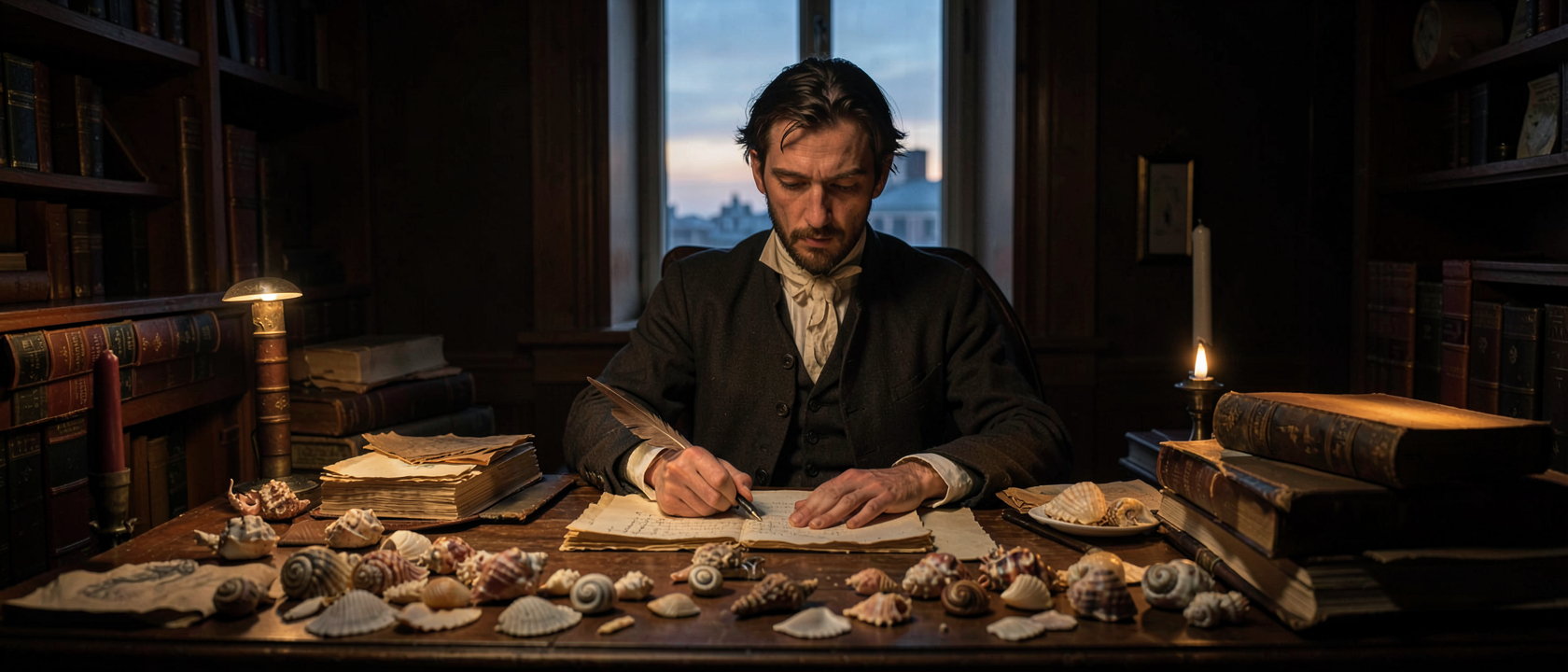
Edgar Allan Poe is remembered today for “The Tell-Tale Heart,” for “The Raven,” and for more or less inventing detective fiction. None of that was his best-selling work while he was alive. That distinction belongs to a seashell guidebook published in Philadelphia in 1839, a book he did not fully write and could not fully claim as his own.
The Soldier and the Shells
Poe’s connection to conchology, the study of mollusk shells, started years before any publishing contract. Under the alias “Edgar A. Perry,” he arrived at Fort Moultrie on Sullivan’s Island, South Carolina, in November 1827, and remained there through roughly 1829. Sullivan’s Island was home to Dr. Edmund Ravenel, an eminent conchologist who also served as the island’s intendant, its mayor in effect, and who in 1824 became the first chair in chemistry and pharmacology at the newly founded South Carolina Medical College.
Poe reportedly sought Ravenel out during his posting there. No exact date survives for that contact, only its rough place, years before Poe’s name ever touched a shell manual.
A Name for Hire
By the late 1830s, Poe had a reputation as a horror writer and a critic sharp enough to worry his rivals. He had no financial security to match it. Thomas Wyatt later said Poe “needed money very sorely at the time.”
Wyatt had his own problem. His Manual of Conchology, published by Harper & Brothers in 1838, cost $8 and carried a full set of illustrations, too expensive for beginners and serious students alike. He wanted a stripped-down classroom edition at $1.50. Harper’s refused; a cheaper edition from the same house would only eat into sales of the original. So Wyatt took the idea to Haswell, Barrington, and Haswell, a Philadelphia firm, and hired Poe to rewrite the text under a new title.
Poe wrote a fresh preface and introduction, translated a passage of Georges Cuvier’s French into English, built a new classification scheme, and reworked the descriptions of the animals themselves. The bulk of the actual shell-by-shell content still came from Wyatt. Poe’s name went on the title page. Wyatt’s did not. The publishers reportedly wanted a writer with a low enough profile that suing him for damages would hardly be worth anyone’s trouble. Poe took the job for $50.
The Bestseller
The Conchologist’s First Book: Or, A System of Testaceous Malacology appeared in 1839. It sold out within two months and went back to press twice more, with further editions in 1840 and 1845, the only one of Poe’s books to reach a second edition in the United States in his lifetime. It outsold everything else he ever published. He drew no royalties from any of it, only the flat fee he had already been paid.
Trouble followed almost as fast as sales did. Poe had acknowledged his debt to the field’s established experts inside the book itself. Newspapers and literary critics named what much of it plainly was anyway: someone else’s work, rearranged.
The Refusal
Five years later, in 1844, Poe brought a wholly original manuscript, nothing borrowed this time, to Harper’s, the same house that had published Wyatt’s Manual of Conchology back in 1838. They turned him down.
According to biographer Jeffrey Meyers, a friend relayed Harper’s reasoning to Poe directly: the firm had complaints “grounded on certain movements of yours.” Not unpaid debts. Not a weak manuscript. His conduct on a shell book five years earlier was reason enough to close the door. At a point in his career when Poe badly needed a major publisher behind him, the shell book is what he got instead.
What the Record Doesn’t Say
Not everyone reads the Ravenel contact as pure convenience. Biographer Arthur Hobson Quinn, and later the scholar Fernando Galván drawing on Quinn’s research, argue that Poe’s earlier exposure to a working conchologist points to genuine engagement with the subject, not a hack angling for a fast contract. Quinn described the actual publishing deal in blunter terms, as Galván later quoted him: “Wyatt decided to have a book prepared that he could sell; Poe accepted the job of rewriting the text.” Quinn’s account separates the two questions. He suggests Poe’s curiosity about shells came first, even if the money came before the writing.
A good deal here is simply undated. No source fixes the day Poe sought out Ravenel, or the moment plagiarism talk started, or a real print figure for the book, and some researchers doubt the two men ever met at all, since no direct documentary evidence of that meeting has surfaced. “Best-selling” is a comparison against Poe’s own catalog, not a documented sales count. Even the layer underneath the layer is unsettled: some accounts hold that Poe’s own contributed material leaned heavily on Thomas Brown’s earlier Conchologist’s Text-Book, though sources disagree on whether that book dates from the early or the mid-1830s.
What’s certain is narrower than the legend around it. A book carried Poe’s name on the cover. Most of its substance belonged to someone else. Five years passed, and it was still the reason a publisher shut its door on him.