
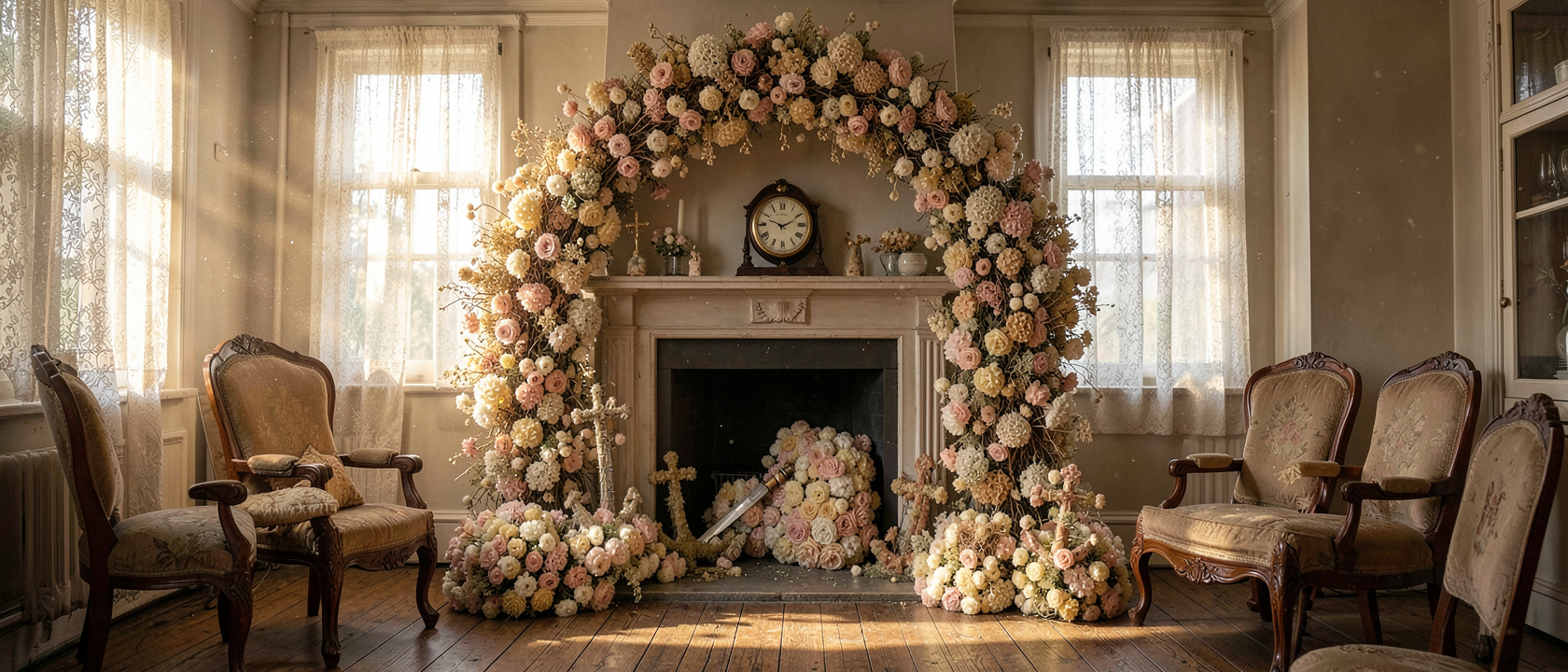
The Clock at 8:08
Ulysses S. Grant arrived at a rented cottage near the summit of Mount McGregor, in Saratoga County, New York, on June 16, 1885. He came with his wife Julia, other family members, servants, and a team of physicians, and he came because he was dying of cancer of the throat and tongue. He was also, by that point, financially ruined: in 1884 he had lost his fortune investing with Ferdinand Ward, whose firm turned out to be a fraud. The memoirs he was writing were the one asset left to leave his family.
He worked through June and into July, racing the illness rather than any deadline set by a publisher. On July 18, 1885, he finished the manuscript that became Personal Memoirs of U. S. Grant. Five days later, on July 23, at 8:08 in the morning, he died in the cottage. His eldest son, Frederick Dent Grant, stopped the mantel clock in the parlor at that exact minute, then reached over and touched his father’s forehead. The clock has read 8:08 ever since, one fixed detail in a house that has otherwise stayed much as it was.
A Cottage Lent for a Legacy
The cottage belonged to Joseph W. Drexel, a family friend who offered it once Grant’s doctors recommended he leave the New York City summer for mountain air. Some accounts also credit William J. Arkell, an investor with a stake in a nearby hotel, with pushing for the arrangement, on the reasoning that a former president’s final weeks under their roof would raise the property’s value for good. That detail isn’t independently confirmed, but it fits the pattern of what came next: at the moment Grant died, nothing guaranteed the cottage would end up a landmark rather than simply a house a famous man had once borrowed.
The memoir did what Grant had hoped. It sold well and left Julia Grant financially secure. What secured the cottage’s own future was decided two weeks later, by what mourners chose to leave behind in it.
Flowers as Architecture
A memorial service was held at the cottage on August 4, 1885, ahead of Grant’s formal state funeral in New York City on August 8. Floral tributes had been arriving for days, and several were built on the scale of furniture rather than flowers. The largest was a “Gates Ajar” piece, a floral gate design roughly six feet tall bearing Grant’s name, set in front of the parlor fireplace. Beside it stood a floral sword resting on an oversized pillow, sent by Union veterans of the Grand Army of the Republic in Philadelphia, men who had served under Grant two decades before. Smaller pieces followed the same idea: a cross, a heart, an anchor. One Gates Ajar tribute still carries its original card, reading “Deepest Sympathy Mr. & Mrs. Leland Stanford.”
None of this was improvised. By 1885, elaborate floral “set pieces” for the funerals of prominent Americans were an established trade, grown out of Civil War-era mourning customs of the late 1860s and largely gone again by the early 1900s. Most were built from pearly everlasting, a small cottony flower that florists bleached and dyed, then wired onto moss-packed frames strong enough to hold a shape upright for a viewing. After the service, Grant’s pieces were left where they stood, in the parlor. They have remained there, more or less undisturbed, ever since.
Found Again
For 141 years the flowers were simply part of the house, a detail pointed out to visitors, kept clean by the site’s own staff without anyone treating them as a research question. That changed in August 2021, when Robert Treadway, a floral historian and author of A Centennial History of the American Florist, learned of the pieces and arranged to examine them with the Friends of Grant Cottage, the organization that runs the site. His conclusion: these were the last known complete examples of the 19th-century floral set-piece tradition anywhere in the country. Every other funeral of that kind, for every other public figure mourned the same way, had left nothing comparable behind.
Treadway’s visit turned routine housekeeping into a formal problem. Afterward, Heidi Miksch, a New York State conservator, began a closer study of what was actually happening to the flowers and what, if anything, could still be done.
What Darkness Couldn’t Stop
Miksch’s first finding undid a piece of the cottage’s own folklore. Staff had long believed the flowers were sealed under a coat of wax. There was no wax. What had kept the pieces intact this long looks closer to modest care and plain luck: occasional dusting, and a room nobody handles the contents of.
Her assessment set out what is working against the flowers now. Sunlight through the parlor windows fades the dyed petals and breaks down the plant fiber. Humidity encourages fungal and bacterial growth on organic material that has spent over a century drying out and turning brittle. Even dust sitting on petals that fragile acts as an abrasive, so that brushing it away can take fragments of flower with it. Care, at this stage, is not a neutral act. Every intervention carries some chance of doing damage of its own.
What No One Can Yet Say
Some questions remain open. Conservators cannot yet say how much of the current fragility is simply age, an organic object sitting in one room for 141 years, and how much came from decades of well-meant handling applied without expert guidance. A further environmental threat assessment has been proposed, but no date has been set for it.
There is also no agreed fix. Ben Kemp, the Friends of Grant Cottage’s operations manager, has proposed enclosing the pieces in a display case. Conservators, Miksch among them, are wary that a case could trap moisture inside or change the character of a room meant to look as Grant’s mourners left it. A third idea, building faithful replicas for public display while the originals stay where they are, remains under discussion, with no decision made and the originals left to decay in the meantime. Nobody has yet explained why, out of an entire American mourning tradition, only Grant’s flowers made it this far. That question, too, is still open.