
The Snowless Race
The winter of 1970 arrived on Michigan’s Keweenaw Peninsula without the one thing the region counts on: snow. Hancock and the surrounding Upper Peninsula usually disappear under hundreds of inches of it by midwinter, and snowmobiling had become part of the local economy, not just a pastime. By one regional account, the Range Snowmobile Club of Atlantic Mine had a race booked for December 4, and that fall the ground around town stayed bare and brown. For a club whose season depended on that race, an empty sky was a real problem.
A DJ, a Joke, and a Made-Up God
David Riutta sold advertising for Hancock’s WMPL radio station and also had time on the air. He was Finnish-American and a fan of the country singer Hank Snow, and that fall he ran the singer’s name through Finnish. “Heikki” is the Finnish form of Henry, or Hank; “lunta” is simply the Finnish word for snow. Put the two together and you get Heikki Lunta, a snow god invented on the spot out of a pun.
Riutta wrote the lyrics to “Heikki Lunta’s Snow Dance” in about twenty minutes, setting them to a melody he already had in his head, so the whole song came together in under an hour. He recorded it slow and almost solemn, closer to a chant than a novelty tune, even though the words were a joke. WMPL put it on the air.
Snow Falls, a Legend Is Born
Snow followed soon after, and Upper Peninsula memory turned that timing into a story: Heikki Lunta had answered, buried the region, and forced the December 4 race to be called off. It is a satisfying version of events. It is also, by the historical record, not accurate. The 1970 race went ahead as planned.
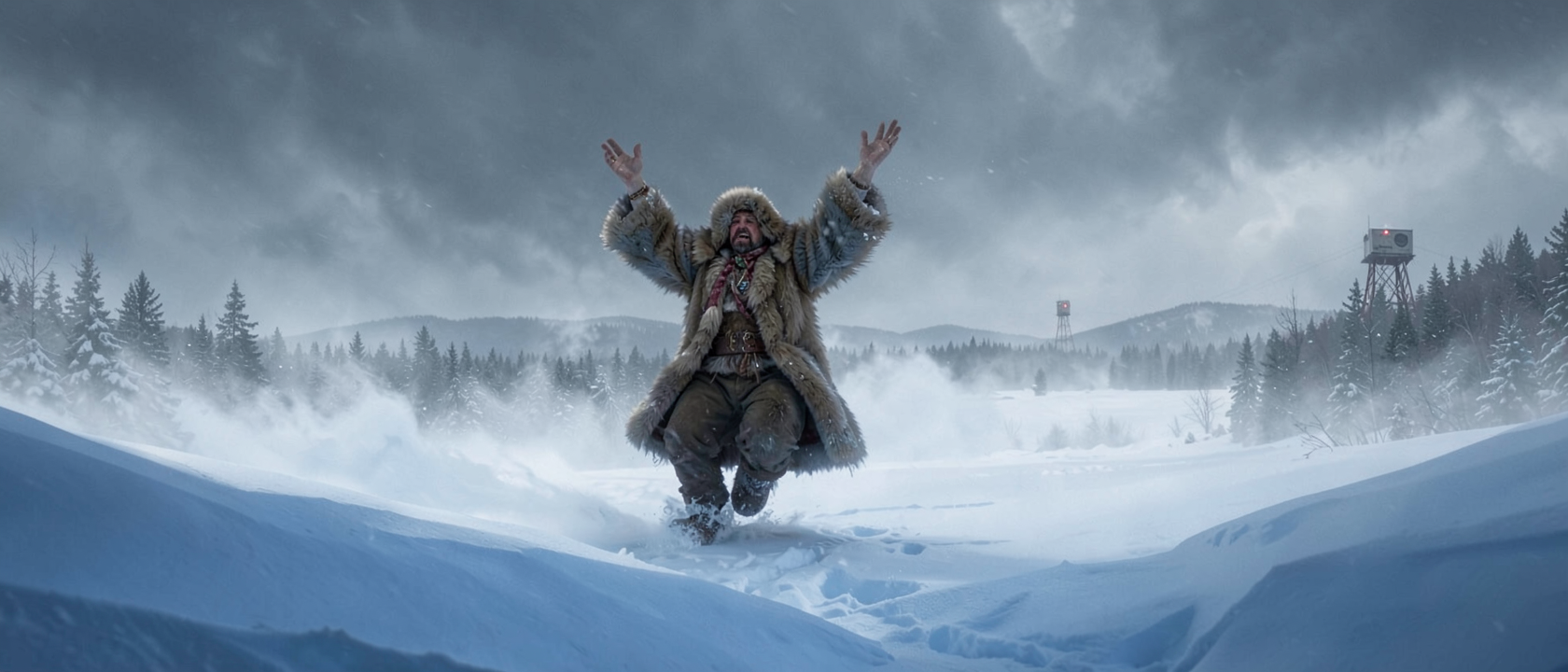
What did happen was more snow than Riutta wanted, enough that he wrote a second song, “Heikki Lunta Go Away,” asking his own invention to stop. WMPL pressed both songs onto opposite sides of the same 45, one side calling snow down and the other calling it off. Sometime later, a friend tied to the Range Snowmobile Club asked Riutta to put on a fur coat and appear in person as Heikki Lunta at a club event. He was reluctant, but he did it, and the character had its first body.
Heikki Gets a Body
Over the next two decades, Heikki Lunta stopped belonging to Riutta at all. In 1991, the comedy-rock band Da Yoopers recorded their own song about him. In 1994, the Finnish reggae group Conga Se Menne released a music video, “Guess Who’s Coming,” that showed Heikki as a faceless mass of fur coats rather than one figure with a face. Between 1995 and 1997, Finlandia University in Hancock staged plays that filled in his backstory further, none of them working from the same script. By the time they closed, Heikki Lunta was shared regional material, and nobody was in charge of what he looked like.
Making It Official
The groundwork for a festival had been laid earlier, when the Hancock City Council appointed twelve residents in the early 1980s to a Finnish Theme Committee charged with keeping the area’s Finnish heritage alive. Out of that committee, in 1999, Jim Kurtti, later named Honorary Consul of Finland for the Upper Peninsula, co-founded Heikinpäivä, a winter festival tied to the Finnish name day for Henrik on January 19. The festival grouped Heikki Lunta with two other “Heikkis”: Saint Henrik, the Finnish patron saint whose name he shares, and “Hankookin Heikki,” a real community member chosen as grand marshal each year. Alongside them, Heikinpäivä kept Finnish-American foods on the table and a wife-carrying race on the schedule.
An art student named Becky Weeks later designed the festival’s costume and dressed Heikki as a backwoods Yooper, in a plaid shirt and wool pants, rather than anything mythic-looking. A separate festival in Negaunee, built around outdoor winter recreation rather than Finnish heritage, settled on its own version: a bearded man in goggles, used as the festival’s logo. Two towns ended up with two unrelated gods sharing one name.
What It Actually Cost
Nothing in the record shows lives lost, money lost, or property damaged. The race went ahead. The songs sold as novelties. The one real bill Heikki Lunta ran up was cultural. Some conservative residents of the Upper Peninsula criticized Riutta at the time, arguing that his invented snow god revived older stereotypes about Finnish immigrants as pagan or magical, echoes of the Finnish folk belief in “noita,” or witch doctors. Folklorist Hilary-Joy Virtanen of Finlandia University has traced that objection back to those older sources. It has faded with time, but it is worth stating plainly rather than skipping past it: a joke written to save a snowmobile race also, for some, reopened a question about how the region’s own past got told.
What Nobody Can Settle
More than fifty years on, three things stay open. Heikki Lunta has never had one settled look: a fur coat in 1970, a faceless pile of coats in 1994, a plaid-shirted Yooper at Heikinpäivä, a bearded man in goggles on a festival logo, each made by someone different for a different occasion. How far the backlash against Riutta actually reached, and who organized it, is not documented beyond the fact that it happened. And the larger question, whether Heikki Lunta draws on a genuine older strand of Finnish folklore about magical figures or was invented in 1970 and read backward into tradition afterward, remains a folklorist’s interpretation rather than settled fact. The Upper Peninsula kept the god. It never agreed on what he looks like, or where he actually came from.