A Truck at the Side Entrance
On Monday, July 22, 1946, shortly after noon, a delivery truck pulled up at the service entrance of the King David Hotel in Jerusalem, then administered by Britain as Mandatory Palestine. Nothing about it drew a second look. Trucks came and went through that side door all day, dropping off food and linens for a hotel that ran a full kitchen, a basement nightclub, and, on its upper floors, the offices of a government. The truck had in fact been stolen, though hotel staff had no reason to suspect it.
The Nerve Center of the Mandate
The King David was Jerusalem’s grandest hotel, but its south wing did double duty as the seat of British authority in the region. It housed the Secretariat, the civil administration Britain ran in Palestine, along with the headquarters of the British Army for Palestine and Transjordan. Orders for the territory were drafted and issued from those offices, which sat directly above the hotel’s basement rooms.
Three weeks earlier, British forces had carried out Operation Agatha, a wide search-and-arrest campaign against the Jewish underground that opponents nicknamed Black Saturday. The Irgun (Irgun Zvai Le’umi), one of the groups it targeted, had cleared a strike on the hotel with the Haganah, the larger Jewish paramilitary command, though the Haganah asked for repeated delays as the political situation shifted. The Irgun’s commander, Menachem Begin, would later serve as Israel’s prime minister.
Into the Basement
Accounts differ on how many men carried out the plan, from five to eight, the gap perhaps reflecting how many actually went inside against how many stood watch outside. Dressed as Arab laborers, they forced their way into the hotel’s service bay, overpowered the chief delivery clerk and the kitchen staff, and locked them away. Then they hauled seven milk churns down a service corridor and into La Régence, the hotel’s basement bar, directly beneath the Secretariat and army offices above. Packed inside was a mix of TNT and gelignite, a charge most accounts put at roughly 770 pounds (350 kilograms); at least one estimate puts the total closer to 350 pounds in all (159 kilograms).
An Officer Intervenes
At some point during the break-in, a British Army officer challenged the group. He was shot and later died of his wounds. He was the first person to die that day, killed before any charge had gone off, simply for being in the way of men moving explosives into a basement.
Fuses Lit, Building Unaware
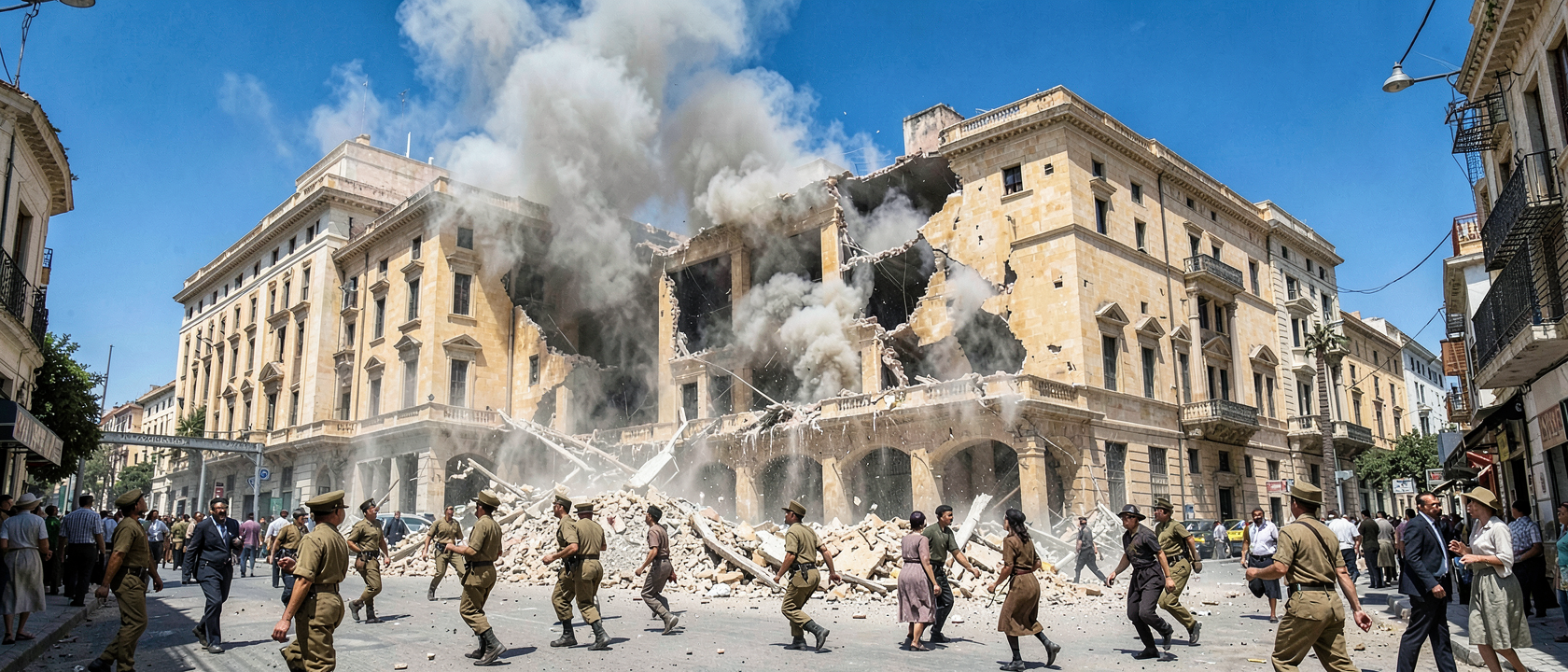
The attackers wedged the churns against the basement’s load-bearing columns, aiming to bring the weight of the south wing down on itself, and lit fuses set to burn for about thirty minutes. As they withdrew, a courier began phoning warnings: the hotel switchboard at 12:22 p.m., the offices of the Palestine Post four minutes later with a request to pass the message on again, and the French Consulate next door at 12:27 p.m. A second, smaller bomb went off outside nearby shops around the same time, a diversion the CID, the Mandate police’s Criminal Investigation Department, later judged was meant to spread panic and speed an evacuation. None of it reached anyone with the standing to clear the building. At 12:37 p.m., the charges detonated.
The Toll
The blast killed 91 people, a figure every account of that day agrees on. A later breakdown attributes the dead to 41 Arabs, 28 British nationals, 17 Jews, two Armenians, and one each of Russian, Greek, and Egyptian nationality, a spread reflecting the range of people who passed through the hotel that day. Estimates of the injured run from 45 to 49. Separate from that count is the British officer shot during the break-in, killed by a bullet rather than the blast, but no less a casualty of the same operation.
Open Questions
What is not disputed is who carried out the bombing. What remains argued is whether the warning ever reached anyone able to act on it. The Irgun always maintained it had given enough notice to clear the building. A British inquiry later agreed a warning had been phoned in, but found it never reached “anyone in an official position with any power to take action.” John Shaw, the Mandate’s chief secretary, denied for decades that any call had reached his office at all; only in 1979 did a member of the British Parliament produce evidence that it had.
In the days that followed, British authorities placed a dawn-to-dusk curfew on Jewish neighborhoods in Jerusalem that held for sixteen days, until August 7, 1946. The Jewish National Council publicly condemned the bombing the day it happened. Decades later, the historian Benny Morris would call it “probably the most important” episode in the campaign that pushed Britain toward leaving Palestine in 1947. Whether it was that, or one violent afternoon among many on the road to a state founded two years later, is a question the record leaves open.