
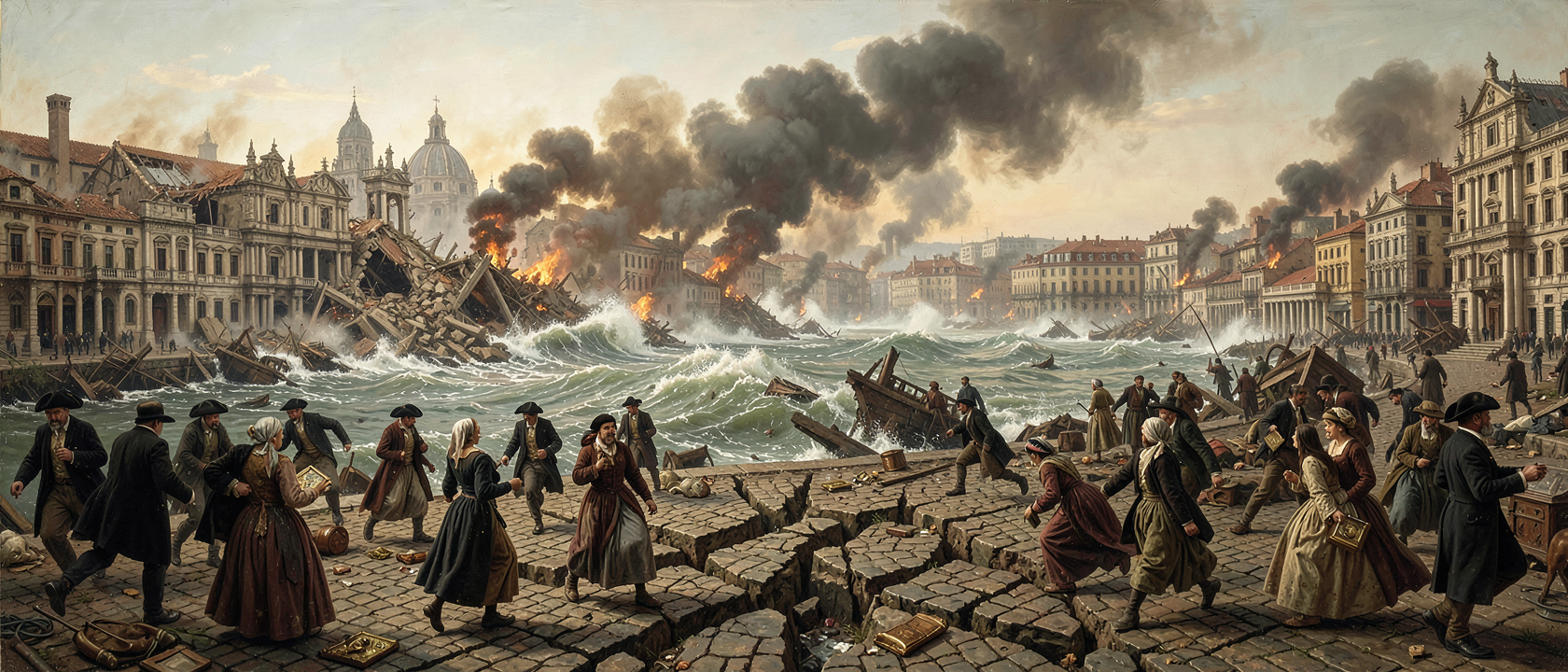
All Saints’ Morning
Saturday, November 1, 1755. In Lisbon, the feast of All Saints’ Day had drawn a large part of the city’s estimated population of 250,000 to 275,000 into mass. The churches along the hills above the Tagus were full for the morning liturgy. An English merchant present in the city left an account that became one of the standard testimonies of the disaster, one whose account stressed the complete absence of any warning before the ground moved. At approximately 9:40 in the morning, it moved.
What the Enlightenment Had Staked
By the middle of the eighteenth century, the intellectual movement later historians would call the Enlightenment had built considerable prestige on the confidence that nature operated according to rational, knowable principles. The most influential formulation was the doctrine associated with the German philosopher Gottfried Wilhelm Leibniz, who held that humanity inhabited the best of all possible worlds, and that suffering and disorder were parts of a coherent whole a reasoning mind could comprehend. The English poet Alexander Pope gave this position its tidiest summary: all is well.
A catastrophe that collapsed churches during feast-day mass could not be kept in the category of abstract philosophy. It demanded an answer about whether God had sent it and, if he had, what he meant by it.
Tremors, Water, Fire, In That Order
Three distinct shocks arrived over roughly ten minutes; the second was the most powerful. The total duration of shaking was estimated at three and a half to six minutes. The estimated magnitude is disputed: most encyclopedias give 8.5 to 9.0 Mw, while more recent modelling has proposed 7.7 Mw. Fissures roughly 16 feet (5 meters) wide opened in the center of Lisbon, and buildings that had stood for centuries came down in sequence.
The epicenter lay in the Atlantic, approximately 124 miles (200 km) west-southwest of Cape St. Vincent. Seafloor faulting along the Africa-Eurasia plate boundary generated a tsunami; the Tagus estuary first receded, then at least three successive waves surged back roughly 40 minutes after the main shock, reaching about 20 feet (6 meters) at the Lisbon waterfront and up to 39 feet (12 meters) at maximum run-up. Survivors who had fled to the riverbanks were directly in the water’s path.
The tsunami crossed the Atlantic. A wave estimated at roughly 66 feet (20 meters) hit Cádiz; about 10 feet (3 meters) struck the Cornwall coast; Galway’s Spanish Arch was damaged; waves reaching roughly 13 feet (4 meters) arrived at Martinique, approximately 3,790 miles (6,100 km) away, in about ten hours. In Lisbon, fires burned through the ruins for approximately five to six days. Significant damage extended into Spain and Morocco, and was reported as far as Algiers, approximately 684 miles (1,100 km) to the east.
What Was Left, and What It Cost
Lisbon before November 1, 1755 was one of the wealthiest capitals in Europe. Afterward, roughly two-thirds to 85% of the city had been destroyed and approximately 12,000 dwellings were lost. The human toll is genuinely contested. Sebastião José de Carvalho e Melo, the Secretary of State who effectively governed Portugal under King Joseph I, recorded 6,000 to 8,000 deaths, scholars regard that figure as a deliberate understatement. A contemporary Apostolic Nuncio’s estimate reached 40,000. Modern scholarly consensus centers on 30,000 to 40,000 deaths in Lisbon alone, rising to 60,000 to 100,000 when the wider area is included; Morocco alone lost an estimated 10,000.
The Question the Rubble Asked
Two positions formed quickly. The Jesuit priest Gabriel Malagrida preached that the earthquake was divine punishment for sin. Carvalho e Melo (later titled Marquis of Pombal) moved to suppress that argument and insisted on a naturalistic response. On January 26, 1756, he dispatched a thirteen-question seismological survey through the country’s bishops to every parish priest; roughly 646 responses came back. It is widely identified as the first systematic scientific inquiry into an earthquake’s effects over a large geographic area.
The French writer Voltaire (François-Marie Arouet) composed a 180-line poem in December 1755, published the following year, that used Lisbon directly to challenge Leibnizian optimism: if everything was for the best, what had the dead of Lisbon done to deserve their fate? He pressed the argument again in his 1759 satirical novel Candide, partly set in the earthquake’s aftermath.
Jean-Jacques Rousseau answered on August 18, 1756, defending Providence with a pointed counterargument: the scale of casualties reflected human choices, dense urban construction, at least as much as divine will. Immanuel Kant published three texts on the earthquake in 1756, seeking geological causes and interpreting the event as evidence that the physical world operated with no regard for human concerns.
None of these positions settled the argument. Pombal could move against Malagrida (the priest was eventually condemned by the Inquisition), but suppressing the man did not close the question. Whether catastrophes are messages or mechanisms, whether they call for prayer or engineering, remained open in 1756 and has not resolved itself since. November 1, 1755 forced that argument into the center of European intellectual life, confronting a movement that had staked considerable confidence on having, or at least finding, an answer.