
A Mother Waits Thirteen Years
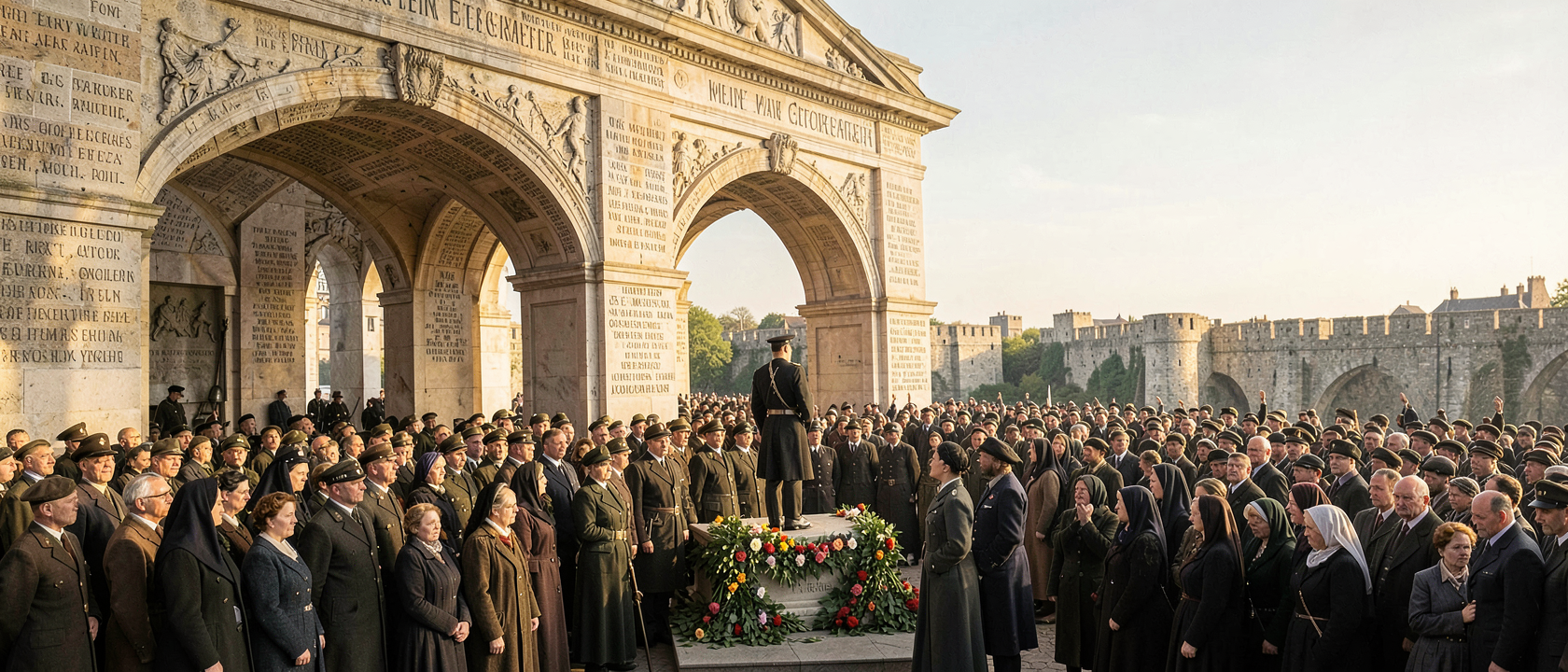
On the morning of Sunday, July 24, 1927, about 700 mothers and widows arrived at Ypres (today Ieper, Belgium), many traveling on trips paid for by charity. Among them was Caroline Merriman, whose two sons, Arthur and John, were both listed among the missing. John had disappeared in October 1914, and for nearly thirteen years she had no grave to visit, only the date the army had given her for when he vanished. That morning, she laid a wreath at the foot of the newly finished Menin Gate, a monument built to hold the names of men like her son.
What Ypres Cost
The town of Ypres had drawn armies for four years. Between 1914 and 1918, an estimated 200,000 people died defending it, part of the fighting known as the Ypres Salient, the bulge in the front line that British and Commonwealth troops held for most of the war. Many of the dead were never recovered, and tens of thousands more were buried without their names ever being confirmed. For their families this meant something specific and practical: no death certificate in the ordinary sense, no grave to stand beside, nowhere fixed to bring a wreath. A name inscribed in stone was, for many families, the nearest thing they would ever have to a grave.
The Architect’s Estimate
In the early 1920s, before construction began, the architect Sir Reginald Blomfield designed a memorial at the site of the old Menin Gate, one of the roads soldiers had marched out through toward the front. He modeled it on the idea of a triumphal arch with a central hall, drawing on a seventeenth-century gateway in Nancy, France, that he admired, and he allowed for about 40,000 names. Around the same period, Winston Churchill argued for something far more drastic: that Britain buy the ruined town of Ypres itself and preserve it exactly as the war had left it, treating the wreckage as sacred ground rather than something to rebuild. Nothing in the record says whether that idea was ever formally weighed by anyone with the power to act on it. It simply disappears from the story, while Blomfield’s more modest plan went ahead.
Grief for Sale
Even before the Gate existed, the ground around it had become a business. In 1919, The Times criticized what Ypres was turning into: hawkers working the ruins, organized sightseeing parties moving through what was, for many visitors, still a graveyard. By 1920, the Pilgrim’s Guide to the Ypres Salient offered seven suggested routes for those who wanted to walk the old front lines themselves. Ex-officers ran five-day “Battlefield Tours de Luxe” for visitors who could pay for the comfort of a guide. Meanwhile, in the town square, a Graves Registration Unit did quieter, harder work, helping families search among roughly 200 local war cemeteries for one specific name. Pilgrimage and tourism used the same roads, the same fields, sometimes the same week.
The Number Nobody Planned For
By the time the Menin Gate was finished, it carried, by the most commonly cited count, 54,896 names, some 15,000 more than Blomfield had designed for (a rival tally puts the figure at 54,370, and the discrepancy is never fully explained in the record). On July 24, 1927, Field Marshal Lord Plumer unveiled the memorial in front of thousands of veterans and family members. Loudspeakers carried the ceremony to the market square, and the BBC broadcast it further still. Buglers of the Somerset Light Infantry sounded the Last Post, pipers of the Scots Guards played a lament, and a minute of silence followed the drumming and the speeches. The Times, which had mocked the site’s commercial reputation eight years earlier, called the moment deeply moving.
The Ledger
Even that many names were not enough space. Because the Gate could not hold every missing man, planners set an arbitrary cutoff of August 15, 1917: those missing before that date were named at Ypres, and those missing after it were inscribed instead on a separate memorial at Tyne Cot, dedicated in 1920, where an estimated 34,986 more names were eventually added (some counts give 34,984, a small discrepancy the record never fully explains). Caroline Merriman’s son John was one name among the first total, her thirteen-year wait one of tens of thousands like it, ended not with a grave but with a line of engraved stone. What the record does not settle is whether the friction between pilgrimage and tourism eased or worsened once the crowds went home in 1927, or whether Churchill’s idea of leaving an entire town as a ruin was ever seriously weighed by anyone at all.