
The Signal in the Cathedral
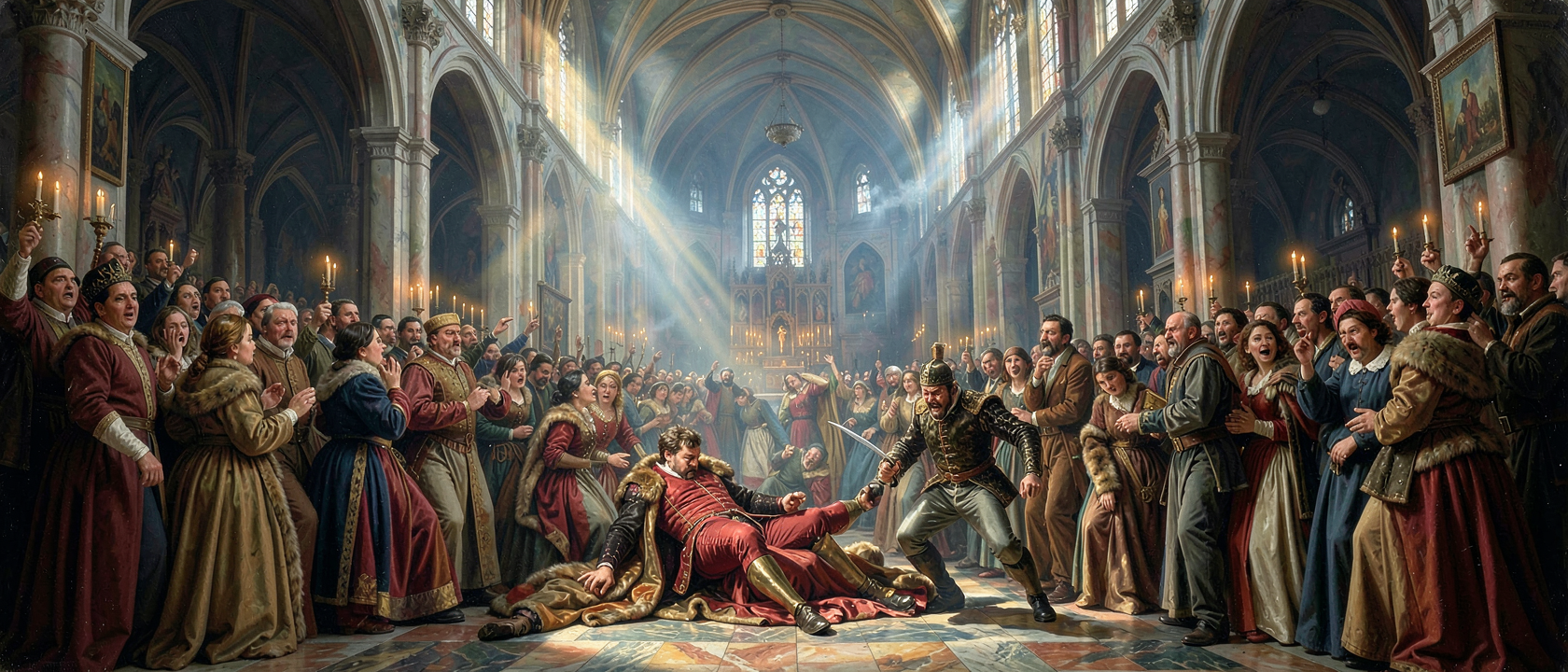
Easter Sunday, 26 April 1478. High Mass was under way inside Florence’s cathedral of Santa Maria del Fiore. At approximately 11 a.m. a bell rang to mark the elevation of the host, the moment when every head in the building bowed.
That bell was the signal.
Two clerics, Antonio Maffei da Volterra and Stefano da Bagnone, moved toward Lorenzo de’ Medici. Across the choir, Bernardo Bandini Baroncelli and Francesco de’ Pazzi went for Lorenzo’s younger brother Giuliano, born in 1453, who was there in the nave without armor. Baroncelli struck first; Francesco continued with such intensity that he drove a blade into his own thigh. Giuliano died in the cathedral, contemporary sources record 19 stab wounds, though at least one account gives a range of 12 to 19.
Lorenzo fared differently. Maffei caught him with a shallow cut to the neck. Companions forced the sacristy door open, pushed him through, and bolted it from inside. The fear that the blade had been poisoned was real enough that one companion drew blood from the wound by mouth. Lorenzo survived. Baroncelli also killed the Medici retainer Francesco Nori while fighting his way clear.
Everything Had to Work at Once
The attack on the brothers was one part of a coordinated plan taking shape since around the summer of 1477, operating on three simultaneous fronts.
While the assassination unfolded inside the Duomo, Francesco Salviati, Archbishop of Pisa, appointed by Pope Sixtus IV against Lorenzo’s explicit objection, was to lead an armed party to the Palazzo Vecchio and neutralize Cesare Petrucci, the Gonfaloniere, before any organized response could form. Simultaneously, Jacopo de’ Pazzi, the elderly head of the family and the conspiracy’s main organizer, was to ride through Florence’s streets calling on the population to rise: “Popolo e Libertà!”, People and Freedom.
The three fronts were mutually load-bearing. Both brothers had to die at once, or the survivor would raise an alarm before Salviati’s men could secure the palace. If the palace seizure failed, Jacopo’s street appeal carried no institutional weight. And without the population, neither of the first two operations could be consolidated. What the conspirators had not tested was what ordinary Florentines would actually do when asked to choose.
The Count, Front by Front
Inside the cathedral, Giuliano was dead and Lorenzo was locked behind a bolted sacristy door. At the Palazzo Vecchio, Salviati’s men entered on a pretext, but Petrucci was not caught unprepared. He confined Salviati’s armed support in waiting rooms and raised the alarm. Salviati was taken without achieving any part of his objective.
In the streets, Jacopo de’ Pazzi rode and shouted. Florentines answered, but with “Palle, Palle!”, a partisan cry built around the balls on the Medici coat of arms. No district rose. No gate was seized.
By early afternoon on 26 April 1478, the conspiracy had spent every asset it held. One Medici brother was dead, but the other was alive, the Palazzo Vecchio was still in Florentine hands, and the city had answered the call for liberty with a slogan defending the family the conspirators wanted to destroy.
What We Cannot Establish
Two questions the sources raise but do not settle. The first is the degree of papal involvement. Sixtus IV had longstanding quarrels with Lorenzo over Florentine banking, control of the Romagna, and the Salviati archbishopric. His nephew Girolamo Riario was directly involved in organizing the conspiracy. Giovanni da Montesecco, a condottiere recruited into the plot, was arrested on 1 May 1478 and wrote a detailed confession before his execution on 4 May, one of the primary sources for the planning phase. Whether it establishes that Sixtus IV personally sanctioned the killings, or only a coup that stopped short of murder, historians have not resolved from the available record.
The second question concerns the two priests. Montesecco had refused to carry out a killing inside a church; Maffei and Bagnone may have replaced him as a late adjustment. Whether they chose to participate or were assigned the role to limit damage if they hesitated, the sources do not say.
The Bill, Paid in Full
On 26 April 1478, the same day as the attack, Francesco Salviati and Francesco de’ Pazzi were hanged from the windows of the Palazzo Vecchio. Salviati was still dressed in his sacerdotal robes, detail enough for Pope Sixtus IV to issue, on 1 June 1478, the bull Ineffabilis et Summi Patris Providentia, excommunicating Lorenzo and threatening Florence with an interdict. The war that followed lasted approximately two years, ending around 1480.
More than 80 conspirators were convicted and executed. Stefano da Bagnone was hanged on 3 May 1478; Montesecco was beheaded on 4 May. Surviving Pazzi family members who had played no direct role were banished, and the family name was suppressed in the city.
Baroncelli got furthest. He reached Constantinople, where he apparently expected to remain out of reach. The Ottoman sultan Mehmed II had him arrested on 23 December 1479 and returned him to Florence, by most accounts a personal diplomatic gesture toward Lorenzo. Baroncelli was hanged on 29 December 1479 at the Palazzo del Capitano del Popolo, the building known today as the Bargello. Leonardo da Vinci made a pen-and-ink sketch of the body, 7.6 by 2.9 inches (19.2 by 7.3 centimeters), now held at the Musée Bonnat in Bayonne, France, dated 28 December 1479, one day before the recorded execution date. That discrepancy has not been resolved.
The Pazzi had planned three simultaneous operations and prepared for the resistance of armed men. The one factor they had not planned for was the silence that met Jacopo de’ Pazzi’s ride, and then, out of that silence, a crowd chanting the name of the man they were trying to kill.