The Last Known Position
On May 29, 1925, at a jungle waypoint in the Brazilian Mato Grosso called Dead Horse Camp, Percy Fawcett handed a packet of letters to the guides he was about to dismiss and told them to carry it back to civilization. One letter went to his wife, Nina. He expressed confidence about what lay ahead. Then he, his son Jack, and Jack’s friend Raleigh Rimell walked north. No credible witness saw the three of them again.
Fawcett had passed through Dead Horse Camp before, on an earlier expedition. The name was already on his maps.
Credentials, 1867–1906
Percy Harrison Fawcett was born on August 18, 1867, in Torquay, Devon. He entered the Royal Military Academy at Woolwich and received his commission into the Royal Artillery on July 24, 1886. Postings followed: Hong Kong, Malta, Trincomalee in Ceylon (today Sri Lanka), where he met Nina Paterson, whom he married in January 1901. That same year, he joined the Royal Geographical Society to train formally as a surveyor and cartographer.
Around 1902, the British government sent him to Morocco in an intelligence capacity, cartographer on paper, something else in practice. By 1906 the RGS had a concrete task for his skills: map the disputed border between Bolivia and Brazil, a job projected to take roughly two years. He completed it in a matter of months and received a formal commendation.
That record matters, because what followed was not the project of an amateur. He was a trained surveyor who had done exacting work under difficult conditions and returned with results.
The Evidence He Assembled, 1906–1924
Between 1906 and 1924, Fawcett conducted seven South American expeditions. Over those years, he built a case for an ancient Amazonian city he called “Z,” which he fixed somewhere near the Xingu River in the Brazilian Mato Grosso. The argument rested on three supports.
First, he identified recurring structural details across independent accounts left by Spanish and Portuguese conquistadors. Second, he held, against the prevailing anthropological consensus of the period, that the Amazon basin was capable of sustaining a complex settled civilization. Third, in the National Library of Brazil, he found a document purportedly written by a Portuguese slaver describing a ruined city reportedly encountered in 1753. The document’s authenticity has not been established; its author’s reliability remains contested.
Hiram Bingham III’s rediscovery of Machu Picchu on July 24, 1911, gave Fawcett a concrete precedent he could cite: a major pre-Columbian site that had occupied the landscape for centuries while European knowledge passed straight over it. In 1921, Fawcett published his hypothesis in the Geographical Journal of the RGS under the title “A Search for the City of Z.”
A 1920 attempt to reach the site failed before it reached its objective. Serious planning for a second attempt began in 1924. Jack Fawcett, born in 1903, and his friend Raleigh Rimell joined the party. The expedition was backed by a London-based group referred to as “the Glove.”
The Decision to Go Alone
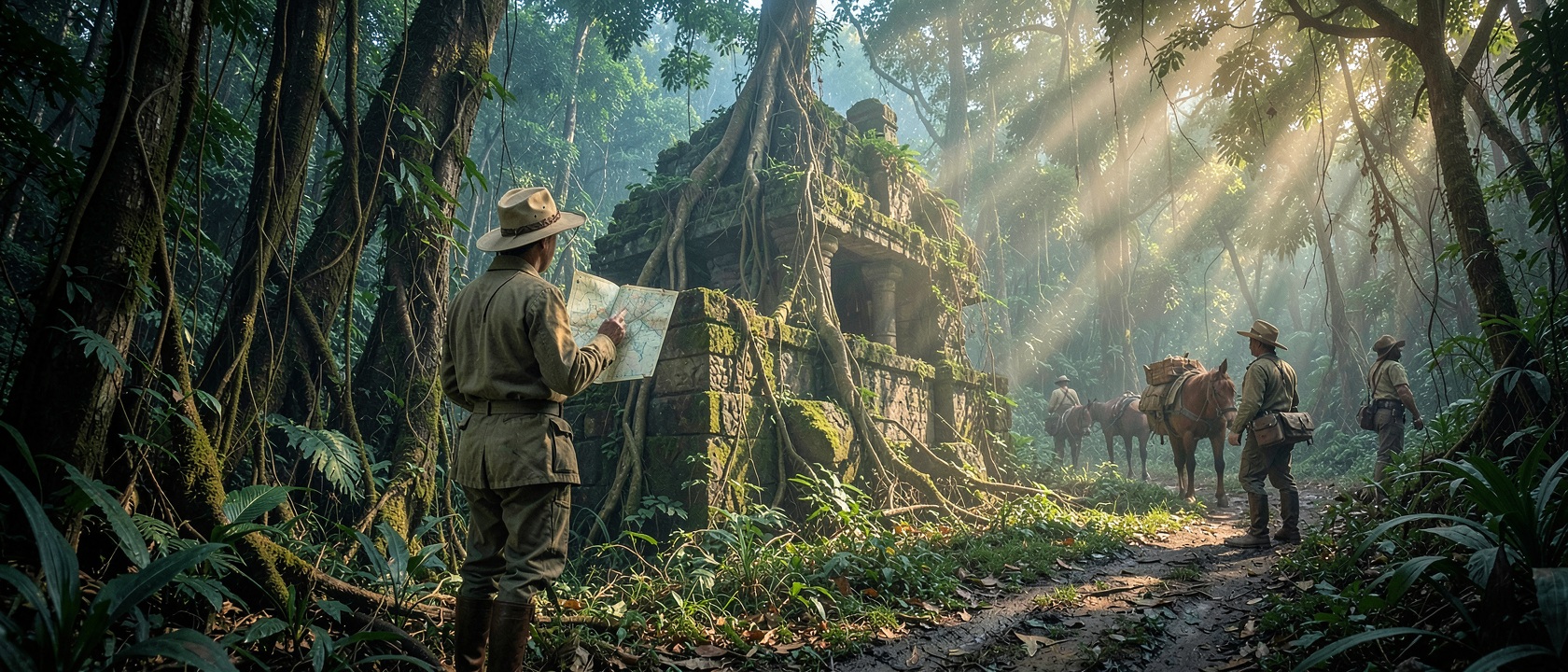
The party left Cuiabá, capital of the Mato Grosso state, on April 20, 1925. The route Fawcett had charted beyond Dead Horse Camp required crossing the Xingu River and entering territory controlled by the Xavante, a people whose reputation among Brazilian officials and earlier travelers was of sustained hostility to outside contact. No European had reportedly made that crossing and returned to describe it.
Dismissing the guides at that specific point removed the three men from any practical safety net. Nobody left behind knew their intended route in enough detail to identify a specific place at which to raise an alarm. There was no agreed timetable after which a search would automatically begin. What they carried with them was all they had.
Objects Without Owners, 1927–1979
In January 1927, the Royal Geographical Society formally declared Fawcett lost. That same year, a nameplate linked to the expedition was recovered in the Mato Grosso. A theodolite believed to belong to the party turned up in 1933. Fawcett’s personal signet ring was recovered in 1979, more than fifty years after the three men had walked out of Dead Horse Camp.
Not one of these objects came with any account of what had happened to the people who carried them. Multiple search expeditions were launched in the intervening decades; several added casualties without resolving anything. Historian John Hemming described Fawcett in print as disagreeable and, in the end, pathetic.
Three Questions Still Open
How Fawcett, Jack, and Rimell died has never been established. The leading theories include an attack by bandits operating in the interior, death at the hands of the Xavante, and the possibility, which surfaces periodically without firm supporting evidence, that Fawcett chose not to return. Not one has moved beyond speculation.
The 1753 Portuguese document that anchored his documentary case remains unauthenticated. Whether any ancient Amazonian city of the kind Fawcett described actually existed is a question the record leaves formally open. For decades, the scholarly reflex was to treat “Z” as pure fantasy. Archaeological work conducted since the 1990s on pre-Columbian settlement patterns in the Upper Xingu basin, including evidence of large, interconnected communities, has made that dismissal less straightforward than it once appeared.
That research has not located what Fawcett was searching for. It has, however, made the assumption that he was searching for nothing harder to hold.