
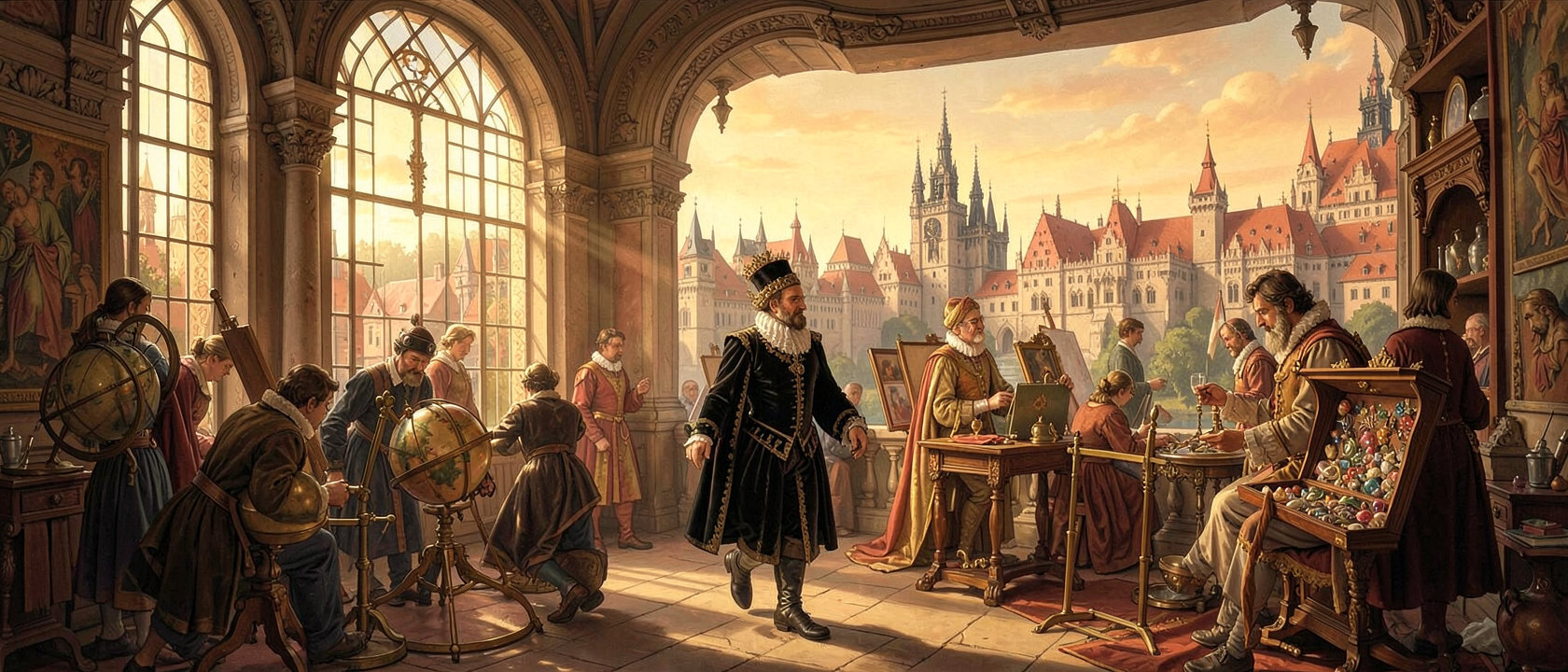
A Court Moves North
In 1526, a dynasty fighting to hold its southeastern frontier looked for ground it could keep. As Ottoman forces advanced on Hungary, Ferdinand I of Habsburg took the crowns of Bohemia, Hungary, and Croatia. From then on, the Habsburgs treated Prague, seat of the Bohemian crown, as a place to retreat to, not a stop along the way.
Prague was no stranger to imperial notice. Founded in the late ninth century around the castle district of Hradčany, it had already served as an imperial residence, roughly two centuries earlier under Charles IV. By the 1520s that chapter had closed; Prague sat inside the Habsburgs’ collection of crowns as a regional city, not an empire’s working center. What drew it back was pressure, not design: a dynasty stretched toward a fighting border needed ground it could hold regardless of the frontier’s fate.
Deciding Where to Stand
But moving a court to a city did not settle whether it would stay there. For decades after 1526, an open question remained: once danger on the Hungarian frontier eased, would the court return south, or had Prague become permanent?
More than safety rode on the answer. A dynasty ruling territory stretching from Central Europe toward Hungary needed a seat that could hold courtiers and administrators, not just soldiers, and let a ruler act like an emperor rather than a commander camped near a border. Prague, with a castle district already built for a royal court, was equipped to be more than a shelter.
That question stayed open through much of the sixteenth century. What happened between Ferdinand I’s crowns in 1526 and Rudolf II’s accession in 1576 is not laid out step by step in what survives. What is clear is that Prague’s status, temporary or permanent, was not settled until an emperor chose to live there.
Rudolf II’s Prague
Rudolf II Habsburg was born in Vienna on July 18, 1552. He became Holy Roman Emperor, King of Hungary, and King of Bohemia on succeeding his father, Maximilian II, on October 12, 1576, and soon began moving his court to Prague, a move complete by 1583. Vienna’s exposure to Ottoman attack may have factored into the choice, though Prague is also described simply as a sound capital in its own right.
What followed is known as Rudolfine Prague: twenty-nine years, from 1583 to Rudolf’s death in the city on January 20, 1612. Prague Castle was rebuilt into a residence filled with paintings, sculpture, and curiosities. The era’s leading astronomers, Tycho Brahe and Johannes Kepler, worked in the city and sat at Rudolf’s table. The painter Giuseppe Arcimboldo produced his Four Seasons series there and, around 1591, the portrait of Rudolf as Vertumnus; the Antwerp-born Bartholomeus Spranger and court painter Hans von Aachen worked in the same circle. Craftsmen came too: the German gem cutter and glass engraver Caspar Lehmann, and the Italian Miseroni and Castrucci families, who carved stone. One contemporary called Rudolf “the greatest art patron in the world.”
Rudolf collected as widely as he patronized, building a cabinet of curiosities with objects brought from as far as India, and funding alchemists who competed for his patronage. He read Humanist literature and Hermetic texts, spoke five languages besides German, and spent 1563 to 1571 at the Spanish court of his uncle, Philip II. Under his patronage, Prague’s painters’ guild rose from the standing of a craft to that of a liberal art.
What the Ascent Cost
The record gives no figures for what Prague’s rise cost in lives or money: no tally of soldiers lost on the Hungarian frontier, no account of what the court spent on painters, gem cutters, and alchemists. A transformation this visible in its results left little behind in numbers.
What can be traced is the strain underneath it. Rudolf’s own wars with the Ottoman Empire did not end until 1606, closed by the Treaty of Sitvatorok, the first agreement in which the Ottomans recognized the Habsburgs as their equal in diplomacy rather than a lesser power. The astronomers and painters at Prague Castle worked while that war was still open.
Rudolf paid a cost of his own. After an illness in 1600 he withdrew into seclusion in Prague, largely stopping attention to politics and refusing to deal with the war or with unrest in Hungary. His brother Matthias won over the Hungarian nobility, watched the Moravian Estates desert Rudolf too, and marched on Prague with them in 1608. Rudolf was stripped of power and died in the city in 1612; his collections and the court gathered around them were largely dispersed soon after, leaving little of Rudolfine Prague in place.
Prague’s standing as an imperial capital had been earned by necessity, not chosen for its own sake. It grew out of a retreat forced by an outside power, and it did not outlast, in full, the one emperor who had built it there.
What the Record Leaves Open
Some claims about Rudolfine Prague hold up less firmly than others. That Prague’s Renaissance arrived later than the Renaissance in Venice, Flanders, or Rome is repeated often, but the material behind it gives no dates for those cities to measure Prague against; the comparison is asserted, not shown.
The reason Rudolf moved his court is also less settled than it sounds. One account says Vienna’s exposure to Ottoman attack may have shaped his decision, then adds that Prague was simply a sensible capital in its own right. Both can be true, and the sources do not choose between them.
Even the boundaries of his reign are not stated the same way twice: one academic study frames it as 1576 to 1611; other accounts give his death as January 1612, a gap that shows even a well-documented reign carries small disagreements at its edges.
Two more pieces belong here as folklore rather than fact: the nickname “Magic Prague,” and the legend of the Golem said to date from the same years. Both are part of how the city is remembered, but neither carries the documentation behind Rudolf’s astronomers or painters. What the record supports clearly is that named scholars and artists gathered at his court. What it does not explain is how a German glass engraver, Italian stone carvers, and an Antwerp-trained painter, working around the same emperor, produced the mixing of traditions later writers call Rudolfine Prague.