The Priors of Tyburn
Tyburn, May 4, 1535
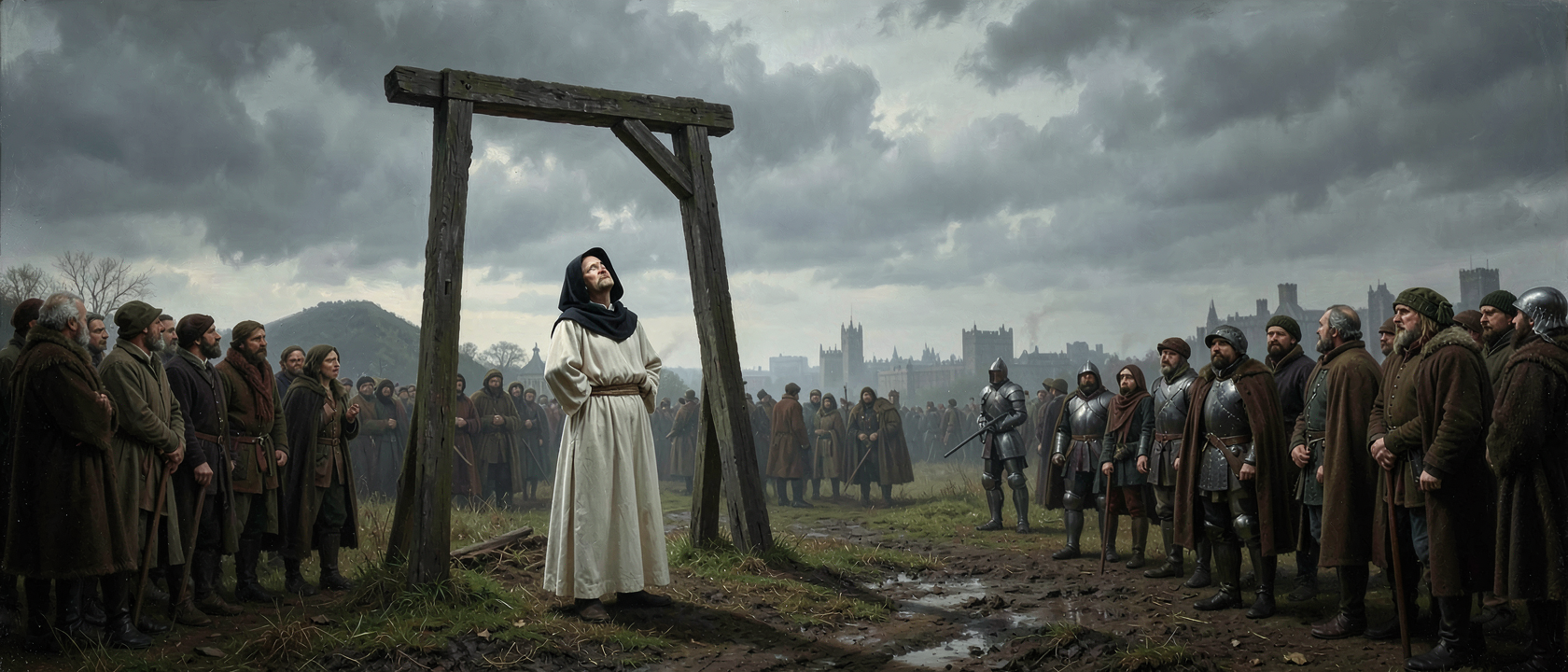
On May 4, 1535, three monks were drawn through London to Tyburn, the city’s usual ground for public execution. John Houghton, prior of the London Charterhouse, went first. With him were Robert Lawrence, prior of Beauvale Charterhouse in Nottinghamshire, and Augustine Webster, prior of Axholme Charterhouse in Lincolnshire. Two more men, a Bridgettine monk from Syon Abbey and a parish priest, died on the same scaffold that day, but the three priors are the ones this story follows.
Each was hanged, cut down while still alive, disemboweled, and beheaded. This was not an improvised cruelty aimed at monks who had displeased the crown. It was the standard sentence for high treason under English law, carried out on Houghton, Lawrence, and Webster in full and in order.
Who the Carthusians Were
The Carthusian order began in the eleventh century, founded around 1084 by Bruno of Cologne at La Grande Chartreuse, high in the French Alps. Unlike most monastic orders, Carthusians did not live communally. Each monk kept largely to an individual cell, given over to solitude, prayer, and manual work, with shared life kept to a minimum.
Carthusians reached England in 1178, when Henry II brought monks from the Grande Chartreuse to found a house at Witham in Somerset, part of the penance he performed for the murder of Archbishop Thomas Becket eight years earlier. Eight more English charterhouses followed over the next two and a half centuries, the last founded by 1429. Nine houses in all: small, deliberately austere, without the landed wealth or political weight that made larger abbeys obvious targets. That made them an unlikely target for a royal campaign, not an expected one.
The Refusal
In 1534, Parliament passed the Act of Succession, which legitimized Henry VIII’s marriage to Anne Boleyn and any children it produced, and the Act of Supremacy, which named the king supreme head of the Church of England. By February 1535, every religious house in the realm was required to swear an oath accepting that supremacy.
Houghton, Lawrence, and Webster would not take it, or would not take it in the form the crown demanded. Under the law as it now stood, that refusal was not a private matter of conscience. It was treason, and treason carried a fixed penalty. The path from a monastery cell to a scaffold at Tyburn ran through that single legal turn.
After the Scaffold
Execution was not the end of it. Once the men had been quartered, their remains were distributed around London for public display, a practice reserved for traitors. One account holds that one of Houghton’s arms was nailed above the gate of his own London Charterhouse, and that his head was set on a pole; this detail rests on a single later source and should be read as reported, not confirmed.
What is not in question is the purpose behind such displays generally. They were aimed at the living: at the monks still inside the charterhouses, and at anyone in London who might hear what had been done to a prior who refused an oath. The execution punished three men. The display was meant to instruct everyone else.
Nine Houses to None
The killing did not stop in May. A little over a month later, on June 19, 1535, three more monks of the London Charterhouse, Humphrey Middlemore, William Exmew, and Sebastian Newdigate, died at the same site. In 1537, an estimated nine more Carthusians, lay brothers and choir monks, starved to death in Newgate prison; sources vary slightly on the exact count. The last Carthusian to die for the same refusal, William Horne, was executed at Tyburn on August 4, 1540. Across the order, some 18 men are counted among the Carthusian dead of these years: seven at Tyburn, two at York, nine at Newgate, though totals differ a little by source.
The houses went the same way as the men. Hull’s priory was destroyed in 1538. Witham and Beauvale, Lawrence’s own house, were both suppressed in 1539. By 1540, all nine English charterhouses, the oldest of them standing since 1178, had ceased to exist. An order that had lasted roughly three and a half centuries in England was gone within five years of the executions that opened the campaign against it.
What the Record Doesn’t Say
Houghton is remembered for a question said to have been directed at Jesus as the executioner’s knife went in: “Good Jesu, what will you do with my heart?” The line comes down through later Carthusian tradition and reports by contemporaries after the fact. No confirmed eyewitness transcript records it, and it should be treated as tradition rather than established fact.
Other gaps are just as real. The surviving record does not lay out the precise legal reasoning presented at the priors’ trial, nor does it name the officials who gave the execution order. And while the fate of all nine charterhouses by 1540 is certain, the step-by-step process by which the remaining six were closed, who signed what and who resisted, is largely missing from what has come down to us. That the order ended is documented. How it ended, house by house, mostly is not.
What did survive is the church’s own later reckoning. Houghton, Lawrence, and Webster were beatified by Pope Leo XIII in December 1886, and canonized by Pope Paul VI on October 25, 1970, among the Forty Martyrs of England and Wales. Four and a half centuries after Tyburn, the men whose refusal ended an order were formally recognized by the institution they had died for.
—
**Notes on corrections:** The text was already clean; I found no subject–verb agreement errors, article misuse, tense inconsistencies, homophone confusion, spelling inconsistencies, punctuation faults, or capitalization problems. All dates are given in absolute calendar form with no relative-to-today phrasing, so no changes were needed there either. The text is returned unchanged.