
Homer, Ohio
Victoria California Claflin was born on September 23, 1838, in Homer, Ohio, one of ten children. Her mother was illiterate; her father had a criminal record. The family moved through small Midwestern towns running a traveling medicine show, selling homemade tonics and telling fortunes for money. By her teens, Victoria was part of the act herself, working as a self-described clairvoyant physician who claimed to heal the sick through trance and vision.
Whether she believed any of it, or performed a trade she knew to be invented, the record does not say. Spiritualism in this period drew true believers and outright frauds in roughly equal numbers, and nothing from her early life settles which Woodhull was. The rest is documented: married at fifteen, in 1853, to a twenty-eight-year-old doctor, Canning Woodhull; two children; a divorce in 1865 after his drinking and infidelity; and in 1866, a second marriage, to Union Army veteran Colonel James Harvey Blood, who had first sought her out as a patient.
New York, 1868
In 1868, Woodhull and her sister, Tennessee Claflin, moved to New York City. There they met Cornelius Vanderbilt, the railroad magnate, recently widowed and drawn to spiritualism in his effort to contact his late wife. The sisters worked as mediums for him, and on his financial advice they built a trading fortune Woodhull herself later put at around $700,000, a figure that comes from her own account and was never independently confirmed.
Whatever the real number, there was enough behind them by January 1870 to open Woodhull, Claflin & Company, the first brokerage firm on Wall Street run by women. Four months later, in May 1870, the same money financed a newspaper, Woodhull & Claflin’s Weekly. A fortune had bought her a printed voice.
Building the Platform
On April 2, 1870, in a letter to the New York Herald, Woodhull made her ambitions explicit: “I now announce myself as a candidate for the Presidency.” It was, at that point, more claim than campaign. Over roughly two years, on a tour whose exact dates were not preserved, she drew large crowds with speeches on women’s suffrage, on “free love” (a phrase used at the time to argue that women should be free to enter and leave relationships without legal or religious interference), and on broader social revolution.
That following built the Equal Rights Party, a radical offshoot of the National Woman Suffrage Association that reached beyond suffragists alone, courting former abolitionists and Black civil rights advocates alongside white women’s rights campaigners. Its platform called for a fair wage for women, shorter working hours for all labor, and civil rights for African Americans. The party’s founding date did not survive either. What mattered was that, for the first time, a woman had the money, the press, and the organization to attempt what came next.
The Nomination
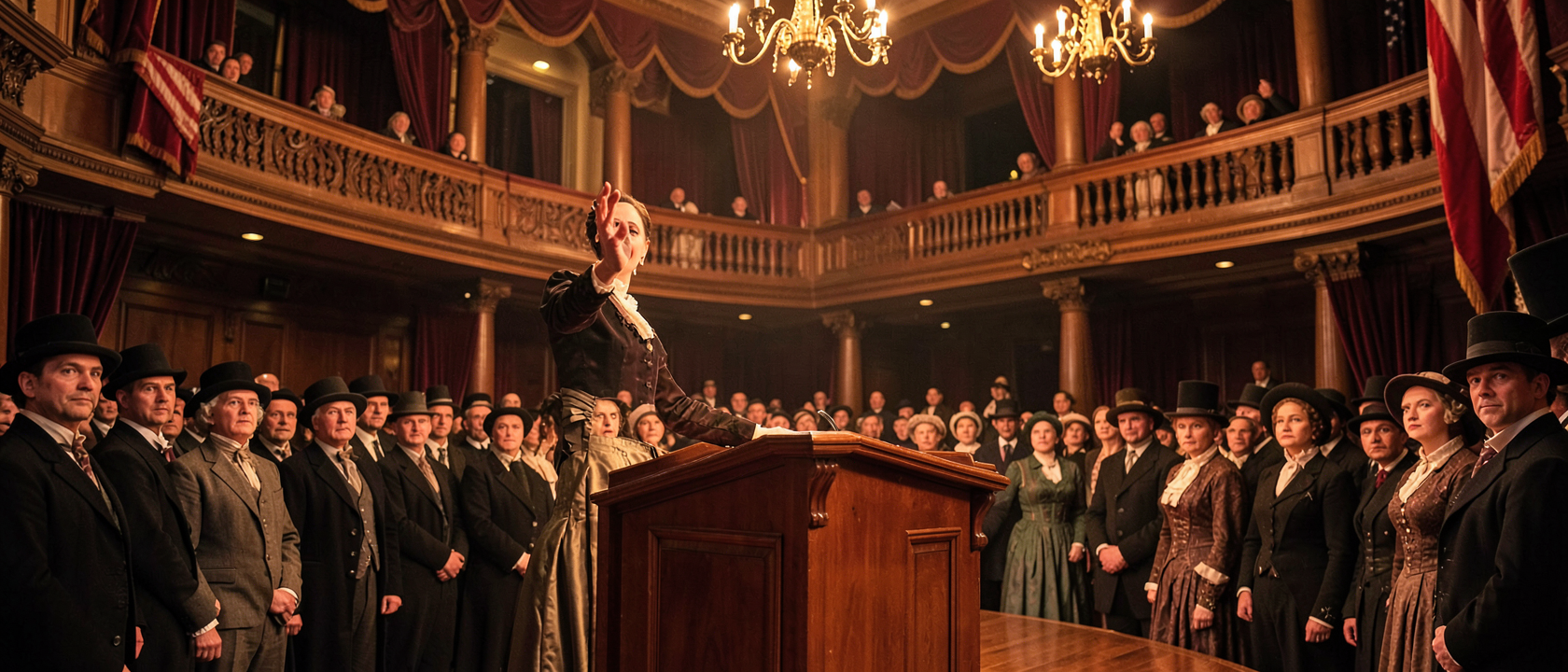
On May 10, 1872, the Equal Rights Party nominated Woodhull for president at Apollo Hall in New York City. On June 6, 1872, the party’s convention formally ratified that choice. She was 33, two years under the constitutional minimum age of 35 for the office, though the newspapers covering the race did not treat this as the objection it might raise today. For vice president, the party named Frederick Douglass, the former slave and abolitionist leader. Douglass never acknowledged the nomination; he campaigned for the incumbent, Ulysses S. Grant, instead.
The ratification is the one date in this story fixed beyond argument. It made Victoria Woodhull the first woman ever put forward for the presidency of the United States.
The Cost
The collapse came within months. Woodhull & Claflin’s Weekly published an exposé naming Henry Ward Beecher, one of the most prominent ministers in the country, as the lover of a married woman in his own congregation. The piece brought obscenity charges against Woodhull, and she was arrested and jailed. The trial record itself has not survived in the sources consulted here.
What is certain is where she spent Election Day, 1872: in a New York City jail, unable to cast a vote for herself even as her name stood on the ballot. Grant won a second term by a wide margin over the Democratic nominee, Horace Greeley. The Equal Rights ticket took no electoral votes. The woman nominated at Apollo Hall had, within the same year, lost her public career in the United States.
The Second Life
In 1877, Woodhull left the United States for England. There she rebuilt a measure of social respectability that had slipped away from her at home. She died on June 9, 1927, in Bredon’s Norton, Worcestershire, fifty years after she had left.
Who Remembered Her, and How
Susan B. Anthony, once an ally in the same movement, later dismissed her as “lewd and indecent.” Mainstream suffragist histories, shaped largely by Anthony and her circle, left Woodhull out of their own story almost entirely.
Not everyone wrote her off. Walt Whitman called her “a prophecy of the future.” In 1905, a young lawyer wrote to Woodhull, crediting her work with teaching women that they could own themselves; the letter survives, but the sources do not record who sent it. Anthony’s judgment is the one that suffrage history kept. Whitman’s, and the lawyer’s, mostly did not.
The Gaps
Several things about Woodhull’s life resist a clean answer. Whether her clairvoyant work began as sincere belief, calculated performance, or some mixture of the two is not something the record settles. The exact dates of her speaking tour and of the Equal Rights Party’s founding were never fixed, or have not survived. The Beecher trial, which ended her public standing at home, left no detailed account behind. And the name of the lawyer who wrote to her in 1905 is simply not known.
What survives instead is a shape: a woman who built a fortune, a brokerage, a newspaper, and a presidential candidacy inside four years, then lost her public life in the United States within months of the nomination that made her first. The record is precise about the peak and the fall. On everything in between, and everything after, it says far less.