
A Dam Called Progress
In 1952, revolution brought a new government to power in Egypt, one that made economic modernization its central promise. That promise took shape as the Aswan High Dam, meant to generate electricity, open farmland through irrigation, and control the Nile’s seasonal floods. The dam’s engineering specifications were fixed before anyone decided what would happen to the ancient structures standing in the water’s path.
The reservoir, later named Lake Nasser, was designed to reach deep into Nubia, the stretch of the Nile valley on the border between Egypt and Sudan. Carved into sandstone cliffs there, more than 3,200 years earlier, stood the Great Temple of Ramesses II and the Small Temple of Hathor and Nefertari at Abu Simbel. The dam was not built against them. It was built without them in mind.
Twenty Temples, Four Bad Options
By the early 1960s, UNESCO and Egypt’s government had confirmed that Abu Simbel and more than twenty other Nubian monuments would go under once the reservoir filled. UNESCO launched the International Campaign to Save the Monuments of Nubia, eventually running forty technical missions drawn from five continents.
Four approaches were considered: ring the temples with a dam and let the water rise outside it, lift the whole site on jacks, float it on pontoons, or accept the flooding and build a chamber for viewing the temples underwater. The winning plan came from the Swedish firm VBB, later Sweco: cut the temples apart, carry the pieces uphill, and rebuild them.
The choice was not purely technical. Historian Lucia Allais argues Washington favored the most labor-intensive option because the United States held a surplus of Egyptian pounds built up through the Food for Peace program, which sold American farm surplus abroad for local currency it struggled to spend elsewhere. A years-long construction project was a convenient way to draw the balance down. The final cost came to $40 million, split evenly between Egypt and UNESCO’s international campaign, a sum worth, by one modern estimate, well over a quarter of a billion dollars today.
Twenty-Five Thousand Hands
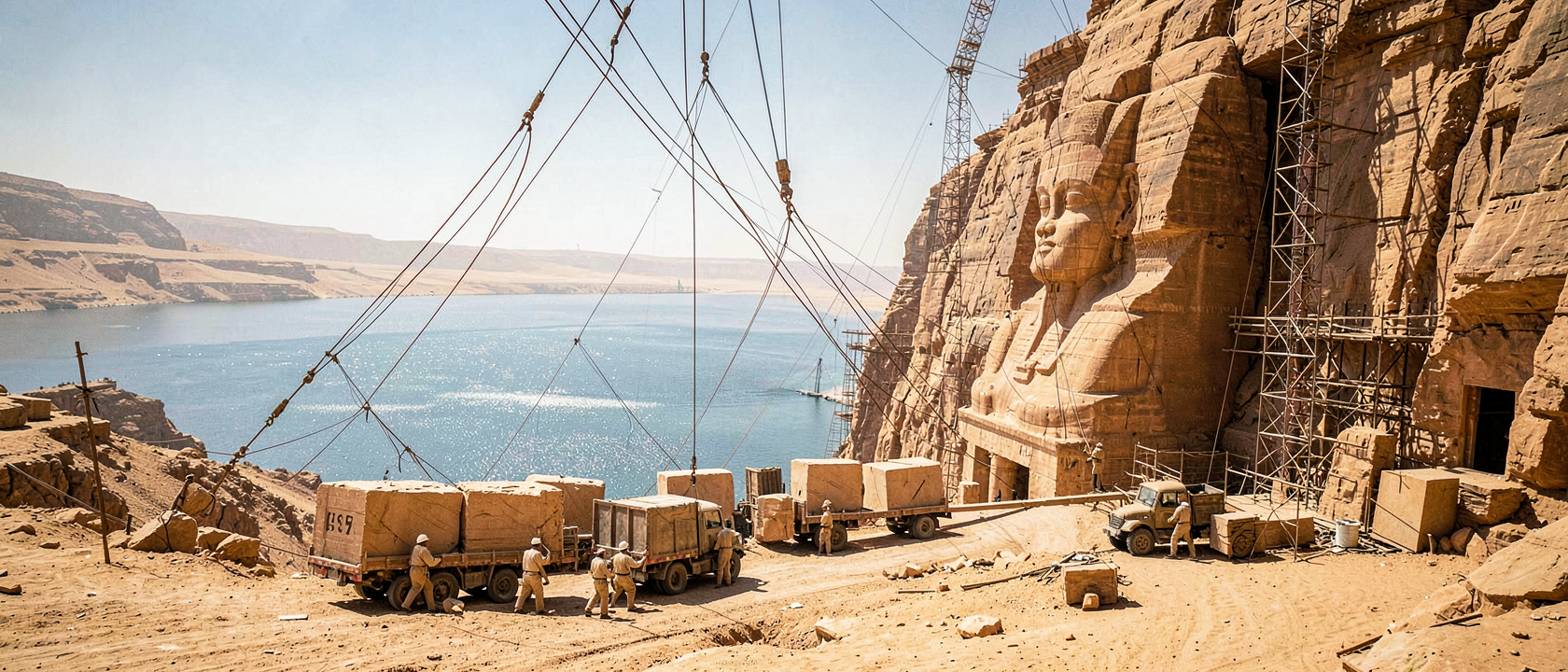
Cutting began in November 1963, with crews using wire saws to free the stone from the cliff face. At peak the site carried between 1,600 and 2,000 engineers, administrators, and workers, organized under a ten-firm consortium called Joint Venture Abu Simbel, a number far smaller than the dam’s own workforce of an estimated 25,000, including about 800 Soviet engineers.
The Great Temple’s four seated colossi of Ramesses II, 20 to 21 meters (66 to 69 feet) tall, could not be blasted apart since the sandstone was too porous for explosives to be used with control. Crews relied on pneumatic breakers, compressors, and hand saws, applied to more than a thousand further blocks, by some counts closer to two thousand, weighing 10 to 40 tons apiece. The Small Temple added six more standing figures, about 33 feet (10 meters) tall. Clearing the new site for reassembly alone took about 39,000 cubic yards (30,000 cubic meters) of rock.
The temples were rebuilt roughly 590 feet (180 meters) inland and 210 feet (64 meters) higher, inside a concrete dome covered with an artificial hill of sand to mimic the cliff. Mortar mixed with Nubian sand and plastic epoxy injected into the stone held it together and hid the saw lines. Blocks went back into place one at a time, within a permitted margin of error of about a fifth of an inch (5 millimeters). On September 22, 1968, the relocated temples were formally inaugurated, their façades facing the sun again, a short distance from where they had stood originally.
Who Is Abu Simbel?
Funding a rescue a continent away was a hard sell in Washington. One congressman, pressed on the cost, is recorded asking plainly: “Who is Abu Simbel?”, a question marking the real distance between what was happening on the Nile and what anyone back home understood of it.
The record carries its own gaps. Even the on-site workforce is disputed, with counts running from 1,600 to 2,000, and no reliable figure exists for how many people were hurt or killed moving thousands of tons of stone over five years. Nor does the surviving material address the Nubian communities displaced by the reservoir itself, a cost rarely weighed against the stone.
The Invention of World Heritage
The Abu Simbel campaign ran alongside a new international vocabulary for protecting old buildings. In 1964, architects and archaeologists from sixteen countries drafted the Venice Charter, an early attempt at common conservation standards. In 1965, the phrase “world heritage” was used for the first time, at a White House conference on preserving global cultural diversity. The United States passed its National Historic Preservation Act in 1966, and by 1972 UNESCO had turned the idea into a working system through the World Heritage Convention.
The Nubia campaign itself ran until 1980; its last major project moved the Philae temple complex to higher ground on Agilkia island between 1972 and 1979. Egypt gave one of the smaller rescued monuments, the Temple of Dendur, to the Metropolitan Museum of Art in New York, where it still stands. In 1979, Abu Simbel and the surrounding Nubian Monuments joined the new World Heritage list. A rescue built to answer one engineering emergency had become the template for how the world agreed to protect a monument at all.
Monument or Counter-Monument?
Historians still disagree about what the rescue actually was. Allais argues that Abu Simbel functioned, from the start, as a counter-monument: Cold War-era soft power meant to answer the dam’s own symbolism, built with American-favored labor and held up as proof that the West could match what Soviet engineers were doing at the dam site. She also argues that UNESCO’s declared neutrality sat uneasily with the project’s practical effect, which was to raise the number of visitors able to reach the temples once they stood on dry, accessible ground. Other critics, writing at the time, called the original temple a monument to a despot’s vanity in the first place, which complicates any clean story of rescue. None of this is settled; it is argument, built from facts both sides accept.
What is not in dispute is the shape of the trade. Statues built to put the power of Ramesses II beyond question were cut into pieces, carried uphill, and sealed back together under a concrete dome. The operation that saved them from the water also turned them into currency: political currency for two Cold War powers, and literal currency for a US government working off a surplus it had no other use for. The sandstone survived intact. What it was made to mean kept changing hands.