
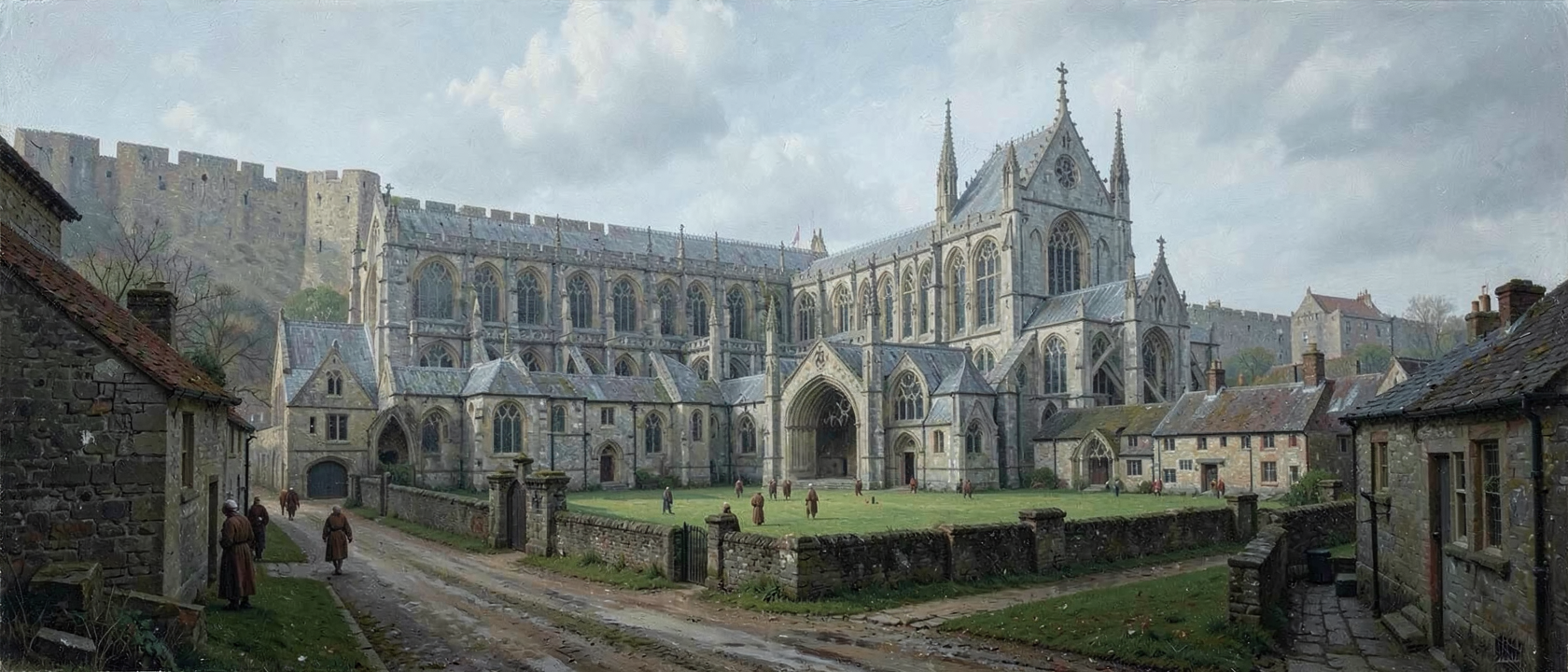
Landfall at Dover
On September 10, 1224, nine Franciscan friars stepped off a boat at Dover. They were the first members of their order to reach England, a handful of men with no church, no house, and no arrangement waiting for them on either side of the Channel. At Canterbury, five stayed behind. The other four, among them Richard Ingworth, a priest, and the Lombard lay brother Henry Detrenizo (also recorded as de Trevizo), pushed on toward London.
Almost everything known about this landing comes from one man, the Franciscan chronicler Thomas of Eccleston, who wrote his account decades after the event. He gives no description of weather, no words exchanged on the dock, nothing beyond the bare fact of nine men splitting into two groups. That is the scene as it survives: numbers, a place, and a direction of travel.
A Rule Against Owning Anything
The Franciscans operated under a rule of absolute poverty. Friars could not hold money. They could not hold property or land, not as individuals and not as a community. This was not a loose ideal; it was the binding constraint of the order founded by Francis of Assisi, and it followed the four men all the way to London.
Other religious orders arriving in a city like this could call on an endowed house, land already deeded to them, rents already flowing in. The Franciscans had none of that by design. Four men walked into London in the autumn of 1224 with no legal means of acquiring shelter and no money to pay for it if they had. Whatever came next would have to come from someone else’s hand, and be held in someone else’s name.
Borrowed Roofs: Cornhill
What came next, for a fortnight, was the Dominicans. The rival mendicant order was already settled in London, and it took the four Franciscans in, feeding and housing men who belonged to a different habit but the same kind of poverty.
After that fortnight, John Travers, Sheriff of London, granted the friars a house on Cornhill. There they built their own quarters: small cells woven from wattle, with straw packed between the branches, structures plain enough that the record compares them to sheep pens. It was not a purchase. Travers gave them use of a house; the friars themselves held no title to anything, which was precisely the point. The rule stayed intact because the gift bypassed it.
Growth Forces a Move
By the following summer, in 1225, Cornhill could no longer hold them. The Franciscan mission in London was drawing new men quickly, and the wattle cells had run out of room.
A London mercer named John Twyn (the name also appears in other records as Iwyn or Ewin) bought land in the parish of St. Nicholas Shambles, inside Newgate, for the friars to use. The purchase solved the same problem Cornhill had solved: Twyn held the money and made the deal, and the land itself was vested not in the friars but in the Commonalty, the governing body of the City of London, to be used by the order without ever being owned by it. That plot, bought by a layman and held by a civic body, became the seed of the Newgate friary.
Built One Gift at a Time
Over the next century and more, the site grew the only way it legally could: by accumulation, gift by gift, each one passing through someone else’s name before the friars could use it. Around 1228, a donor named Joce Fitz Piers added his property on Stinking Lane. In 1229, King Henry III gave the friars oak to build with. Further gifts followed across the thirteenth and fourteenth centuries, and the last of them, a tenement from Queen Isabella, arrived in 1353 or 1354.
By the time that final gift came in, the site was bounded by the city wall to the north and west, by Stinking Lane (today King Edward Street) to the east, and by Blow Bladder Street (today Newgate Street) to the south. Even after 130 years of donations, the friary never amounted to more than four acres. Nothing was bought in the friars’ own name, not one parcel of it. The cost of that restraint was paid in time, in the patience of waiting for a stranger’s deed each time the walls needed to move.
What the Record Doesn’t Say
All of this, the Dover landing, the fortnight with the Dominicans, the Cornhill grant, the string of land gifts that followed, rests on a single chronicler. Thomas of Eccleston recorded it decades after it happened, and no corroborating account from 1224 or 1225 survives alongside his.
He gives no exact date for the move off Cornhill, none for most of the gifts that built up the Newgate site before 1353. Historians generally treat his account as reliable in outline, but it remains one man’s record of events he did not necessarily witness himself. The friary he describes stood for roughly another two centuries after his writing, until its dissolution in 1538, built the whole time on land the friars who lived there never once owned.