
A Morning at Chestnut Hill
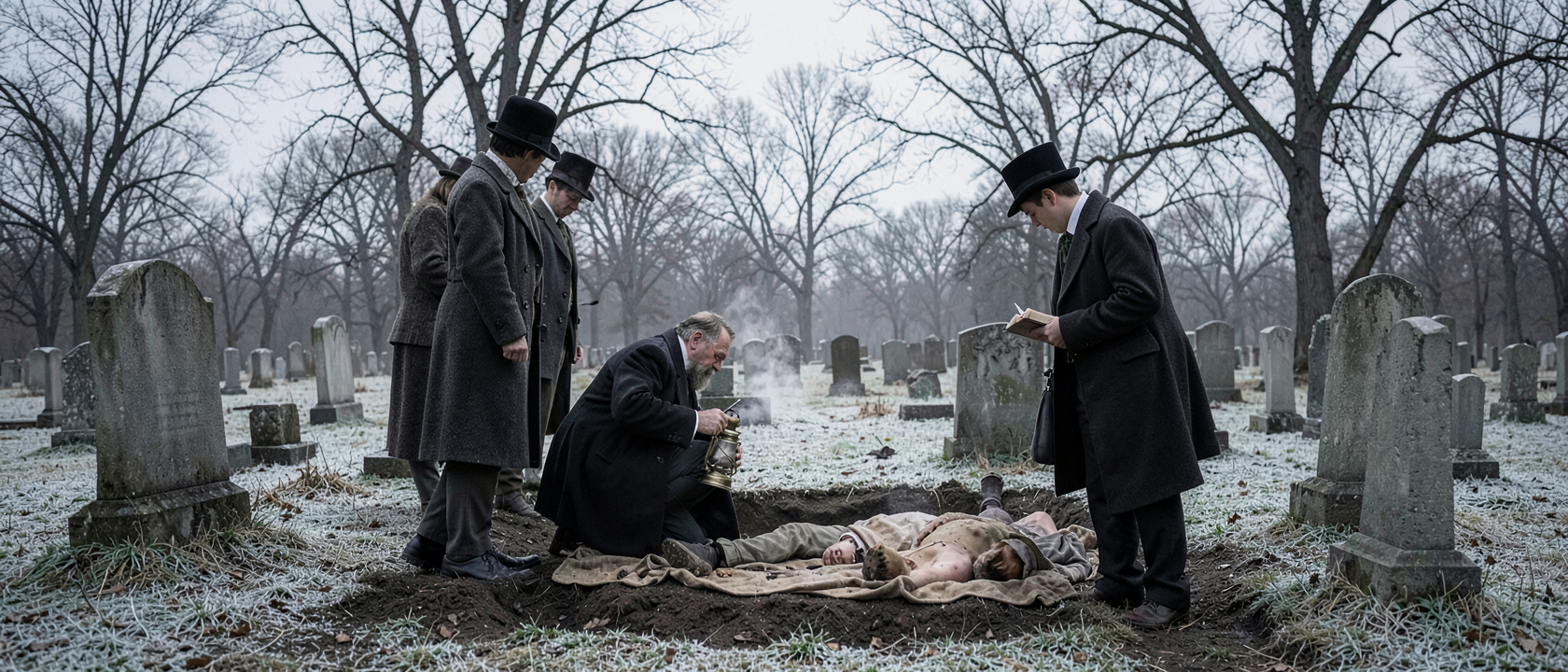
On March 17, 1892, a small group walked into Chestnut Hill Cemetery, known locally at the time as Shrub Hill, in Exeter, Rhode Island, to open three graves in the Brown family plot. Relatives and neighbors suspected that one of the dead women buried there was still drawing life from someone among the living. George Thomas Brown, the family’s father, was reluctant but gave his consent. His wife, Mary Eliza Brown, his elder daughter, Mary Olive Brown, and his younger daughter, Mercy Lena Brown, came out of the frozen ground that morning so the living could look for proof of something the dead were not supposed to be able to do.
This was not the seventeenth century. Rhode Island in 1892 had physicians, newspapers, and a decade-old understanding that disease traveled by invisible organisms, not spirits. A family in that world dug up its own dead anyway, hunting for the reason its members kept dying.
A Family Consumed
The Browns had been burying each other for close to ten years. Mary Eliza died on December 8, 1883, at age thirty-six, of consumption, the era’s name for tuberculosis. Mary Olive, the elder daughter, died of the same disease sometime after, though no exact date survives; one account puts the gap at roughly six months, unconfirmed. Mercy, the youngest, died at nineteen, on January 17 or 18, 1892 (accounts differ by a day). By the time she was buried, her brother Edwin had fallen seriously ill with the same symptoms that had already killed his mother and both sisters.
None of this was a curse. It was one disease moving through one household, a distinction that gave the family little comfort and no way to stop what was already underway.
The Disease With No Name for Its Cause
Tuberculosis was the deadliest disease of the century, an estimated 25 percent of all deaths in the Eastern United States in the 1800s. Robert Koch had identified the bacterium behind it in 1882, ten years before Mercy died, but identifying a cause did not produce a cure; none existed until well into the following century.
Into that gap stepped an older New England belief: that a dead relative, if not properly at rest, could go on draining the vitality of someone still living under the same roof. Families facing repeated deaths sometimes opened the suspected grave and checked the corpse for signs it had not decayed the way a corpse should. Called in to examine the Brown women was Harold Metcalf, a physician from nearby Wickford, standing for the medicine of his time against a ritual far older than it.
Three Bodies in the Cold
Mary Eliza and Mary Olive, each dead for years, showed the decay expected of bodies buried that long. Mercy was different only because she had been buried barely two months earlier, in ground that had scarcely thawed. She had decayed far less than her mother or sister, not because anything had kept her whole, but because cold slows decomposition and she had simply had less time in the earth. Metcalf opened her chest and abdomen there in the cemetery, in front of her family, and examined her heart and liver.
The Verdict, and the Ritual Anyway
His finding was plain: blood had drained from Mercy’s heart and liver, still liquid enough to look, to untrained eyes, like the blood of someone not fully dead. Metcalf said the amount was exactly what would be expected from a body buried that length of time. By the medical standard of 1892, nothing in her organs pointed to anything but ordinary death.
The family burned the heart and liver on a rock near the grave anyway, mixed the ashes with water, and gave the mixture to Edwin to drink, hoping to break whatever hold the dead still had on him. He died on May 2, 1892, of the same tuberculosis that had already taken his mother and both sisters.
Not the Only Grave
Mercy Brown’s case is the best documented of its kind, not the only one. Michael Bell, a folklorist who has consulted for the Rhode Island Historical Preservation and Heritage Commission for more than twenty-five years, has counted at least 86 comparable exhumations across the United States since 1784, which he calls “therapeutic exhumations,” most clustered in New England around tuberculosis deaths. One account places the last known case in Pennsylvania in 1949, following another tuberculosis death, though other accounts treat the Brown case itself as the final one on record. Either way, the practice ran well over a century past 1892, into the age of X-rays and, eventually, antibiotics.
Reading the Bones Again
In 1987, Paul Barber published “Forensic Pathology and the European Vampire,” rereading such cases through ordinary decomposition science. Skin shrinks after death, making nails and hair look as if they have grown. Gas builds up and bloats a body. Blood pools and can still look fresh long after death. None of it requires anything supernatural, only an absence of forensic training in the people looking at it. Mercy Brown’s body was not strange for its conditions; it was strange only to people with no vocabulary yet for what decomposition actually does.
The Case in a Museum Case
The Mütter Museum in Philadelphia later built an exhibit, “Dracula and the Incorruptible Body,” around period autopsy tools and cases like this one. Curator Meredith Sellers has connected the Brown family’s ordeal to a much older, wider fascination with bodies that seem to resist decay. A rural Rhode Island exhumation, once local rumor passed by word of mouth, became a documented episode displayed for museum visitors and studied by name.
What the Record Doesn’t Say
Some of this story has gaps no later research has closed. Mary Olive’s exact death date was never recorded, only her death itself. Harold Metcalf’s precise role is uncertain too; some accounts call him the district’s medical examiner, others simply the local physician directing the exam. Bell himself is careful to say his count of 86 is a floor, not a ceiling, most such rituals left no records at all. What is certain is narrower and harder: Edwin Brown died all the same, six weeks after his sister’s heart was burned to save him.