
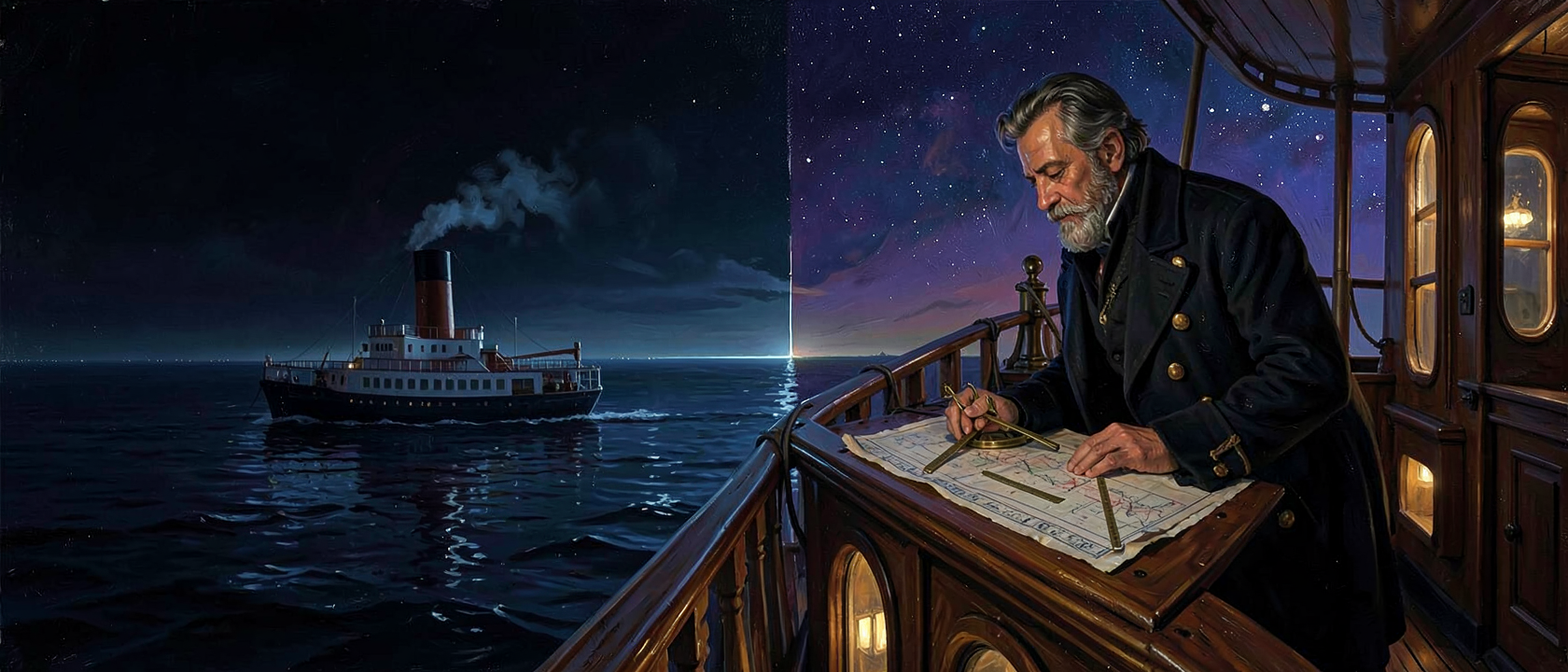
A Bankrupt Writer at Sea
Mark Twain likely boarded the steamer SS Warrimoo in Vancouver in 1895, traveling to lecture his way out of debt. He had lost an estimated $300,000, his own money and his wife’s, on the Paige Compositor, a mechanical typesetting device that failed. By one estimate, that sum would equal roughly $9 million today. To pay what he owed, Twain spent the year on a round-the-world lecture tour, and the Warrimoo carried him across the Pacific on its regular run from Vancouver to Sydney, Australia, then operating under the Canadian-Australian Steamship Line.
Somewhere on that crossing the ship passed over both the equator and the 180th meridian, the line that doubles as the International Date Line, where the calendar jumps a full day. Twain wrote down what he saw. An apple, cut into two halves for two family members riding in different parts of the ship, was eaten two calendar days apart because of where each half sat relative to the line. In steerage, the cheapest deck-level passage on the ship, a baby was born during the crossing, and neither the ship’s nurse nor its surgeon could agree on which day the birth belonged to. Twain set this down as something he had witnessed, not as a story someone had told him.
The Crossing Goes to Print
Twain published the travelogue “Following the Equator” in 1897, built from the diary he kept across the whole tour. The book carried his own photograph as its frontispiece, likely taken aboard the Warrimoo itself. The split apple and the disputed birth date went into print alongside it. A private note made on a Pacific crossing became a published anecdote that readers on several continents could buy and read. A second, stranger episode involving the same ship followed four years later.
The Captain’s Calculation
On the night of December 30 into December 31, 1899, the Warrimoo was again making the Vancouver-to-Sydney run. According to the account that later circulated, Captain John Duthie Sydney Phillips set a course not merely across the equator and the date line but toward the single point where the two meet: a position near 0 degrees 30 minutes north latitude and 179 degrees 30 minutes west longitude. Five navigators, by one telling, checked the ship’s position every three hours through the night, reading the sun and the stars, the only tools available for fixing a ship’s location at sea in 1899. The goal, as told afterward, was to have the bow and the stern land on opposite sides of the line at the same instant: opposite days, opposite months, opposite seasons, opposite years.
Midnight, Split in Two
At midnight, the story goes, the Warrimoo sat astride both lines at once. The bow, south of the equator and on the far side of the date line, had already crossed into January 1, 1900, and into the southern summer. The stern, still north of the equator and on the near side of the line, remained in December 31, 1899, in the northern winter. In the telling, the ship stood in four hemispheres at the same moment, north and south of the equator and on both sides of the date line, split between two months, two years, and, in some retellings, two centuries. Holding a 345-foot (105 m) ship on that one geographic point meant relying on periodic sextant sightings through the night, a level of precision that sun-and-star navigation of the period was not built to guarantee.
One Man’s Word, Decades Later
The story did not reach print until 1942, when the Ottawa Journal ran an account of it, by then more than four decades after the night in question. The source for every detail was Phillips himself, retired, speaking from his own ship’s logbooks. None of the five navigators said to have checked the ship’s position every three hours were named or quoted. No newspaper from December 1899 or January 1900 reporting the feat at the time it supposedly happened has surfaced. The entire legend rests on one retired captain’s recollection of his own records, given to a reporter forty-some years on.
What the Calendar Won’t Allow
Three problems sit unresolved in the story as told. The first is arithmetic: by calendar convention, a century ends on a year ending in “00,” which means the 20th century began on January 1, 1901, not January 1, 1900. Whatever else happened that night, the ship could not have crossed into a new century at midnight in 1899. The second is navigational: sun and star sightings taken every three hours could narrow a ship’s position, but whether 1890s navigation could guarantee a landfall on one exact point, to the degree the story requires, is doubtful. The third is documentary: no logbook beyond Phillips’s own, no passenger letter, and no contemporary press account from the crossing itself has ever turned up. What survives is a retired captain’s word, printed once, decades after the night he said it happened.
The Warrimoo itself outlasted the legend by less than two decades. On May 17, 1918, while serving as a troop transport between Bizerte and Marseille, it collided with the French destroyer Catapulte about 12 nautical miles (22 km) southwest of La Galite. The collision set off an explosion of depth charges that sank both ships. The vessel said to have once stood in two years at once went down, by every surviving record, in one.