
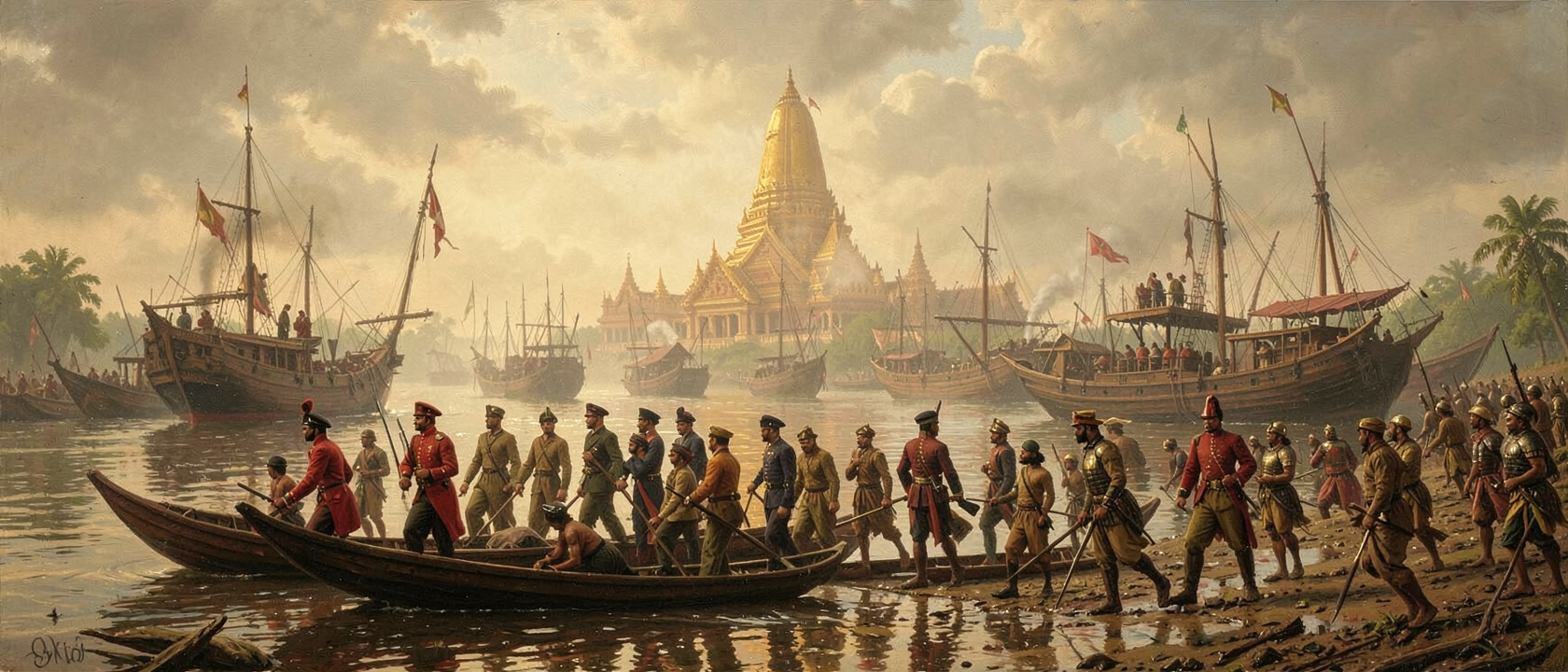
War by Mercantile Order
On March 5, 1824, the British East India Company declared war on the kingdom of Burma (Myanmar today). One near-contemporary account puts the declaration on February 24; the exact day is disputed, though the month is not.
By 1824, the Company was more than a trading concern. Chartered by the British Crown, it had built its own army and taken over government of large parts of India, acting with much of the authority of a state while remaining, on paper, a private corporation answerable to shareholders in London.
The kingdom it now moved against was the Konbaung dynasty, ruled from Amarapura by King Bagyidaw, with its own royal court, standing army, and centuries of self-government behind it. It answered to no outside power.
The friction had built along an unclear frontier, mainly around Assam and Arakan, where Company and Burmese territory ran into each other without a settled line. In March 1824, that friction turned into a declared war: a chartered company, formally, at arms against a kingdom.
Sovereignty on the Frontier
This was not a quarrel over a few miles of ground. At stake was whether Burma would keep governing itself or start down the road to absorption into Britain’s colonial system in Asia, a contest that would recur, on and off, over the next six decades.
The First Anglo-Burmese War ran for just under two years, ending on February 24, 1826. Some 40,000 British and Indian troops took part, and more than 15,000 died, an estimated seven in ten from disease rather than combat. Several accounts call it the longest and most expensive war fought in the history of British India, costing an estimated $5 million to $13 million sterling at the time, roughly £400 million to £1.11 billion in 2025 terms. The peace, signed at Yandabo in February 1826, stripped Burma of Assam, Arakan, and the Tenasserim coast (today Tanintharyi), and demanded an indemnity sources put anywhere from £1 million sterling to 10 million rupees, enough to leave the Burmese royal treasury effectively bankrupt for years.
That was the price of the first war alone. The pattern it set, a frontier dispute widening into a contest over sovereignty itself, would repeat twice more before the century was out.
The Sequence, 1824–1885
What happened between 1824 and 1886 was not one war but three, spread across six decades. The first closed in 1826 at Yandabo. A second war followed later in the century; no date or battle detail survives in the record behind this account, which names it only as the middle link in “a series of three conflicts.”
In 1858, the British Crown took direct control of India from the East India Company, ending Company rule outright. The unresolved dispute with Burma passed to the Crown along with everything else: a problem that had belonged to a corporation now belonged to a state.
The third and final war came in 1885: British forces won a quick military victory over the last Konbaung king, then carried out a longer pacification campaign, one this record does not describe in detail. By 1886, Burma had been formally annexed as a province of British India.
The Fall of Mandalay, 1885
British forces advanced on Mandalay, the Konbaung capital, in November 1885, moving against the army of King Thibaw Min. The fighting was over in about three weeks; Thibaw’s forces collapsed, and the king himself was taken.
Compare that with what had come before. The Konbaung dynasty had governed Burma for generations, with its own court and army, and, as recently as 1824, enough standing to be worth a formal declaration of war from a trading company. In roughly three weeks, its last king lost everything that remained of that kingdom.
Exile and Erasure
Thibaw Min, the last king of the Konbaung dynasty, was put aboard a ship bound for India. He would not rule again. The monarchy ended with him: no new Konbaung king was installed, no court kept on in his place.
By 1886, Burma existed on the map only as a province of British India. This was not a change of ruler but the end of Burma as a self-governing country, replaced by direct colonial administration that lasted until 1948: sixty-two years, almost exactly the length of time that had passed between the Company’s declaration of war in 1824 and Burma’s annexation in 1886.
The Gaps in the Account
Some of this history is well documented. The cost of the first war, in lives and money, survives in enough detail to be counted. Much of the rest does not.
The Second Anglo-Burmese War has no fixed date here, no named battles, no casualty figures; it survives only as the middle term in a sequence of three. The pacification that followed the fall of Mandalay, what it involved, how long it ran, at what cost, is not established in the sources behind this account. Nor is there a recorded date for Thibaw Min’s exile itself, only the fact of it.
It is also common to read that the conquest of Burma left divisive wounds that persist. That claim may be true, but this account cannot support it with evidence: no specifics are offered for what those wounds are or how they might be measured. A conquest carried out over sixty-two years left plenty that can be documented, and a few things that, on the present record, cannot.