
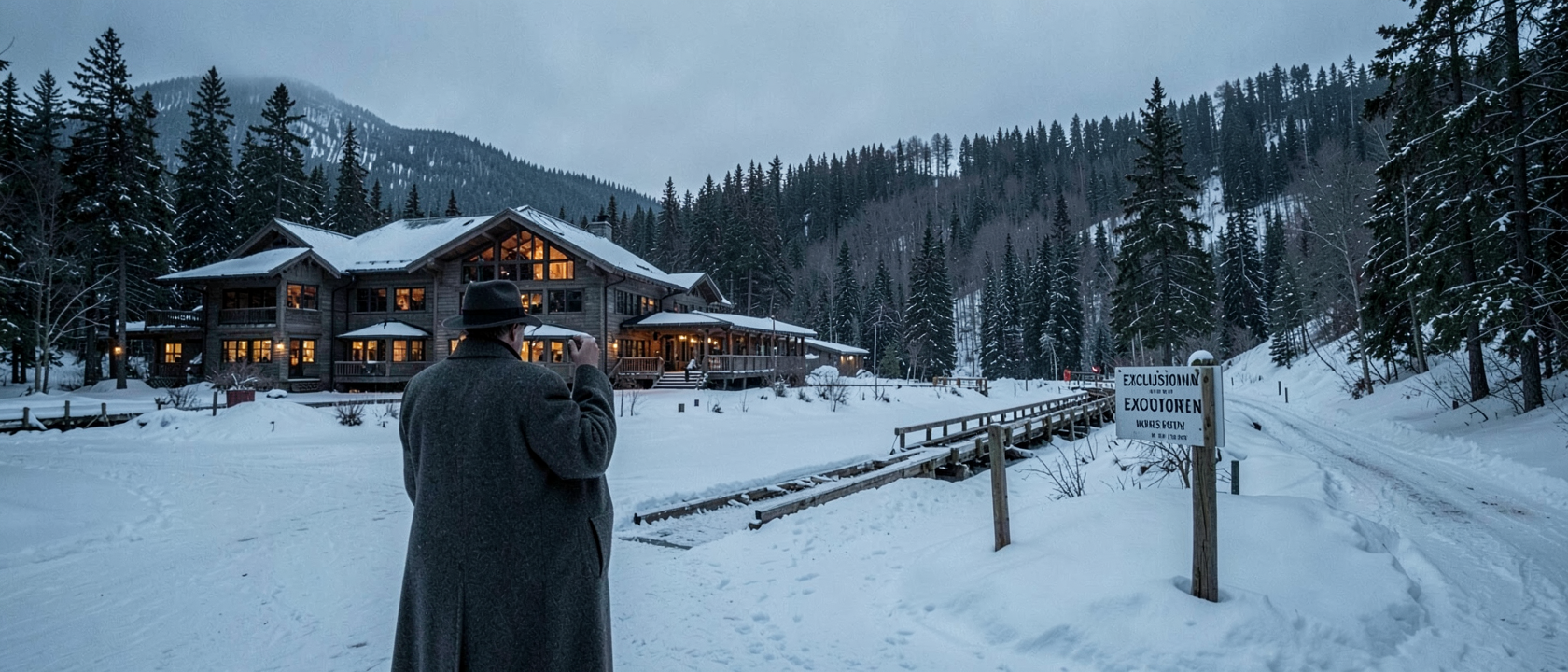
The Door at the Grand Union
In 1877, the banker Joseph Seligman and his family arrived at the Grand Union Hotel in Saratoga Springs, New York, and were turned away at the door. The hotel’s owner, Henry Hilton, blamed Jewish guests for driving off other business. Seligman’s allies organized a public boycott of Hilton’s hotels, and the Grand Union eventually closed. The practice it had tried to stop did not end with it. Other hotels across the Adirondacks and upstate New York adopted the same exclusion as an advertised policy rather than a quiet habit, a shift in business practice the record never fully explains.
Dewey’s Club
By the 1890s, Melville Louis Kossuth Dewey was already a leading figure in American librarianship: inventor of the Dewey Decimal System, former chief librarian at Columbia College, and, since 1888, director of the New York State Library. In 1895 he founded the Lake Placid Club, a winter resort and social retreat in the Adirondacks. By the early 1900s the club reportedly enforced a strict policy barring Jewish members, according to historian Peter Hopsicker. In 1904 the lawyer Louis Marshall brought a petition to the New York State Board of Regents demanding Dewey’s removal as state librarian over his role in that policy. The Regents declined to fire him but issued a public rebuke, and in the summer of 1905 Dewey resigned.
A Quiet Survey
The habits that shaped Dewey’s club did not stay confined to it. In December 1920, worried that Jewish families might buy land next to the Lake Placid Club, Dewey bought the adjoining parcels himself. A few years later, in the mid-1920s, a separate organization, the Adirondack Mountain Club, circulated an informal survey asking members whether Jewish membership should be capped or banned outright. No month survives for when the survey began or ended, and no one recorded how many members actually backed the idea beyond the phrase used at the time, “some radical members.” What is clear is that the thinking Dewey had built into his club in 1895 was still active in Adirondack social life three decades later.
A Letter to Albany
Lake Placid secured the right to host the 1932 Winter Olympics at the International Olympic Committee’s session in Lausanne, Switzerland, on April 10, 1929, beating a rival bid from California. The town, with a population under 4,000, set about building the first bobsled run in North America, and the New York State Legislature approved $125,000 for the work. The land chosen for the run belonged to the Lake Placid Club. In 1930, David N. Mosessohn, editor of the Jewish Tribune and chairman of its National Council, wrote to Governor Franklin D. Roosevelt. His complaint was specific: public money should not underwrite an Olympic facility built on land owned by a club that excluded Jews. He did not ask Roosevelt to call off the Games.
The Property Transfer
Before the opening ceremony, the State Olympic Committee met with the parties involved to settle the dispute. The club’s membership rules stayed exactly as they were. What changed was the land: the Lake Placid Club agreed to relinquish its claim to the bobsled run property, which passed into public control, with the understanding that it would go to the local community rather than back to the club if the state ever stopped maintaining it. Godfrey Dewey, Melvil Dewey‘s son, announced the arrangement; he chaired the Games organizing committee while also serving as the club’s vice president. Melvil Dewey died on December 26, 1931, weeks before the Games opened. On February 4, 1932, Governor Roosevelt, the same official who had received Mosessohn’s letter in 1930, opened the Games, and the bobsled events ran from February 9 to 15 on the track built on the land the club had just given up.
Counting the Cost
The costs did not fall evenly. Dewey lost his state directorship in 1905, choosing resignation over removal. The Lake Placid Club lost permanent control of land it had held since the turn of the century. Mosessohn and the Jewish residents who protested with him paid no recorded financial or personal price, and the record shows no retaliation against him. Much later, in 2019, the American Library Association removed Dewey’s name from its highest award, citing his antisemitism, his racism, and his harassment of women. What never appears in any account is an end to the club’s membership policy itself; only the money dispute got resolved.
What the Record Doesn’t Say
Much of this account rests on one historian, Peter Hopsicker, and his own language carries a hedge: he “alleges” that the Lake Placid Club barred Jewish members, rather than pointing to a surviving written rule. No document fixes the year the policy began, or whether it ever formally ended. The Adirondack Mountain Club survey is dated only to the mid-1920s; no month survives, and no one recorded how many members actually agreed with the “radical” minority said to have pushed it. These gaps do not undercut the episode so much as mark where the documentation stops.
1936 and the Road Not Taken
Four years after Lake Placid settled its dispute over the bobsled run’s land, American Jewish organizations tried something larger: a campaign urging a boycott of the 1936 Berlin Olympics over Nazi Germany’s antisemitic laws. That campaign did not stop the Games from going forward. The comparison is one the record raises without developing it further, and it is worth setting down plainly: a narrow, local funding objection in upstate New York produced a concrete change within two years, while a broad international campaign against a hostile government did not.
The Same Hill, 1980
Lake Placid hosted the Winter Olympics again in 1980. The bobsled and luge events returned to Mt. Van Hoevenberg, the track built on land that had belonged to the Lake Placid Club until 1932. By then, the discrimination dispute that forced the land into public hands had dropped out of how the run was described to the crowds watching it. It was simply the track at Mt. Van Hoevenberg, used for the second time in Olympic history.