
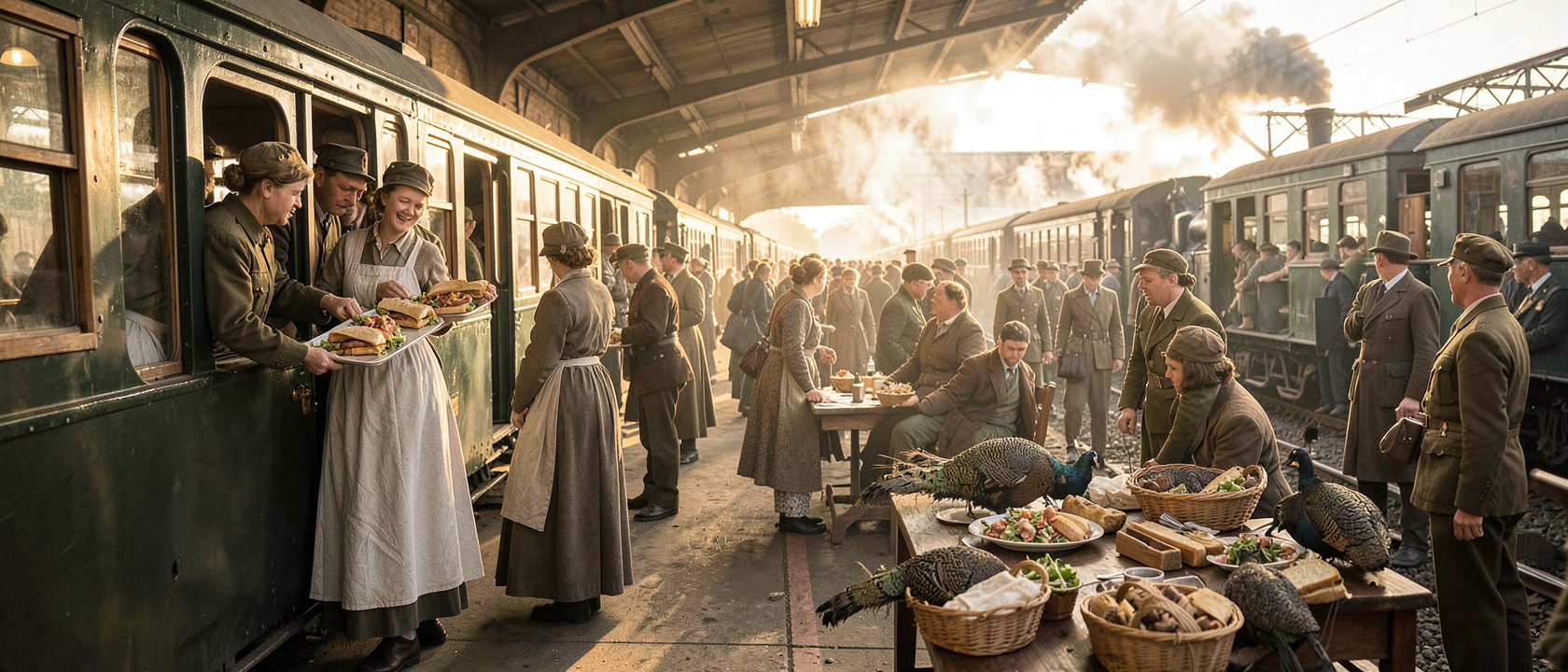
A Troop Train Pulls Into Aberdeen, 1943
On August 19, 1943, a troop train on the Chicago, Milwaukee, St. Paul and Pacific Railroad, known at the time as the Milwaukee Road, pulled into the depot at Aberdeen, South Dakota. Soldiers stepped onto the platform and found a canteen that would run from 8 a.m. to midnight, every day, holidays included, for the next two and a half years. Local volunteers staffed it under the Red Cross and the USO, feeding whoever arrived on whichever train came through, at whatever hour that happened to be. The sandwich on offer was pheasant salad, assembled from a bird that had taken hold in South Dakota only thirty-five years earlier.
From China to Spink County, 1908
Ring-necked pheasants originally came from China. The first successful introduction into the United States happened in Oregon, in either 1892 or 1881 depending on the account. In 1908, breeding pairs reached South Dakota’s Spink County; one account places the release near Doland, another near Redfield, with the Redfield version specifying three pairs. By 1935, the state’s pheasant population was estimated at 12 million birds. On February 13, 1943, months before the Aberdeen canteen opened, the state legislature made the ring-necked pheasant South Dakota’s official bird.
Poultry still carried something of a luxury status at the time, well behind beef and pork, since industrial chicken farming had not yet made it cheap and widely available. Red meat was rationed nationwide for the war effort, which thinned out the ham and egg salad that most wartime canteens relied on elsewhere in the country. Pheasant was rationed by no one. With an estimated 12 million birds already in the state’s fields, South Dakota had an abundant, unrationed protein just as a canteen opened that needed to feed anyone who stepped off a train, at any hour.
Three Hundred Volunteers a Month
The canteen had not always served pheasant. In its early months it handed out the ham sandwiches, birthday cakes, cigarettes, and coffee typical of USO canteens anywhere in the country. As rationing tightened, around the end of 1943 by one account, South Dakota farmers began arriving at the depot with pheasants they had shot on their own land and donating them to the kitchen. The recipe volunteers settled on called for three cups of pheasant meat chopped fine, two hard-cooked eggs, two grated carrots, half a chopped onion, half a cup of chopped celery, two teaspoons of sweet pickle relish, salt and pepper, and enough mayonnaise to hold it together.
Demand outran what individual farmers could bring in, so people pooled their gasoline ration coupons and shotgun shells and organized hunting drives just to keep the kitchen stocked. Roughly three hundred volunteers a month prepared and served the sandwiches, with countless others donating food and supplies to keep the whole operation running without public money. Word spread along the rail line, and Aberdeen picked up a nickname among the soldiers who passed through it: “the world’s standout for a handout.”
Two and a Half Years, Unpaid
No money changed hands at the Aberdeen depot, and this story carries no casualties. What it cost was time, given without pay by women who kept an 8 a.m.-to-midnight shift running every day, holidays included, for two and a half years, while the men in their own lives were away fighting. Canteen records point to an estimated 586,000 service members fed over the life of the operation, with as many as 1,500 soldiers arriving in a single day at times. The canteen closed for good in March 1946, once the trains that had carried those soldiers no longer needed a reason to stop in Aberdeen.
The Sandwich After Rationing
Three years later, in 1949, the Pheasant Restaurant opened in Brookings, South Dakota, and put its own version of the sandwich on the menu. With rationing over, the recipe no longer had to stretch a scarce bird across a long shift. The Brookings version went a different direction, with apple, dried cranberries, roasted pecans, and melted Swiss cheese on grilled marbled rye. It is still served at 726 Main Ave S, alongside live music, the same bird that once padded out a wartime ration now sold as something closer to a treat.
What the Records Don’t Say
No exact date survives for when pheasant first replaced ham on the Aberdeen menu, only that it happened as the war went on and rationing bit harder. No tally survives of the total sandwiches made, and the volunteer count rests on the rough estimate of three hundred a month rather than a payroll or a sign-in sheet. The figure of 586,000 soldiers fed is itself a later estimate, reconstructed from canteen activity rather than a running count kept at the time. A separate, unverified community account puts daily traffic at an average of 500 troops on four to six trains, a number that has not been checked against the historical society’s records. The surviving accounts say only “by the thousand,” and no sharper figure than that has been found.
The sandwich returned to public life in the early 2000s, when the Aberdeen Area Convention and Visitors Bureau began serving it again to hunters arriving at Aberdeen Regional Airport for the pheasant season opener, carried forward by people who had lived through the original canteen. In 2013, seventy years after the canteen first opened its doors in Aberdeen, a group of former volunteers produced a documentary about the operation, titled Pheasant Canteen: A Living Legacy.