
The Main Street Transfer
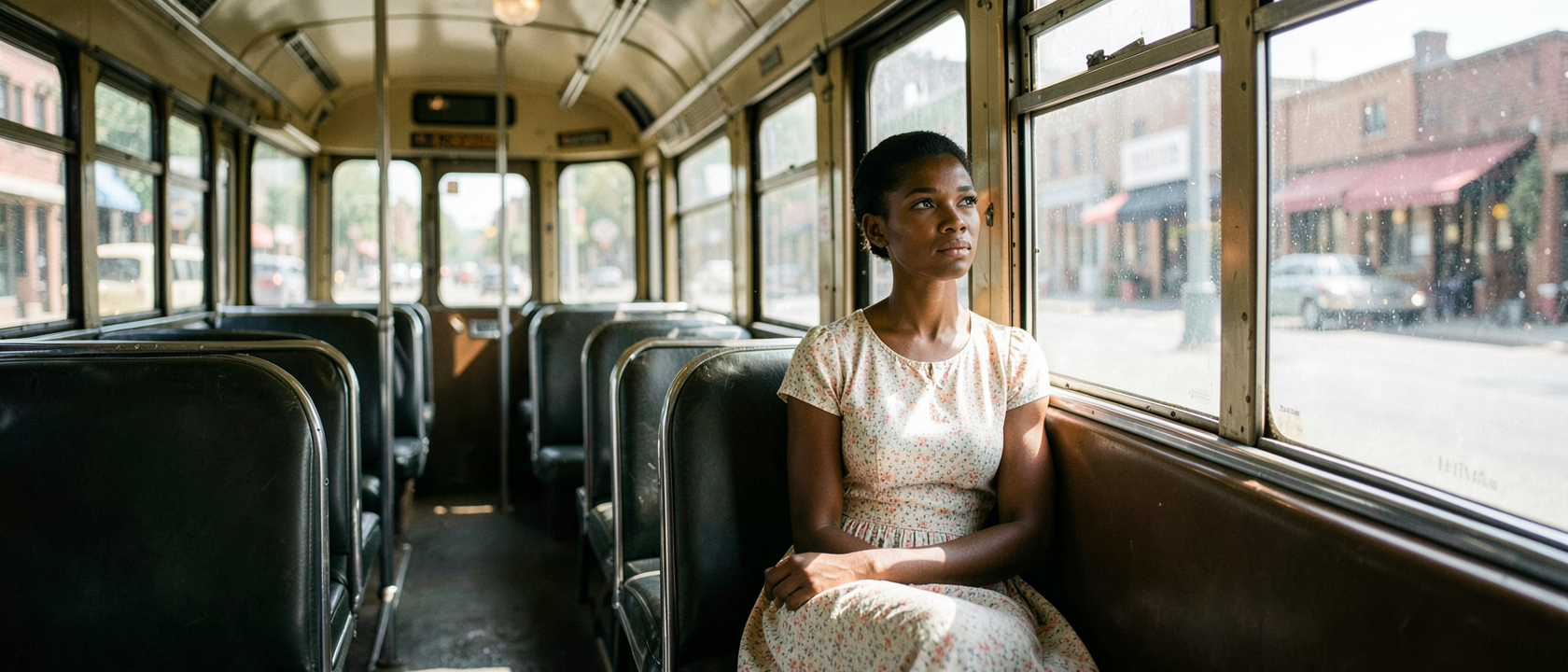
On June 22, 1954, Sarah Mae Flemming boarded a municipal bus run by the South Carolina Electric and Gas Company (SCE&G) at the corner of Main and Taylor Streets in Columbia, South Carolina. She was twenty years old and worked as a housekeeper in the city. Soon after she boarded, a white rider stood up and got off, and Flemming sat down in the seat he left empty, ahead of the line that local custom used to separate Black and white riders. The driver ordered her to move to the back. When she rose to leave at the next stop, he struck her across the abdomen with his forearm, blocking her exit. Flemming got off on Main Street and walked home, where she told her family what had happened.
Seventeen months later, in Montgomery, Alabama, Rosa Parks would refuse to give up a similar seat and set off a boycott that lasted more than a year. Flemming’s case moved through the federal courts well before that boycott began.
The Line After Brown
The assault came thirty-six days after the Supreme Court had struck down school segregation in Brown v. Board of Education. That ruling said nothing about municipal transit. Bus systems across the South, including SCE&G’s lines in Columbia, ran under city codes and state statutes that gave drivers police power to enforce the separation of the races. Challenging those rules in court meant risking violent retaliation from white residents, and it risked a different kind of defeat too: a federal judge reading Brown narrowly, as a ruling about classrooms alone, and leaving the 1896 “separate but equal” doctrine of Plessy v. Ferguson standing for buses, trains, and waiting rooms. Any attorney who wanted to test transit segregation needed a plaintiff willing to be named and exposed in a state where the courts and the police were openly committed to white supremacy.
The Twice-Dismissed Suit
Flemming did not act alone. Backed by Modjeska Simkins, secretary of the South Carolina NAACP, she retained attorney Philip Wittenberg and, on July 21, 1954, filed a federal suit against SCE&G seeking $25,000 in actual and punitive damages. The case went before U.S. District Judge George Bell Timmerman, who dismissed it. On July 14, 1955, the Fourth Circuit Court of Appeals reversed him, ruling that segregated seating on public buses was unconstitutional under the same reasoning the Supreme Court had used in Brown. Timmerman dismissed the suit a second time on procedural grounds; the Fourth Circuit reversed him again, and the Supreme Court declined to review the case, leaving the appellate ruling in place.
The Bill: An Empty Verdict and a Working Precedent
By the time Flemming’s case reached a jury in Columbia in June 1956, she and her trial attorneys, Lincoln Jenkins and Matthew Perry, had already faced intimidation, including an eight-foot cross burned by the Ku Klux Klan. The all-white, all-male jury took under thirty minutes to decide SCE&G owed her nothing. Flemming walked out of the courthouse without a dollar and without protection from anyone who wanted to punish her further for bringing the case.
The appellate ruling from a year earlier did not go away. That November, the Supreme Court affirmed a three-judge federal panel’s decision in Browder v. Gayle, a suit brought by four Montgomery women, Aurelia S. Browder, 37; Susie McDonald, 77; Claudette Colvin, 16; and Mary Louise Smith, 19, striking down bus segregation in Alabama on the authority the Fourth Circuit had set out in Flemming’s case. The Pittsburgh Courier, a Black newspaper, reported that the ruling had effectively finished “separate but equal” as a defense for transit segregation. Montgomery’s buses were desegregated on December 20, 1956, after federal marshals delivered the order to Mayor Gayle.
The Erased Margins
Popular accounts of the civil rights era center on Rosa Parks’s arrest in December 1955, and Flemming’s case rarely appears in the standard story of how Montgomery’s boycott was won in court. The surviving record of Flemming v. South Carolina Electric and Gas Co. never names the driver who struck her; his anonymity survived the lawsuit intact, while her name and testimony remained on the public docket. Flemming, by then married and the mother of three children, withdrew from public life after the 1956 trial. She lived with ongoing health problems in Eastover, South Carolina, the town where she had been born in 1933, until she died there of a heart attack on June 16, 1993, at fifty-nine. She received no damages and no public recognition for the precedent that carried her name.