
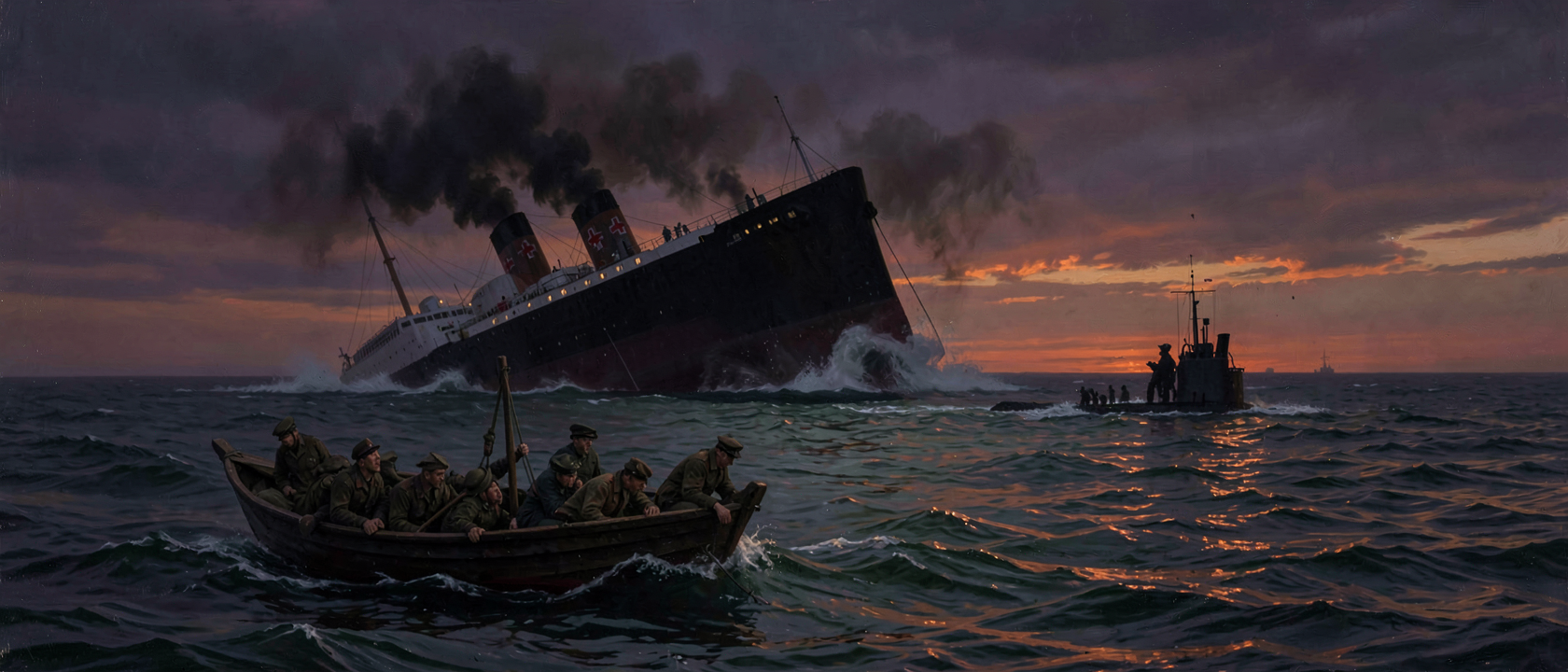
Ten Minutes in the North Atlantic
On the evening of June 27, 1918, the Canadian hospital ship HMHS Llandovery Castle was about 124 miles (200 km) off the southern coast of Ireland, sailing from Halifax, Nova Scotia, to Liverpool, England. She had been launched in Glasgow in September 1913 and completed in January 1914 as the Union-Castle liner RMS Llandovery Castle. Canada commissioned her as a hospital ship on July 26, 1916, one of five such vessels it ran during the war. She measured 500 feet (152.43 m) long, 63 feet (19.28 m) at the beam, and could make 15 knots (28 km/h).
Under the laws of war accepted at the time by every major combatant, including Germany, a hospital ship carried painted and lit red crosses and was not to be attacked. Llandovery Castle wore those markings. She carried no patients that night, only her own complement: 164 crew, 80 officers and enlisted men of the Canadian Army Medical Corps, and 14 nursing sisters, 258 people in all.
None of that stopped the German submarine U-86. It put a torpedo into her hull, and the ship went down in about ten minutes.
The Two Hours After
Llandovery Castle put out her lifeboats before she sank. Survivors later described what came next: U-86 surfaced among the wreckage and, under its commander, Kapitänleutnant Helmut Brümmer-Patzig, rammed and sank the boats one by one, then machine-gunned the people in the water. For close to two hours, the submarine moved back and forth through the debris, firing more than 20 shells from its deck gun. An official report on the sinking described this as an attempt to erase every trace of what had been done to a marked hospital ship.
Only one lifeboat got away, carrying 24 people. The destroyer HMS Lysander found them on the morning of June 29, thirty-six hours after the attack. The account that preserves this story does not give a full tally of how many died in the water or in the boats that were lost. It records only the ends of the arithmetic: a ship of 258 people, and one boat of 24 survivors.
A Court With No Precedent
Three years later, in 1921, Britain, France, and other Allied powers put German officers on trial for wartime conduct, with Llandovery Castle among the cases they wanted answered for. The idea went back to January 25, 1919, when the Allied governments at the Paris Peace Conference set up a Commission of Responsibilities to weigh whether such prosecutions could work at all.
There was no international war crimes court in 1921, no standing tribunal, no body of case law defining what counted as a war crime under international law rather than under a nation’s own military code. Nobody knew if a court could compel a state to hand over its own officers, or what to do with a man who had simply gone home. The Leipzig trials, held before the German Reichsgericht, the country’s supreme court, were an attempt to answer those questions from nothing, a quarter century before Nuremberg and Tokyo did the same work with far more legal machinery behind them.
The Trials Without Teeth
The Reichsgericht sat from May 23 to July 16, 1921, and heard 12 cases in all. For Llandovery Castle, three officers were charged with committing a war crime on the high seas: Brümmer-Patzig, who had commanded U-86, and two of his subordinates, Ludwig Dithmar and John Boldt. Brümmer-Patzig never appeared. In 1921 he returned to Danzig (now Gdańsk, Poland), his birthplace and, as a free city, outside German jurisdiction, and the case against him went no further.
Dithmar and Boldt were convicted and sentenced to four years each, a verdict dated to either July 16 or July 21, 1921, depending on the account consulted. The record does not go further than that. It does not explain the court’s reasoning for convicting the subordinates while the commander went free, nor does it detail how the other 11 Leipzig cases that spring were argued or decided.
The Cost of Forgetting
The Leipzig trials of 1921 are remembered, where they are remembered at all, as a failure. Twelve cases, a scatter of light sentences, and a commander who went home to a city no German court could reach. The Llandovery Castle case sits inside that failure carrying a toll the trial’s outcome never matched: other records put the dead at 234 of the 258 people who had sailed from Halifax, set against two four-year terms for the men who had not given the order to fire.
Despite that, the episode barely survived in memory. Nuremberg and Tokyo, a generation later, are taught in schools and remembered in film. Leipzig is not, even though it was the first serious attempt to test whether “war crime” could mean anything at all under international law.
What the Leipzig ruling established, inside a case that looked like a defeat, outlasted it. A postwar United Nations war crimes commission found that the Llandovery Castle decision was cited directly in the 1943 Kharkov trial, in the later Peleus case, and by Brigadier General Telford Taylor in connection with the Einsatzgruppen trial at Nuremberg. None of that undid the failure of 1921, or brought back the 234. It meant only that when Nuremberg opened a quarter century later, one precedent already existed, buried, and the rest still had to be built from nothing.