
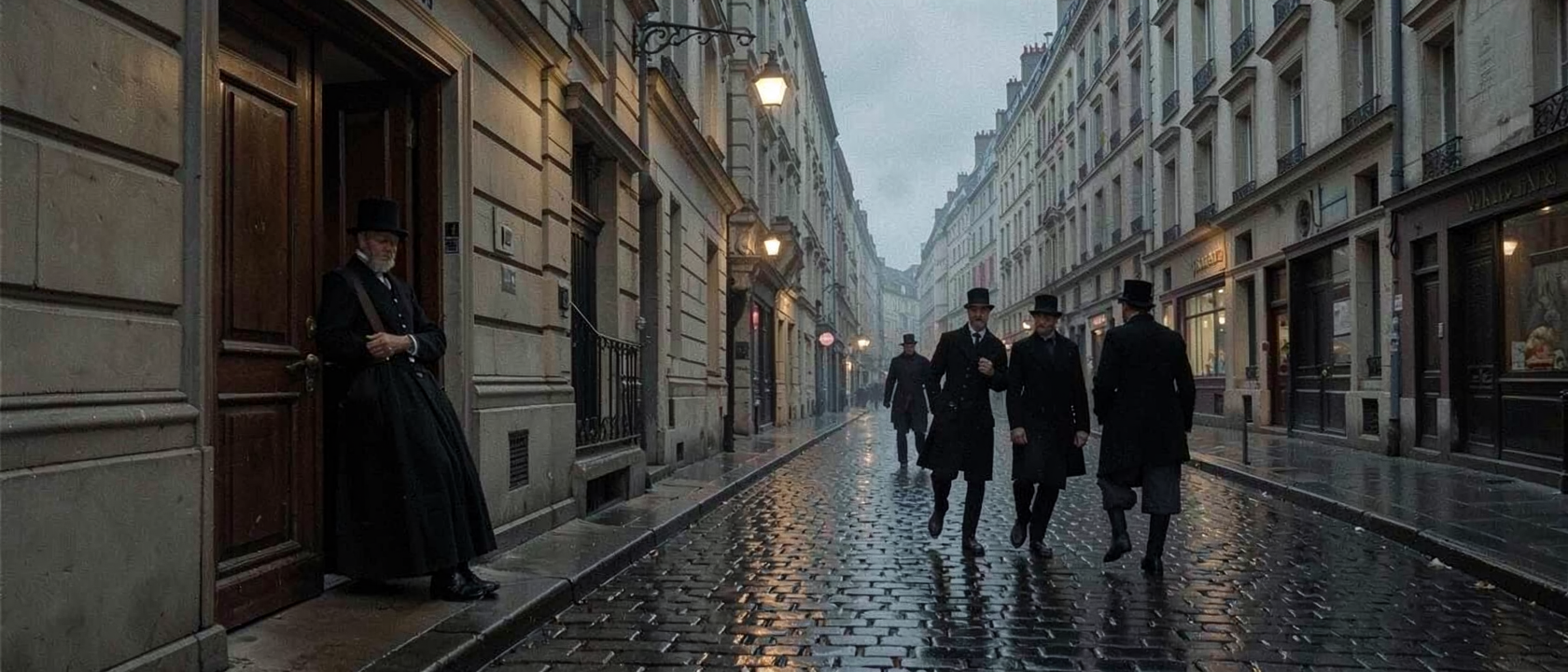
A Bad Night on the rue de Bruxelles
On September 28, 1902, Émile Zola and his wife Alexandrine returned to their house at 21 bis rue de Bruxelles, in the 9th arrondissement of Paris, after a stretch at their country home in Médan. The weather was wet and cold, so a smokeless coal fire was lit in their bedroom for the night, and the shutters were closed the way they always were.
Around 3 a.m., both of them woke up feeling sick. Zola told his wife it was nothing more than an attack of indigestion and stopped her from waking the servants. It was the last exchange between them that either could later recall. The house stayed quiet until 9 a.m.
Why This Death Was Never Going to Be Private
By 1902, Zola was the most famous living writer in France. Four years earlier, in a letter to President Félix Faure published on January 13, 1898, and known ever since by its headline, “J’Accuse…!,” he had charged the army with convicting Alfred Dreyfus, an army officer, on fabricated evidence and covering it up. The letter cost him: a conviction and time driven abroad, along with threats that kept coming from nationalists who saw Dreyfus’s defenders as enemies of the army and the nation.
None of that had faded by the autumn of 1902. When France’s most visible defender of Dreyfus was found dead in his own sealed bedroom, the public was never going to read it as simple misfortune.
9 a.m.
When no one could rouse the couple, the bedroom door was forced open. Zola was found on the floor, dead or close to it. Alexandrine lay unconscious on the bed. Doctors worked on Zola for more than twenty minutes, trying artificial respiration. It did not bring him back. Alexandrine was taken to a clinic, where she recovered.
That afternoon, word reached Jeanne Rozerot, Zola’s mistress since 1888, and their two children, Denise, who had just turned 13, and Jacques, who had just turned 11. Jeanne’s first reaction was not grief alone. She suspected, from the start, that he had been murdered.
Fifty Thousand People and One Enemy Turned Mourner
In the days before the funeral, Zola’s body lay at the house on the rue de Bruxelles. Among those who came to see it was Alfred Dreyfus, still in the middle of the fight to clear his own name. Jeanne and the children came too, received for the first time into that part of Zola’s life in public.
The funeral, on Sunday, October 5, 1902, at Montmartre Cemetery, drew a crowd estimated at 50,000 people. Government ministers stood beside delegations of coal miners and Freemasons, soldiers presented arms as the hearse passed, and Anatole France delivered the eulogy, praising Zola for never losing faith in the country’s capacity to rule by law.
Guinea Pigs, Fires, and a Verdict With Gaps in It
An inquest followed. Specialists went back into the sealed bedroom, lit fires the way the fatal one had burned, and placed guinea pigs inside to see whether the room would fill with gas again. The animals survived, and by the time the tests were run, little carbon monoxide could be detected. But when investigators took the chimney flue apart, they found soot built up in a way that suggested it had never been properly swept.
The coroner ruled the death accidental, caused by the blocked flue. He also declined to release the detailed expert findings to the public. A verdict without its evidence attached does not close a question. It sets it aside.
The Ledger
Zola was 62 when he died. Alexandrine survived, after a period of care at a clinic; it had been Zola himself, that night, who stopped her from calling for help. Jeanne Rozerot and the two children lost the man who had supported them and, had he lived, might have brought them further into public view. France lost a novelist still working, in the middle of a fight over Dreyfus that was not yet finished. None of that is disputed. What killed him is.
Reburial, 1908
The Chamber of Deputies had voted on July 13, 1906, the day after Dreyfus’s judicial rehabilitation, to move Zola’s remains to the Panthéon. The ceremony itself did not happen for another two years. On June 4, 1908, his coffin was transferred there and placed beside Victor Hugo’s, the highest posthumous honor the French state could give a writer.
During the ceremony, a journalist named Louis Grégori fired two shots from a revolver at Alfred Dreyfus, who was present as a guest of honor. Dreyfus was wounded slightly in the arm and forearm. Grégori was arrested on the spot, tried at the Paris Assize Court from September 9 to 11, 1908, and acquitted, the jury treating the shooting as the understandable act of a nationalist. Six years after Zola’s death, and roughly a decade after “J’Accuse…!,” the man Zola had died defending was shot at Zola’s own reburial.
A Deathbed Story, Told Secondhand
A contractor who fitted stoves, opposed to Dreyfus’s cause, is said to have confessed on his deathbed in 1927 that he had deliberately blocked the chimney of the house next door, then secretly unblocked it, sending the fumes back into Zola’s bedroom as a political act. The story did not reach print until 1953, in a letter published in a French newspaper, twenty-six years after the alleged confession and more than fifty years after Zola’s death.
By then it survived only at second or third hand: no signed statement, no contemporary witness on record, nothing to check against the man who supposedly spoke it. Biographer Frederick Brown, examining the claim, concluded that it could be neither confirmed nor dismissed. A coroner had closed the case as an accident in 1902 without releasing his full evidence. A newspaper reopened it in 1953 with a story nobody could verify. Both stand, unresolved, against each other.