
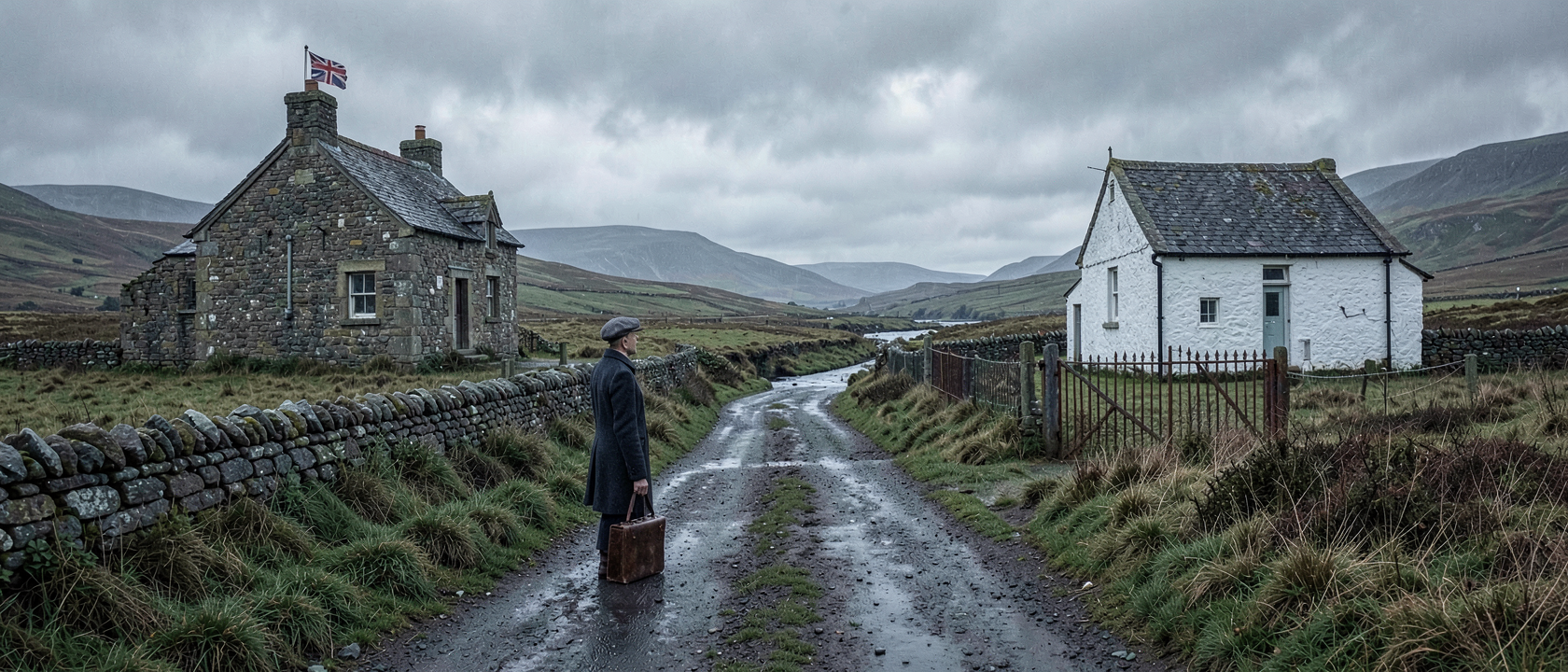
On December 6, 1922, a proclamation signed by King George V gave legal force to a new constitution, and the Irish Free State came into being. Twenty-six of the island’s thirty-two counties now answered to a government in Dublin instead of London. Tucked into that number, unremarked in the day’s ceremony, were three counties of the old province of Ulster, home to an estimated 70,000 Protestants who had spent the previous decade opposing Home Rule.
A State Comes Into Being
The Free State did not appear from nowhere. It grew out of the Anglo-Irish Treaty, signed in London on December 6, 1921, which ended the Irish War of Independence and set the terms for a new Irish state. Under the treaty, that state would hold Dominion status inside the British Commonwealth: full self-government at home, an oath of allegiance to the Crown, and a Governor-General standing in for the monarch in Dublin. This was a major loosening of British control, not a clean break from it. The Crown link stayed on the books, and that surviving link is what would soon matter to the people this story follows.
The Act giving the treaty legal effect passed on December 5, 1922. The Free State came into existence the next day, covering twenty-six counties with a population that was overwhelmingly Catholic. For most of the island, this was understood at the time as a move from direct rule out of London to self-government from Dublin. For a scattered Protestant minority along the state’s new northern edge, it would mean something closer to finding themselves outside the jurisdiction they had organized to prevent.
Where the Line Fell
The treaty had already built in an exit for the six northeastern counties making up Northern Ireland, letting their parliament opt out of the Free State within one month of the enabling Act taking effect. The Houses of the Parliament of Northern Ireland did not wait. On December 7, 1922, the day after the Free State’s establishment, they voted to opt out, splitting the island formally in two: six counties staying inside the United Kingdom, twenty-six joining the new Dominion.
Three of those twenty-six counties, Cavan, Donegal, and Monaghan, belonged historically to the ancient province of Ulster, the same province that gave Northern Ireland its unionist character. Geography did not move on December 7. Jurisdiction did. An estimated 70,000 Protestants lived across the three counties, and roughly half of them had signed Ulster’s Solemn League and Covenant back in 1912, pledging to use whatever means it took to stop Home Rule, meaning Irish self-government inside the United Kingdom, from being imposed on them. “Unionist” and “loyalist” here describe people defined by loyalty to the Crown and to continued union with Britain, not simply by the church they attended. The treaty’s arithmetic of six counties against twenty-six had just placed that identity on the wrong side of a line.
On the Wrong Side of the Border
No population transfer came with the new border, and no one offered residents a choice of sides. The Free State’s authority and its symbols arrived where these families already lived. Unionists in the six counties of Northern Ireland kept the arrangement they had organized since 1912 to defend. Unionists in Cavan, Donegal, and Monaghan did not. Their circumstances changed while they stayed exactly where they were.
The unsettled months before December 1922 had already shown what that could mean. In May 1922, the Irish Republican Army commandeered the Orange Hall, the local meeting house of the Protestant unionist Orange Order, in Lifford, County Donegal, drove off its caretaker, and entered loyalist homes in nearby Stranorlar. In Newtowncunningham, anti-treaty fighters ordered a prominent loyalist, James Black, off his 200-acre (81-hectare) farm within the hour. In County Cavan, eleven armed men raided the house of a wealthy Protestant, Thomas Colby Burrows, taking jewelry, furniture, and cash. When anti-treaty republicans sacked the town of Pettigo that same month, two Protestant families left for Canada. These episodes belong to the chaos surrounding the treaty’s ratification rather than to any settled Free State policy, but they showed some families what life inside the new jurisdiction could feel like before it was even a month old.
Seven Percent
The clearest single number for what had happened comes from the first count taken under the new state. The 1926 census recorded a Free State population of roughly three million. Seven percent of them were Protestant, a smaller share than Protestants had held before independence. That figure is a documented result of an official count, not a rounded guess, and it describes the Free State as a whole, not the three border counties alone.
The census cannot show how this shift was experienced by the minority it counted: a community whose oath of allegiance and Governor-General answered to the same Crown they had pledged loyalty to, while its government, courts, and elected majority did not. Political power in the new Free State never scaled to match that seven percent. The census tells us how small the minority had become. It does not tell us what the minority did next.
What the Record Doesn’t Say
Some gaps here are worth naming rather than papering over. The treaty and the opt-out vote explain, in outline, why the border ran where it did, but the detailed negotiations and criteria behind its exact path fall outside what this account can verify. Even the county count is not fixed across the historical literature: one telling of this story centers on three counties, Cavan, Donegal, and Monaghan; a related account by the same historian widens the frame to five, adding Leitrim and Louth. Both describe real dislocation. They simply draw the edge of the story in different places.
The larger gap sits after 1926. The Free State itself carried on as a Dominion until December 29, 1937, when a new constitution replaced it with the state of Éire. What happened across that decade to the Protestant families of Cavan, Donegal, and Monaghan, who stayed, who left, who reached some accommodation with the new state, and who withdrew from public life instead, is not settled by the sources behind this account. The raids of 1922 and the census of 1926 are two fixed points. The distance between them, for these communities, is the part of the record still waiting to be filled in.