
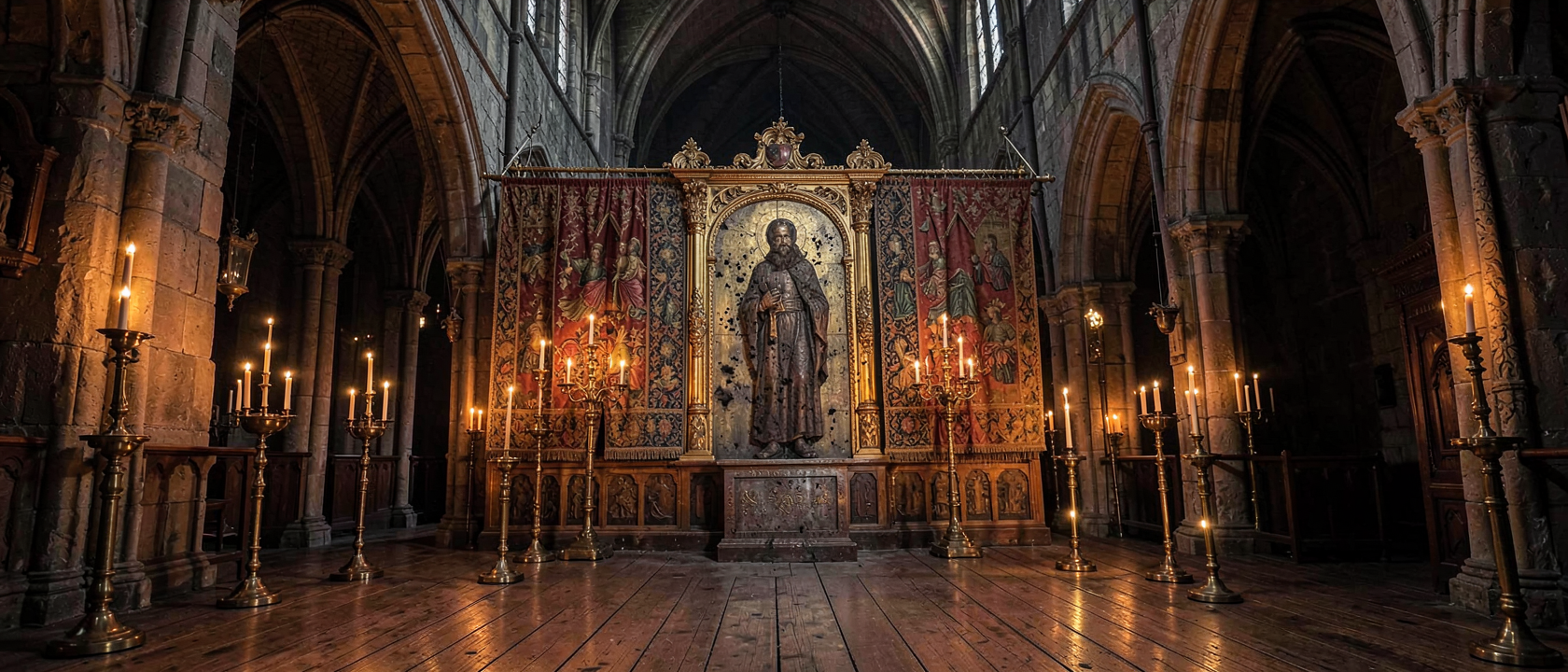
A Gift for Men Who Lived on Water
In 1891, officers serving with an Imperial Russian training squadron paid for the making of a large icon of St. Nicholas. In Orthodox tradition, St. Nicholas is the saint who watches over sailors, travelers, and merchants, which made him the obvious choice for men whose work and whose cadets’ lives depended on the sea. A training squadron carried young men still learning their trade under officers who were answerable for them. An icon of St. Nicholas was not decoration in that setting. It was protection, as the officers understood it, for a crew that spent most of its life afloat.
What set this icon apart was its material. Most icons of the period were painted on wood panels, suited to a fixed wall in a church ashore. This one was made of steel. Steel did not warp in damp sea air and did not crack the way a wooden panel eventually could. It was heavier and harder to damage, built for a life carried from ship to ship rather than a life hung in one place and left there.
A War That Took Ships Down With Their Icons
Thirteen years later, the icon’s durability was tested in earnest. The Russo-Japanese War, fought between the Russian and Japanese empires from 1904 to 1905, was decided largely at sea, and it was hard on the ships that fought it. A steel icon kept aboard a warship faced the same dangers as the crew around it: fire that could run through a hull in minutes, and the chance that a magazine of shells would go up before anyone reached it.
Few objects come back whole from a shipboard explosion. When a ship’s magazine detonates, there is usually not much left to recover, which is one reason icons carried on naval vessels in this war rarely survive to be examined today. An icon that came out of such an event scarred, rather than disappearing with the ship, was already unusual.
Blown Into the Water
Cathedral tradition holds that during a battle of that war, an explosion threw the icon off the ship and into the sea. By that account it was larger than a wide door, big enough that it is said to have kept several sailors afloat until a British warship took them aboard. The icon itself came out of the water damaged by shellfire, carrying marks of the fighting it had just been through.
This is the point where the account has to be read for what it is. The record kept by the cathedral names no ship, gives no date for the explosion, and lists no number of sailors saved or lost. It is tradition handed down with the object, repeated in the cathedral’s own materials and in captions beside the icon, not a naval record that can be checked against a log or a casualty list.
What the Story Doesn’t Tell Us
No muster roll has turned up connecting named sailors to this rescue. No official report ties the icon to a specific engagement in a war that produced many. This gap is not unusual for relics of this kind. When a ship burns or goes down, the paperwork and the witnesses who might have filed it tend to disappear together, leaving the object as the main thing that survives to be asked about.
What is left, in this case, is the icon and an account of what it is said to have done, carried forward by people who were not present when it happened. That does not make the story false. It means the story has outlasted the kind of evidence that would pin down a date, a ship’s name, or a number of men saved, and it should be told as tradition rather than as a documented event.
Repainted, Relocated, Still Scarred
Whatever happened to the icon in the water, it did not return to sea duty. It was kept for years in a church gallery and, at some point not recorded, repainted and repaired. In 1935 it was brought from Russia to England and presented to the Russian Orthodox Cathedral of the Dormition of the Mother of God and All Saints, at 67 Ennismore Gardens in Knightsbridge, London. It underwent a further restoration in the 1990s, after which it was blessed and reinstalled in the cathedral on the eve of the war’s hundredth anniversary, placing that ceremony around 2003 or 2004.
The restoration mended what had broken. It did not erase what the shellfire had left on the surface. Photographs of the icon taken since show the damage still visible, and it hangs in the cathedral’s left corner, where any visitor attending services there can see it.
One Relic Among Others, Still to Come
The St. Nicholas icon is not the only object at the Cathedral of the Dormition with a history attached to it. The cathedral is also linked to relics connected with St. Seraphim of Sarov, a Russian saint canonized in 1903. What can actually be confirmed about those relics, including how and when they came to be associated with the cathedral, is a separate matter and belongs to a piece of its own.