
The Field Each October
On October 14, 1066, King Harold Godwinson’s English army met Duke William of Normandy’s force on a ridge above a valley in Sussex. William won. Harold did not survive the fight, and the town that grew up around the battlefield took its name straight from what happened there: Battle, East Sussex, about 7 miles (11 km) northwest of Hastings.
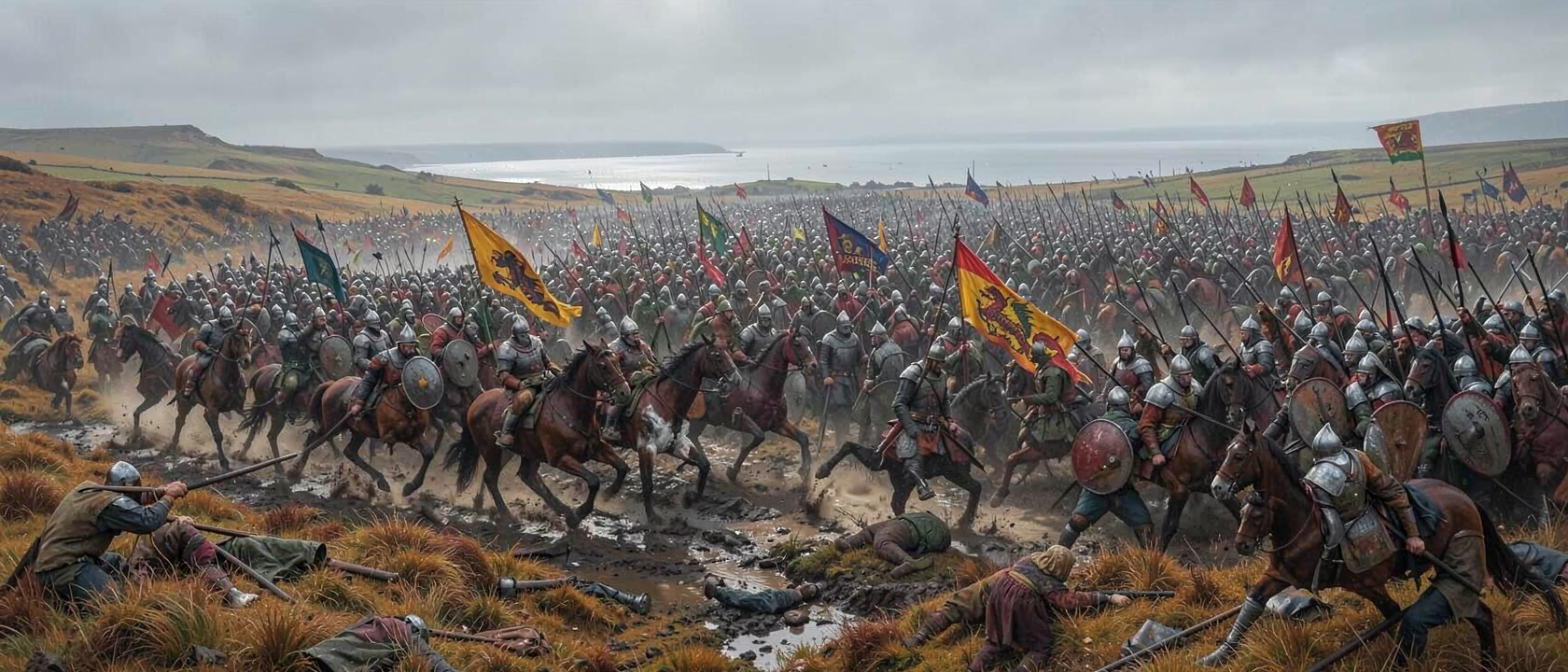
The ground still hosts a fight most Octobers. English Heritage, which owns the site, stages a reenactment on the weekend closest to October 14 each year. The tradition stretches back further than people usually assume; it has run in most years for roughly the past three decades, called off or scaled back only when the weather or the state of the field won’t allow it, and it draws several thousand spectators. English Heritage has announced that the October 2026 staging falls 960 years after the original battle. Costumed knights, English housecarls and archers meet on the slope where the real fighting happened, arrows blunted for the display, while speeches recorded in advance and attributed to Harold and William play over loudspeakers before either side moves.
A Fight With Nothing Physical Left to Lose
Nothing material changes hands on that field anymore. No crown passes. No land is seized. Nobody dies. What the annual restaging actually contests is harder to measure: whose side the crowd takes.
In the reenactment’s script, Harold comes across as weary and sympathetic, a king worn down before the first blow lands. William comes across as fierce, almost unhinged, the invader with something to prove. The historical stake at Hastings, who would rule England, was settled on this ground in 1066. The theatrical stake, who the crowd is rooting for, gets decided again every time the reenactment runs.
How the Afternoon Runs
Each year, the order stays the same. It opens with the two recorded speeches, played before either army has moved. Then come the housecarls, knights and archers, meeting in staged combat while a live commentator narrates the fight for the crowd on the slope.
The crowd isn’t a passive audience. It reacts, sometimes to a question put to it directly, and the reaction follows a pattern that holds from year to year: loud cheers for Harold’s housecarls, and muted, polite applause at best for William’s Normans.
What William Pays for Losing the Crowd
Nobody bleeds and nobody loses land in this version of Hastings, but somebody still pays. William, the man who actually won the battle, absorbs the cost, and he isn’t around to object.
The historian Marc Morris, writing about the reenactment, has pointed out that the script’s portrayal puts William in company he hasn’t earned: in the crowd’s imagination he lands somewhere near Napoleon and Hitler, men remembered chiefly as aggressors. Morris argues the historical record on William is more mixed than that, though he doesn’t spell out exactly what the mix consists of. He also places the performance he saw in what he calls “the 950th anniversary year” of the battle, without naming the calendar year the phrase refers to.
What the Record Doesn’t Give Us
A few things are worth separating from the rest. Most accounts of the reenactment never name a single calendar year for an individual staging, only the recurring pattern: almost every October, spanning roughly the past three decades. The tradition on this ground is in fact older than that framing suggests. The first documented filmed reenactment of Hastings took place in 1966, on the battle’s 900th anniversary, recorded by Alan Wootton and his wife Mary, which puts the real run closer to six decades than three.
Nor is there a calendar year attached to the “950th anniversary” Morris mentions, so there’s no way, from his account alone, to date that particular October. Only the 2026 staging comes with a fixed figure: English Heritage has tied it directly to the 960th anniversary of the battle. The comparison to Napoleon and Hitler is Morris’s own shorthand for how lopsided the portrayal has become, not a cited historical judgment. The claim that William’s record is ambivalent is asserted rather than demonstrated, with no named sources or specific episodes of his reign offered to back it up.
What is documented, consistently, is the sound from the crowd itself: cheers for Harold’s housecarls, muted applause for William’s Normans, repeated often enough across three decades of Octobers to count as a verdict of its own.