
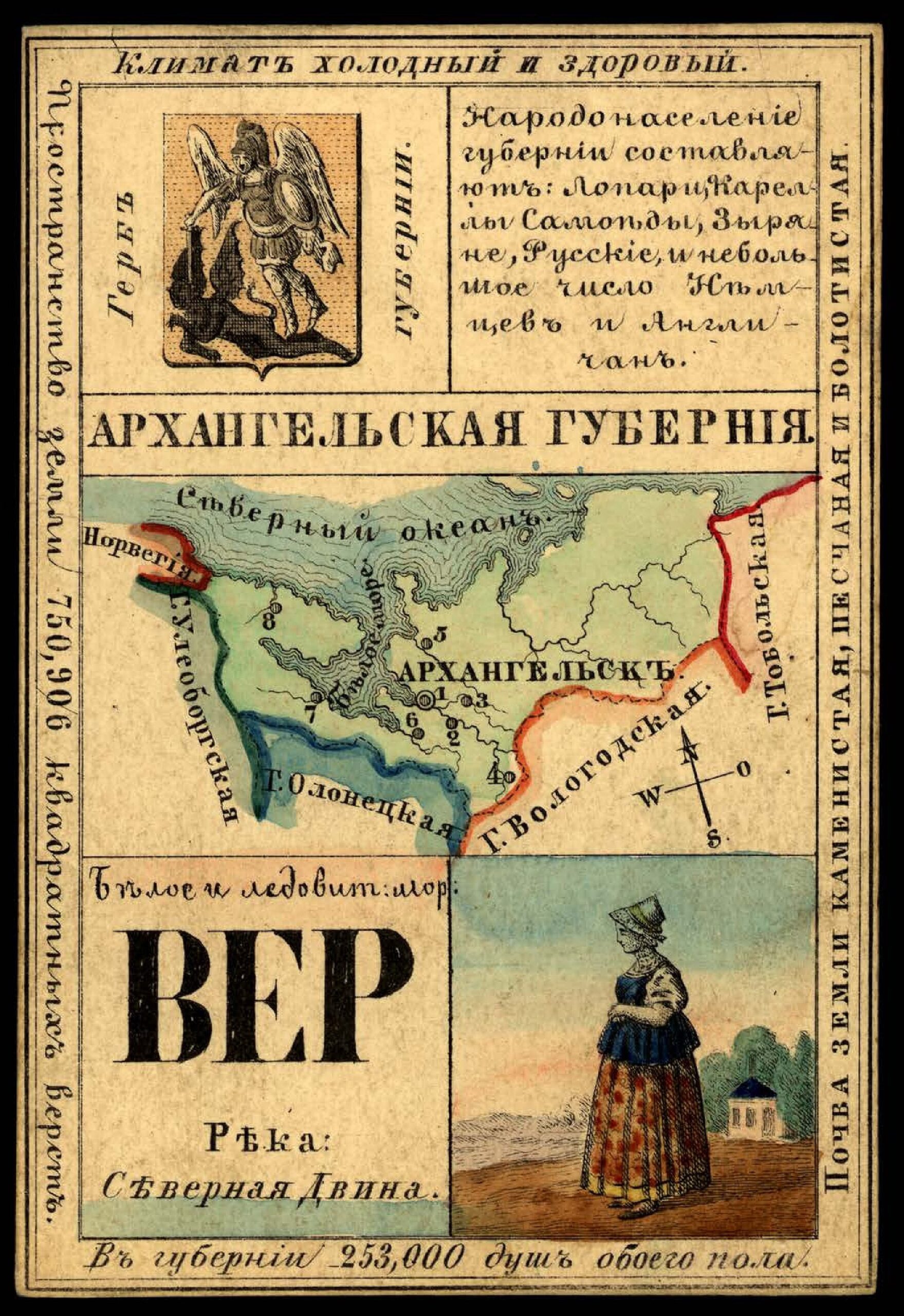
The Arkhangelsk Governorate was a vast administrative division of the Russian Empire, formally established on 12 December 1796 and covering 842,531 km² of Russia’s far north. Stretching from the White Sea coast deep into the Arctic, it encompassed territory that later passed through the Russian Republic and the Russian Soviet Federative Socialist Republic. At the turn of the 19th century, its port processed millions of rubles in outbound trade, exporting fish, lumber, and furs at a value far exceeding annual imports.
Key facts
- Country: Russian Empire
- Type: governorate; governorate of the Russian Empire
- Located in: Russian Empire; Russian Republic; Russian Soviet Federative Socialist Republic
- Coordinates: 64.5333, 40.5333
- Area: 842,531 km²
- Founded: 12 December 1796
Establishment and Territory
The governorate was founded on 12 December 1796, reorganising the administrative map of Russia’s European north. The resulting unit measured 842,531 km², making it one of the largest guberniyas in the empire by area. Its jurisdiction extended to the Novaya Zemlya archipelago in the Arctic Ocean during the late Imperial period, with the governors of Arkhangelsk overseeing that remote chain of islands.
Trade and Economic Life
At the beginning of the 19th century, the port of Arkhangelsk processed imports worth 502,505 rubles annually, while exports reached 4,773,370 rubles. Fish, lumber, and furs accounted for the principal share of those outbound cargoes, reflecting the region’s dependence on its forests, rivers, and coastal fisheries.
The governorate’s commercial importance became acute between 1807 and 1813, when the Continental Blockade of Great Britain was in effect. During those years Arkhangelsk functioned as Russia’s only open port for international commerce.
Notable Figure: Mikhail Lomonosov
Mikhail Vasilyevich Lomonosov was born on 19 November 1711 in the village of Mishaninskaya, now known as Lomonosovo, in the territory of the Arkhangelsk Governorate near Kholmogory. His father was a peasant-Pomor fisherman and ship owner. Lomonosov went on to become the first native-born Russian Academician, receiving that distinction in 1745, and is regarded as the founder of Russian science.
The Allied Intervention of 1918–1919
After the governorate had passed into the Russian Soviet Federative Socialist Republic, the city of Arkhangelsk became the landing point for Allied forces during the North Russia intervention. On 5 September 1918, United States troops of the 339th Regiment, known as the ‘Polar Bears’, came ashore at Arkhangelsk. The Allied front extended to its maximum southward reach at some 450 miles from Moscow before the intervention wound down in 1919.
Did you know
- Russia’s most celebrated polymath, Mikhail Lomonosov — credited with discovering the atmosphere of Venus and establishing Moscow University — was born in 1711 in a small fishing village of the Arkhangelsk territory, the son of a peasant-Pomor fisherman and ship owner. (ilnuovosaggiatore.sif.it)
- During the Allied North Russia intervention of 1918–1919, United States troops of the 339th Regiment known as the ‘Polar Bears’ landed at Arkhangelsk on 5 September 1918, and the Allied front reached its maximum southward extension some 450 miles from Moscow. (nationalgeographic.com)
Data sources
Data updated: 2026-10-31