
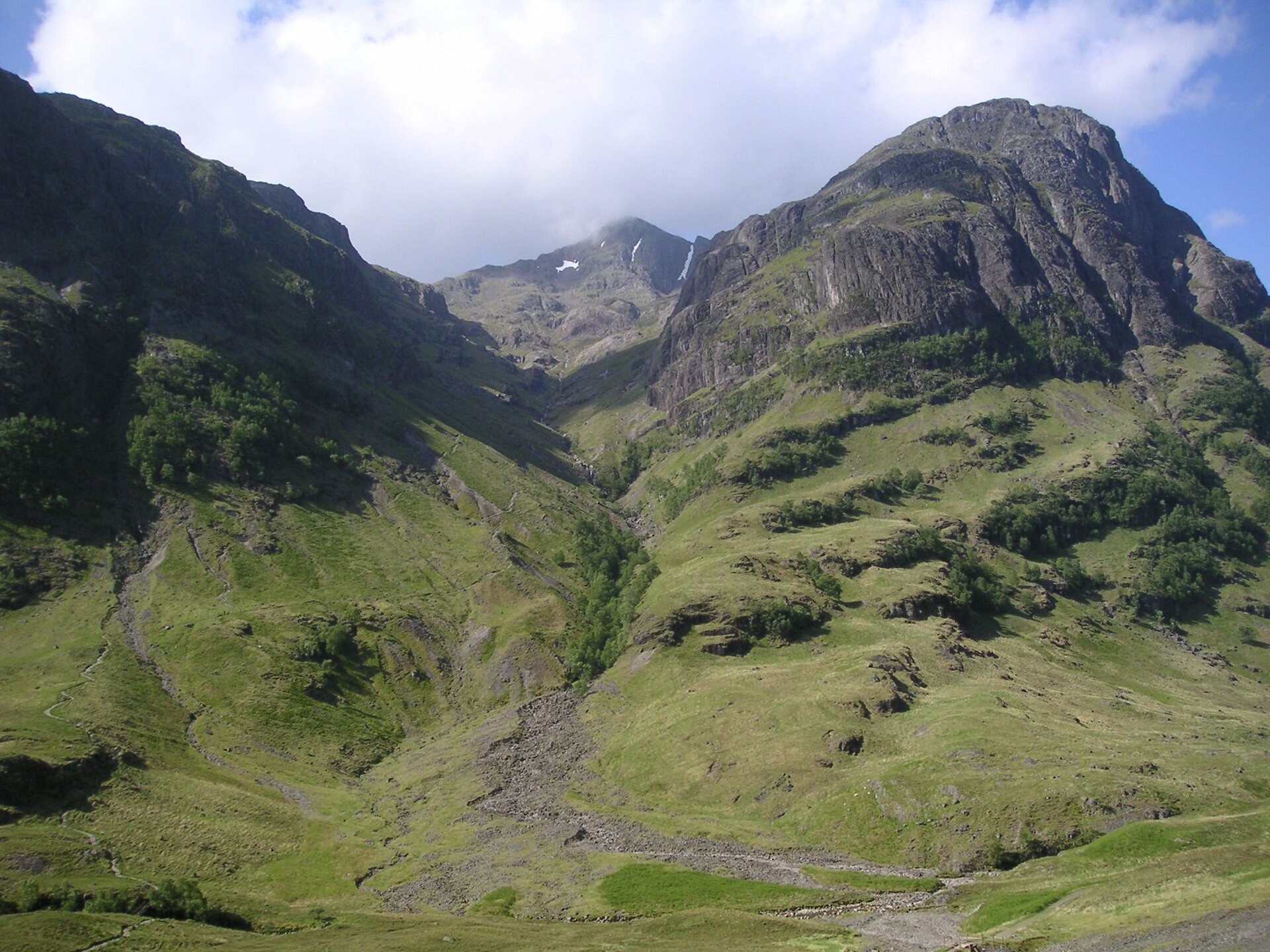
Glen Coe is a glen in the Highland council area of western Scotland, lying within the historic county of Argyll. Its valley floor is flanked by striking rock formations, and the glen contains eight Munro mountains and 25 named peaks within its National Nature Reserve boundaries. The glen’s combination of geological scale, a violent episode in 1692 that reverberated through Scottish political life, and recurring use as a film location has kept it in public attention for centuries.
Key facts
- Country: United Kingdom
- Type: glen
- Located in: Highland
- Coordinates: 56.6678, -4.9867
Landscape and Peaks
The north wall of Glen Coe is formed by the Aonach Eagach, a name drawn from Scottish Gaelic meaning “notched ridge.” The traverse runs approximately 10 km and takes in two Munros: Meall Dearg and Sgorr nam Fiannaidh. Its narrowest section, known as the Crazy Pinnacles, reduces the ridge crest to approximately 3 metres, which is why it is regarded as the narrowest ridge on the British mainland.
The south side of the glen is dominated by the Bidean nam Bian massif. Three ridges extend northward from this massif: Beinn Fhada, Gearr Aonach, and Aonach Dubh. These three are collectively known as the Three Sisters of Glen Coe. Across both flanks and within the surrounding National Nature Reserve, the glen holds eight Munros and 25 named peaks in total.
The Massacre of 1692
In February 1692, soldiers quartered with the MacDonalds of Glencoe turned on their hosts in an act that became one of the most discussed episodes in Scottish Highland history. A government commission subsequently found the killings to constitute murder. Its inquiry identified Sir John Dalrymple, Secretary of State for Scotland, as the prime instigator of the attack.
The event is often described as the product of a Campbell–MacDonald clan feud, but that reading is misleading: the massacre was primarily instigated by the Scottish government rather than by clan rivalry. Within two weeks of the killings, a pamphlet by Charles Lesley had turned the episode into a national scandal.
Roads and Access
The first road built through Glen Coe itself dates from 1785. It was constructed as part of broader government efforts to extend control over the Highland clans, part of a pattern of infrastructure projects driven by political calculation rather than local need.
Glen Coe on Film
Glen Coe and the neighbouring Glen Etive provided the Scottish Highland scenery for the 2012 James Bond film Skyfall. In the film, Glen Coe is depicted as the location of Bond’s ancestral home. The connection between the Bond franchise and this part of the Highlands has a deeper root: Ian Fleming, who created the character, owned a family lodge in neighbouring Glen Etive, which likely inspired Bond’s Scottish Highland connection later made famous in the film.
Did you know
- Although the Glencoe Massacre of 1692 is commonly framed as a Campbell–MacDonald clan feud, it was primarily instigated by the Scottish government. Within two weeks of the killings, a pamphlet by Charles Lesley had made the event a national scandal. (contemplator.com)
- Ian Fleming, the creator of James Bond, owned a family lodge in neighbouring Glen Etive. That connection likely inspired Bond’s Scottish Highland ties, which were later made famous on screen in the 2012 film Skyfall. (visitscotland.com)
- The Aonach Eagach ridge on Glen Coe’s north wall contains a section called the Crazy Pinnacles, where the ridge narrows to approximately 3 metres, giving it the distinction of being the narrowest ridge crest on the British mainland. (lochaberguides.com)
Data sources
- Wikidata
- highlandguide.co.uk
- peakvisor.com
- glencoemuseum.com
- britainexpress.com
- visitscotland.com
- findingtheuniverse.com
Data updated: 2026-10-31