
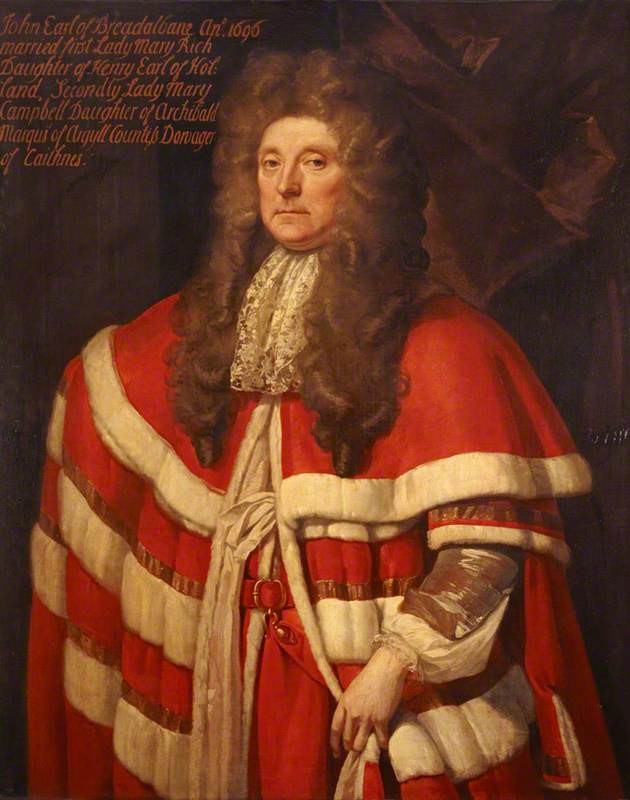
John Campbell, 1st Earl of Breadalbane and Holland (born 17 July 1635, died 19 March 1717) was a Scottish nobleman and politician whose career spanned some of the most turbulent decades in Scottish and British history, from the Restoration through the Glorious Revolution, the Massacre of Glencoe, and two Jacobite risings. Contemporaries rated him “the best headpiece in Scotland,” and his influence among Highland magnates was said to be surpassed only by Argyll, making him a figure the crown could not easily ignore. He was armed with a government fund of £12,000 to negotiate Jacobite submission in 1691, and the double game he played with that commission defined his reputation for the rest of his life.
Key facts
- Born: 17 July 1635
- Died: 19 March 1717
- Country: Kingdom of Scotland; Kingdom of Great Britain
- Occupation: politician; aristocrat
Origins and Early Career
Campbell was the eldest son of Sir John Campbell of Glenorchy, 4th Baronet. His mother was Lady Mary Graham, daughter of William Graham, 1st Earl of Airth and 7th Earl of Menteith, a lineage that placed him near the upper tier of Scottish aristocracy from birth.
He entered formal politics when he sat in the Scottish Parliament as member for Argyllshire, a seat he held from 1669 to 1674. That parliamentary service was the most conventional episode in a career otherwise characterised by back-channel dealings and competing loyalties.
The Achallader Negotiations and the £12,000 Fund
After the Glorious Revolution brought William III to the throne, the government faced the problem of Highland chiefs who remained loyal to the exiled James VII. Campbell was chosen as the crown’s chief negotiator. On 30 June 1691, he met the Jacobite chiefs at Achallader Castle and concluded secret articles with them by which they undertook to refrain from hostilities until October; he also signed the Declaration of Achallader for the government.
The £12,000 he carried was presented officially as money to buy disputed land and reduce inter-clan feuds. In practice it was intended for distribution as bribes to secure Jacobite submission. The ambiguity of the fund’s purpose suited Campbell’s method: commitments made in private, rationale adjusted to the audience.
That same ambiguity had a personal dimension. At the Achallader negotiations, Campbell secretly agreed that if King William refused to accept the peace terms, he himself would join the Jacobites with 1,000 men. He had, in effect, made a binding commitment to both sides.
Arrest, Release, and the Glencoe Affair
The secret negotiations did not stay secret for long. In September 1691 Campbell was imprisoned in Edinburgh Castle on a charge of high treason after his dealings with the Jacobite chiefs came to light. He was released once it became known that he had been acting with King William’s knowledge, a detail that resolved his legal position without resolving the larger questions about his conduct.
The Massacre of Glencoe followed in the wake of the events that Campbell’s negotiations had set in motion. His precise role in the events leading to the massacre has been debated, but his name remained attached to the affair throughout the rest of his life.
Later Jacobite Involvement
Campbell’s career after the Glencoe affair continued along the same lines of carefully managed ambiguity. He encouraged the attempted French Jacobite descent in 1708, but refused to commit himself to paper on the matter, leaving no written trail of his support.
During the Jacobite rising of 1715, he visited the Earl of Mar’s camp at Logierait and the camp at Perth. At the same time, he officially excused himself from a government summons on grounds of age and infirmity. He had promised 1,200 men but sent only 300, and those 300 were withdrawn after the Battle of Sheriffmuir on 13 November 1715.
His death on 19 March 1717 closed the matter practically, if not in the historical record. The government had been considering a fresh inquiry into his conduct during the rising; his death removed the need for one.
Reputation
Two nicknames followed Campbell through his life and beyond it. In English he was called ‘Slippery John.’ In Scottish Gaelic he was ‘Iain Glas,’ meaning Grey John. Both names pointed at the same quality: a readiness to work multiple angles simultaneously without fixing his position until circumstances demanded it.
Contemporaries who admired his abilities described his influence in Scotland as greater than any man’s except Argyll, which was precisely why King William considered it vital to secure his cooperation in conciliating the Highlanders. The same qualities that made him useful to the crown made him unreliable to every party that dealt with him.
Did you know
- He carried two striking nicknames throughout his life: ‘Slippery John’ in English and ‘Iain Glas’ (Grey John) in Scottish Gaelic. Both reflected the reputation for political duplicity he built across the Glorious Revolution and the Jacobite risings. (ccsna.org)
- At the Achallader negotiations in 1691, he quietly agreed that if King William refused to accept the peace terms, he would personally join the Jacobites with 1,000 men. That private pledge to the opposing side was the commitment that later brought him to Edinburgh Castle on a charge of high treason. (alastaircunningham07.blogspot.com)
- Despite his implication in the Massacre of Glencoe and a stint in prison for treason, he lived to approximately 81 or 82 years of age. When he died in March 1717, the government had been weighing a fresh inquiry into his part in the 1715 Jacobite rising; his death made that inquiry unnecessary. (en.wikisource.org)
Data sources
Data updated: 2026-10-31