
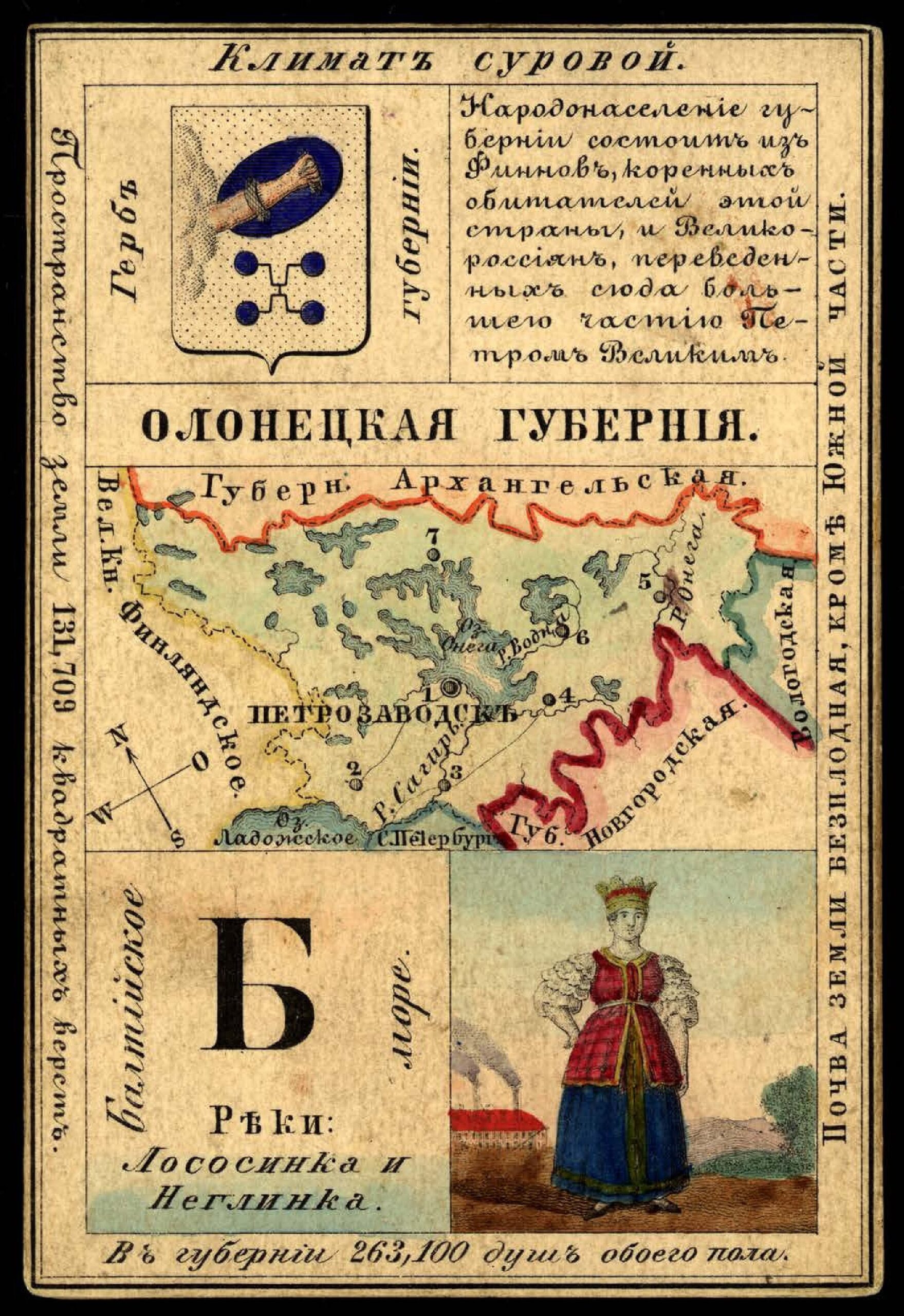
Olonets Governorate was an administrative division of the Russian Empire in the northwest, covering 114,930 km² of the Karelia region and bordering Arkhangelsk, Novgorod, St. Petersburg, and Vologda Governorates, as well as Finland. Formally established on 9 September 1801 by Emperor Alexander I, it survived until the collapse of the imperial order in the early twentieth century, with Petrozavodsk as its capital throughout that period. Its recorded population stood at 364,156, spread across a landscape so thinly settled that as of January 1, 1896, only 25,882 of its then 376,102 inhabitants lived in towns; the rest were distributed across approximately 5,022 villages. The governorate is considered the historical predecessor of the present-day Republic of Karelia, though its boundaries differed from the modern administrative unit.
Key facts
- Country: Russian Empire
- Type: governorate; Governorates and Oblasts of Russian Empire in 1914; governorate of the Russian Empire
- Coordinates: 61.7833, 34.3500
- Population: 364,156
- Area: 114,930 km²
- Founded: 9 September 1801
Administrative History
The territory’s distinct administrative life began in 1776, when Olonets uezd became a province within the Novgorod Viceroyalty. In 1784 the capital was moved from the town of Olonets to Petrozavodsk, a shift that proved permanent. The viceroyalty structure did not last: Emperor Paul I abolished the Olonets Viceroyalty in 1796 and folded its lands into Novgorod. That arrangement lasted only five years. Emperor Alexander I restored governorate status on 9 September 1801, with Petrozavodsk retaining the role it had held since 1784.
Although the governorate’s external boundaries overlapped substantially with what is now the Republic of Karelia, they were not identical. Some territories within the governorate now fall within the Vologda and Arkhangelsk regions, and the governorate did not include a coastline on the White Sea.
Geography and Waterways
At 114,930 km², the governorate occupied a substantial portion of northwestern European Russia. Its rivers drained to two separate sea basins: some fed the Baltic Sea, others the White Sea, placing the governorate across a continental hydrological divide. The navigable waterways included the Vidlitsa, Svir, Oyaty, Vytegra, Onega, and Vyg rivers, which gave the region its primary arteries for movement and trade.
Lake Onega, one of the largest lakes in Europe, lay within the governorate’s territory. Kizhi Island, situated on that lake, is home to Kizhi Pogost, a complex of wooden architecture that has been a UNESCO World Heritage Site since 1990.
Population and Settlement
The governorate was among the most sparsely populated in European Russia. As of January 1, 1896, its population of 376,102 was distributed across seven towns and roughly 5,022 villages. Fewer than 7 percent of inhabitants lived in any of those towns, meaning the overwhelming majority of residents were rural. The seven administrative towns held a combined population of only 25,882.
The governorate also had a notable economic character despite its sparse settlement. Pearls were found in the Onega River, and the region supported ironworks supplied by locally produced iron ore and bog iron, marking it as an early industrial area relative to its population size.
Petrozavodsk and the Museum of Local Lore
As the capital from 1784 onward, Petrozavodsk was the administrative, cultural, and economic center of the governorate. The Museum of Local Lore in Petrozavodsk was founded in 1871 by governor G. G. Grigoriev and is housed in the former governor’s house, a building constructed in the late eighteenth century. The museum covers Karelian culture and history.
Kizhi Pogost
Within the governorate’s former territory on Kizhi Island in Lake Onega stands Kizhi Pogost, a complex whose centrepiece is the Church of the Transfiguration, completed in 1714 with 22 domes. The complex became a UNESCO World Heritage Site in 1990. A restoration of the Church of the Transfiguration was completed by 2021, drawing renewed international attention to the site.
The church’s construction has attracted considerable scholarly and popular interest. According to legend, a master carpenter named Nestor built the structure without a single nail, using only an axe, though the historical documentation of that claim is traditional rather than archival.
Did you know
- The Church of the Transfiguration at Kizhi Pogost, on Lake Onega within the former governorate’s territory, was completed in 1714 with 22 cupolas. According to legend, a master carpenter named Nestor built the entire structure using only an axe, without a single nail. (gallerybyzantium.com)
- As of 1896, Olonets Governorate had the second-lowest population density of all gubernias in European Russia, at just 3.2 inhabitants per square verst. Only the vast Archangel Gubernia was more sparsely settled. (heninen.net)
- Pearls were found in the Onega River within Olonets Governorate. The region’s ironworks drew on locally produced iron ore and bog iron, making it a notable early industrial centre despite a population that ranked among the thinnest in European Russia. (zum.de)
Data sources
Data updated: 2026-10-31