
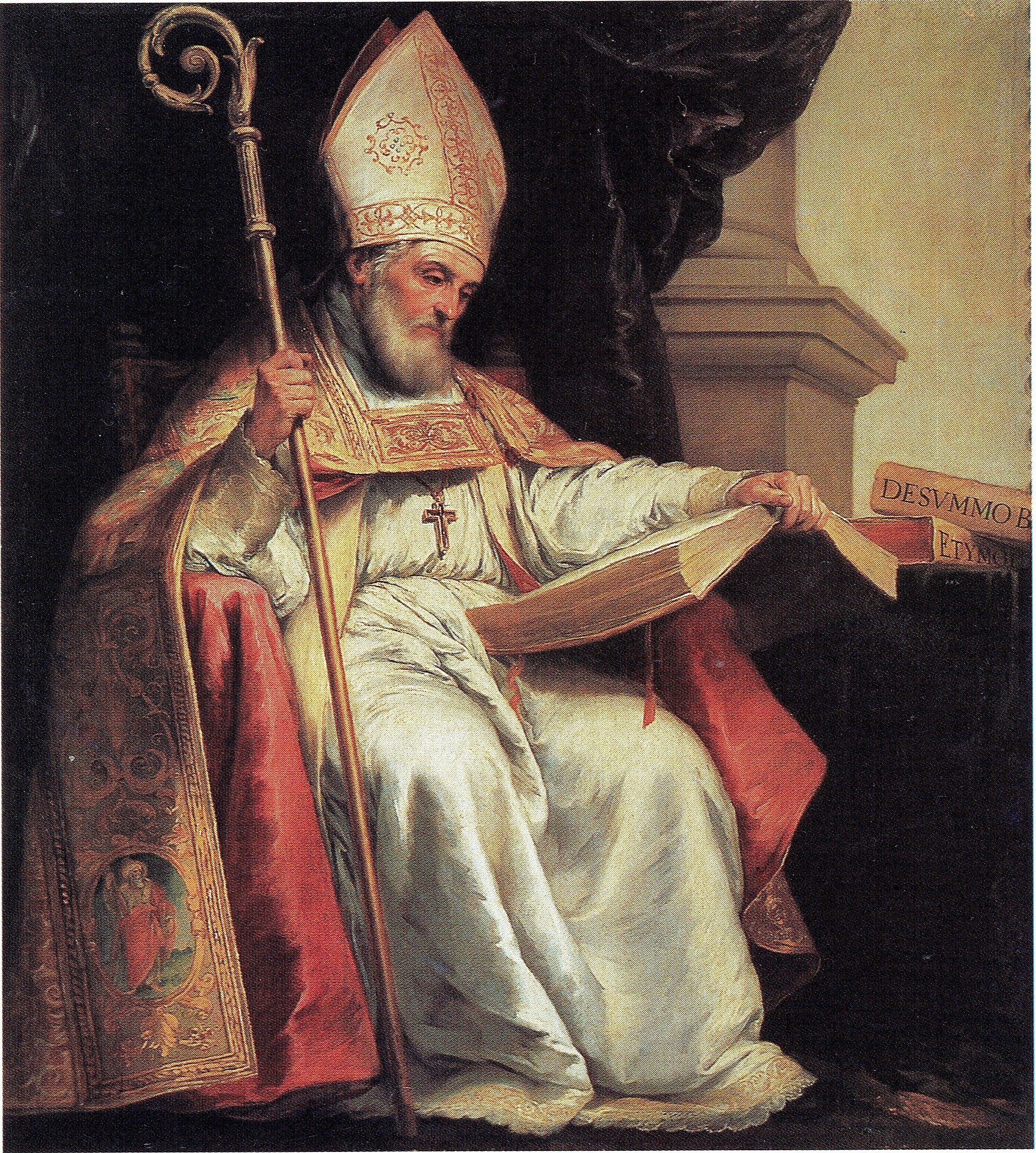
Isidore of Seville was a Hispano-Roman scholar, theologian and bishop who lived from around 560 to 636. He served as Archbishop of Seville for more than 30 years and guided the Visigothic monarchy of Spain in its conversion to Catholicism, continuing work begun by his brother Leander. Isidore is best known for the Etymologiae, also called the Origines, a work organized into 20 books covering subjects from theology to furniture, compiled at the urging of his friend Braulio, Bishop of Saragossa. He died in Seville on 4 April 636, leaving the Etymologiae unfinished.
Key facts
- Born: 560
- Birthplace: Cartagena
- Died: 4 April 636
- Place of death: Spalis
- Country: Kingdom of Toledo
- Occupation: writer; musicologist; philosopher; music theorist
Family and early life
Isidore was born around 560 in Cartagena. His family relocated from Cartagena to Seville to escape a Byzantine invasion, and his parents died when he was young, leaving him in the care of his elder brother Leander. Leander, who preceded Isidore as Archbishop of Seville, became abbot of a monastery school in Seville where Isidore was raised and educated.
Isidore had two other notable siblings: Fulgentius, who became bishop of Ecija, and Florentina, a distinguished abbess.
Archbishop of Seville
Isidore succeeded his brother Leander as Archbishop of Seville and held the position for more than 30 years. In that role he continued Leander’s work in guiding the Visigothic monarchy of Spain toward Catholicism. Isidore died in Seville on 4 April 636, within the Kingdom of Toledo.
The Etymologiae and other writings
At the urging of his friend Braulio, Bishop of Saragossa, Isidore compiled the Etymologiae, organized into 20 books ranging across theology to furniture. He drew heavily on earlier writers such as Aristotle and Pliny for the material in his encyclopedic entries. The work was left unfinished at his death in 636, yet it went on to become one of the most cited books in medieval Europe apart from the Bible.
Braulio, who encouraged Isidore to write the Etymologiae, listed over a dozen major works Isidore produced in his lifetime. Among them were the Chronica, a history of the world from creation to his own time, and the Sententiae, a treatise on Christian morals based chiefly on Gregory the Great’s Moralia. Isidore also wrote a book of astronomy and natural history titled De Rerum Natura, and a History of the Goths, Vandals and Suebi that is regarded today as more critically reliable than some of his other works.
Because of the breadth of his learning, Isidore has often been called the last scholar of the ancient world.
Veneration
Isidore’s feast day is celebrated on 4 April, the date of his death in 636. He is venerated as patron saint of Madrid and of farmers, invoked for protection against drought, locusts and earthquakes.
Did you know
- A stylized world map based on the Etymologiae, known as the T-O map, was printed in Augsburg in 1472, centuries after Isidore’s death. (newworldencyclopedia.org)
- Isidore claimed wine (Latin vinum) was so named because it refreshes the veins (vena) with blood, an example of his often fanciful word origins. (worldhistory.org)
- Isidore explained that “oppidum” (town) derived from “opposite,” reasoning that towns have walls facing each other, an etymology modern scholars reject in favor of a link to “pedem” (foot). (goodreads.com)
- Isidore is said to have been the first saint depicted with a halo in a painting. (catholic365.com)
- Isidore was reportedly the first Christian writer to use the term “the Trinity” to describe that relationship within God. (catholic365.com)
- In 1997, during the papacy of John Paul II, Isidore was proposed as a patron for Catholics using the internet, a modern echo of his ancient encyclopedic project. (ancient-origins.net)
Data sources
- Wikidata
- worldhistory.org
- catholicireland.net
- ancient-origins.net
- newworldencyclopedia.org
- bestiary.ca
- catholic365.com
- goodreads.com
Where it appears
- Beaver, Fish, or Fraud: The Medieval Debate That Hunted a Species Out November 11, 2026
Data updated: 2026-11-08