
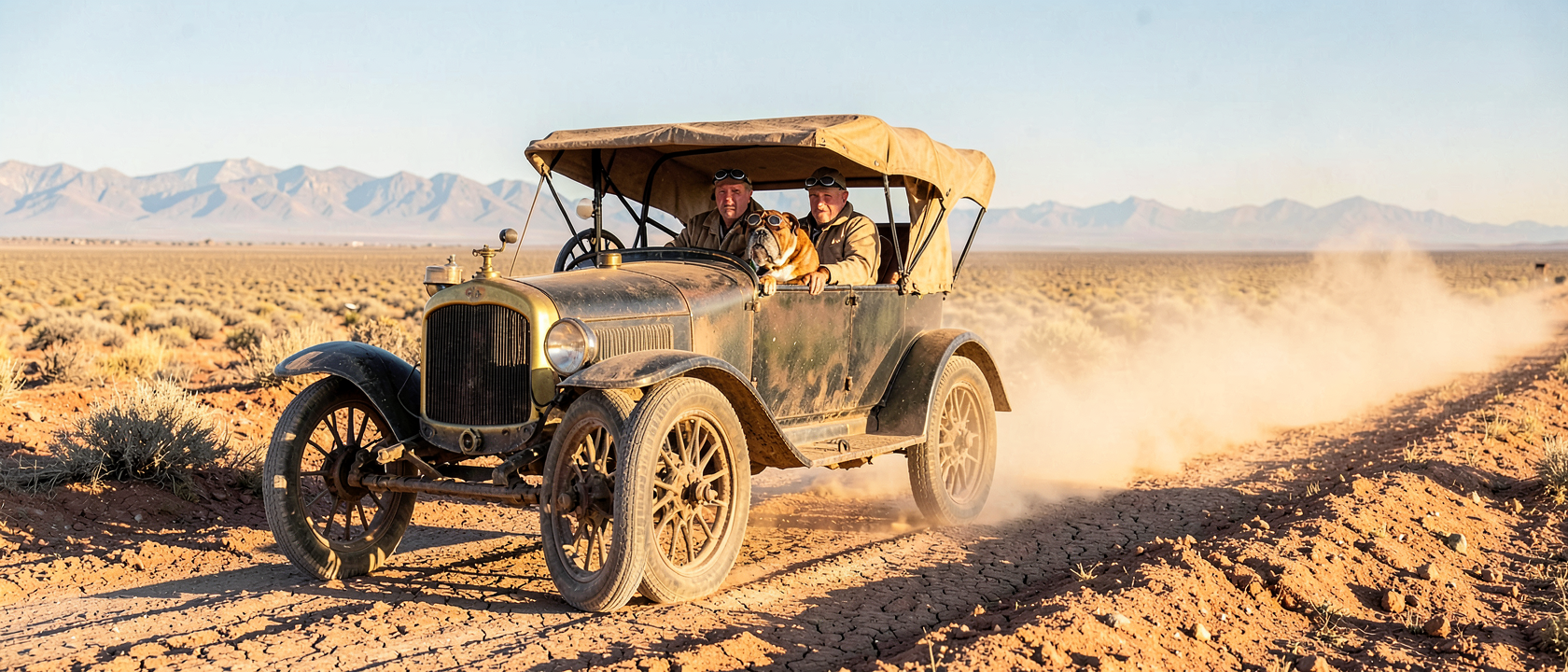
The $50 Bet in the University Club
In the spring of 1903, Horatio Nelson Jackson, a 31-year-old physician from Burlington, Vermont, arrived in San Francisco by train with his wife, Bertha. He owned no automobile and had barely driven one. On May 18, 1903, as a guest at the University Club, he found himself arguing that the “horseless carriage” was more than a passing novelty. The country then had roughly 32,920 registered cars, up from about 8,000 just three years before, and no one had ever driven one from coast to coast. Jackson put $50 on the other side of the argument: he would cross the United States by automobile. His wife went home by train. He did not.
Buying “The Vermont”
Jackson had no car and no route. He hired Sewall K. Crocker, a bicycle racer turned mechanic, to drive and keep the machine running, and on Crocker’s advice bought a secondhand 1903 Winton, a two-cylinder car rated at 20 horsepower. Jackson named it the Vermont. West of the Mississippi there were no road maps worth trusting, no proven route through the mountains or deserts, and no garages to call if the car broke down. A serious failure out there would have left two men stranded with no way to send word to anyone. On May 23, 1903, they left San Francisco regardless.
Off Course, Off Food
Fifteen miles into the trip, a tire blew, and the men were down to their only spare before the day was out. In Caldwell, Idaho, Jackson bought a bulldog for $15 and fitted him with driving goggles to keep the dust out of his eyes. Bud, as they named him, drew crowds wherever the car stopped. On the road to Cheyenne, Wyoming, they lost their way and ran short of money, going 36 hours without food. The route itself was less a road than a patchwork of wagon trails, riverbeds, mountain passes, and stretches where they simply followed the Union Pacific tracks north, swinging up toward Oregon to avoid the worst of the desert and the high passes.
Pavement, at Last
By late June, Jackson and Crocker had crossed the Mississippi into paved roads, and for the first time since San Francisco, driving stopped being an improvisation. On July 26, 1903, they rolled into New York City, 63 days after leaving the West Coast, the figure most often cited by historians. The Smithsonian’s own museum page gives 64 days, counting the stretches spent waiting on parts or hoisting the car over a gully. Either count made them the first people to drive across the country.
The Bill: $8,000 for a $50 Bet
Jackson covered everything out of his own pocket: the car, hotel rooms, repairs, food, and gasoline, which most accounts put at 800 gallons (3,028 liters), though some sources say closer to 600 gallons (2,271 liters). The total ran to about $8,000, an estimated $260,000 in 2022 dollars. He never collected the $50. The trip inspired two rival teams who turned the journey into a race within weeks; within a decade there were already plans for a coast-to-coast highway. Jackson’s 63 days stopped being remarkable almost as soon as he had finished them, as later crossings chipped away at his time.
What Was Left Behind
The Winton eventually went to the Smithsonian Institution, credited as a gift from “Col. H. Nelson Jackson,” and it remains in the collection of the National Museum of American History; the exact year of the donation is not confirmed in the museum’s own records. Jackson died on January 14, 1955, at age 82, having served as an Army Medical Corps colonel in World War I, where he was wounded in the Meuse-Argonne and decorated with the Distinguished Service Cross. He went on to run a newspaper and a bank in Burlington and helped organize the American Legion. On October 6, 2003, Ken Burns released a documentary on the trip, Horatio’s Drive, with Tom Hanks voicing Jackson. Crossing the country by car, a question nobody could answer in the spring of 1903, had become ordinary enough within a generation that people would later retrace the route simply for the sake of doing it. Jackson settled the question for $50 he never collected, and the country spent the rest of the century proving he was right to bet on it.