
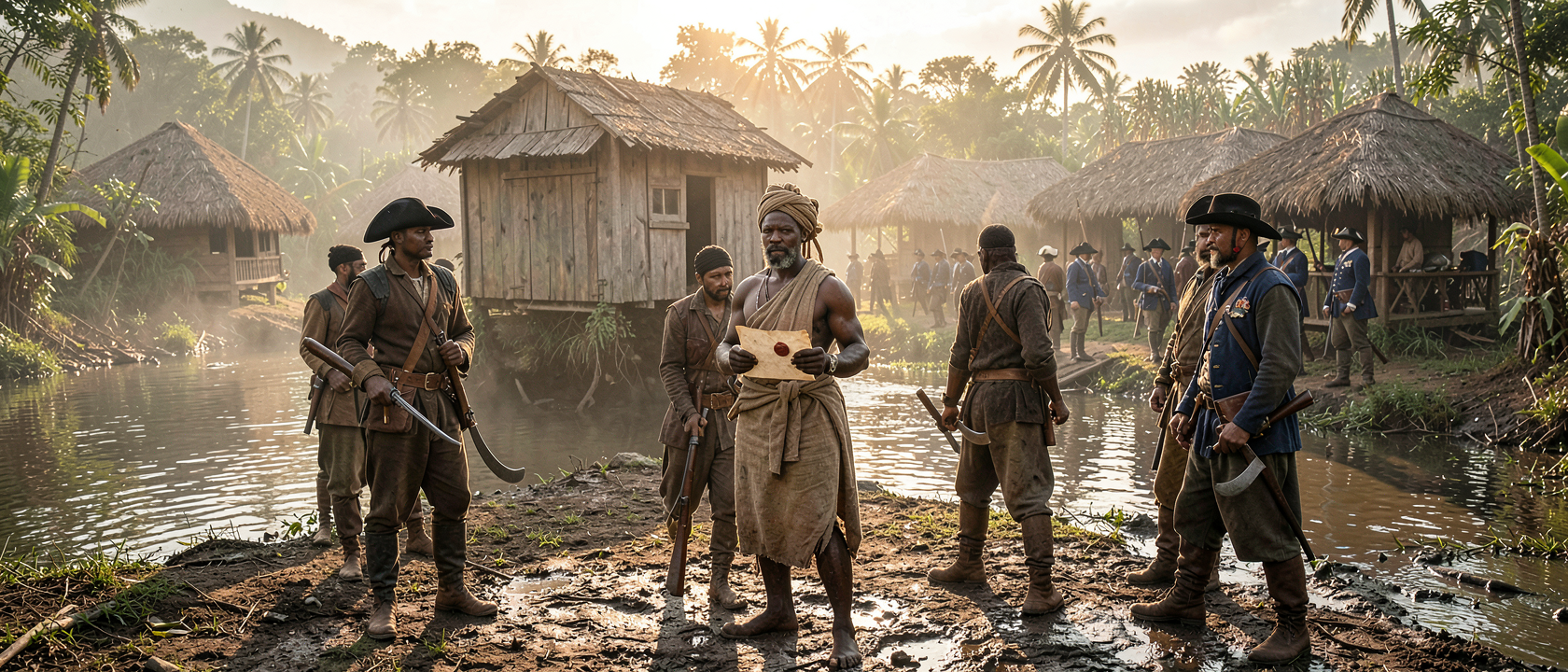
The Siege at Fort Nassau
Berbice, in 1763, was a Dutch plantation colony strung along two rivers, the Berbice and the Canje, in what is now Guyana. Enslaved Africans grew and cut the sugar and coffee that moved down those rivers to the Atlantic.
On February 23, 1763, enslaved workers on the Magdalenenberg plantation, on the Canje River, rose against their overseers. A second uprising followed four days later, on February 27, at Hollandia, next to the Lilienburg plantation on the Berbice River, where an enslaved house servant named Cuffy worked for a cooper, a barrel maker. The revolt spread from estate to estate. Within weeks, Cuffy had been accepted as its leader and had begun calling himself Governor of Berbice.
By the time his forces pushed up the Berbice River toward the colonial capital, Fort Nassau, estimates of his following ranged from 2,500 to 3,800 men. Behind the fort’s walls stood Governor Wolfert Simon van Hoogenheim, commanding a colony whose entire European population numbered only a few hundred. The fort held. For the moment, that was all either side could claim.
Ten to One
Berbice’s European population came to somewhere between 340 and 350 colonists. Its enslaved population numbered 4,000 to 5,000, a ratio close to ten to one. The same imbalance held in Suriname, Demerara, and the British colonies nearby, which is part of why van Hoogenheim was not only defending one fort.
At the same time, van Hoogenheim pursued reinforcements through other channels. He asked the Society of Berbice, the Amsterdam merchants who owned the colony, for troops; they committed only 50 soldiers. He then appealed directly to the States General, the Dutch government, for more. A rebellion that succeeded in a colony run on these numbers was a risk neither he nor his neighbors could treat lightly.
The Correspondence
On April 2, 1763, Cuffy sent van Hoogenheim a letter. He wrote that he did not want war with the Dutch, and proposed dividing the colony: the Dutch would keep the coast, and the formerly enslaved would hold the interior.
Van Hoogenheim answered that the decision was not his to make alone. He would have to refer it to the Society of Berbice, he wrote, and that would take three to four months. The claim was partly true: Berbice was run as a company colony, and such questions did go through Amsterdam. It also bought him exactly the time he needed.
For roughly two to three months, into the summer, letters kept crossing between the fort and the rebel camp. Cuffy’s proposal stayed on the table. Van Hoogenheim’s answer never firmly arrived. The 50 soldiers the Society of Berbice had promised were making their way to Berbice, and by one account, roughly 100 British soldiers and supplies reached him as well. Every week without a reply was a week the colony’s defenses grew. Cuffy’s did not.
The Vote That Removed Cuffy
Not every rebel commander agreed with sending letters. Akara, one of Cuffy’s captains, had already attacked Dutch positions on his own, more than once, without asking Cuffy first. Behind the dispute was a real question: whether the Dutch, now visibly rebuilding their strength, should be negotiated with at all.
Akara’s faction moved against Cuffy and won. Cuffy lost command of the army he had built and took his own life. On October 19, 1763, word reached van Hoogenheim that Captain Atta had turned against Cuffy and that Cuffy was dead.
Command now belonged to Akara and Atta, and they chose force over letters, attacking a Dutch position that was no longer the one Cuffy’s first letter had found in April. The attack failed. By then the rebellion’s strength was ebbing on more than one front: Dutch reinforcements had arrived, and rebel supplies, including gunpowder, were running low.
What Is Not Known
Much of this story is firmer than the correspondence it rests on. The exact number of letters Cuffy and van Hoogenheim exchanged, and the full content of each, is not preserved; historians work from what survived, not a complete file. The precise timing of Cuffy’s fall from command and his death is not settled either; the October 19 report only marks when the news reached the governor, not necessarily the day it happened. And the belief that Cuffy envisioned an independent African nation in Berbice, rather than simply a divided colony, rests partly on later commemoration as much as on anything recorded from him at the time.
The Bill
At the end of 1763, van Hoogenheim had already drawn up a rebuilding plan for the colony: stronger forts, 400 soldiers, and financial support for planters. By early 1764, with that plan underway, the uprising that had held Berbice for about ten months was over. The rebellion is formally dated as lasting until April 15, 1764.
Dutch authorities carried out mass executions. By one account, 40 captured rebels were hanged, 24 were broken on the wheel, and 24 were burned to death. Cuffy did not live to see it. He had already died by his own hand, months earlier, after losing command of the fighters he had led.
What the Name Became
Berbice later passed into British hands, combined with neighboring colonies into what would become Guyana. Guyana became independent in 1966.
On February 23, 1970, chosen because it was the date the rebellion had begun, Guyana declared Cuffy its first national hero. A bronze statue of him, 15 feet (4.6 meters) tall and designed by Guyanese sculptor Philip Moore, was unveiled in Georgetown’s Square of the Revolution on May 23, 1976, Guyana’s tenth anniversary of independence, by the country’s leader at the time, Forbes Burnham.
The uprising itself is what endures in memory, now folded into February 23 as a day of national meaning. Less remembered is the stretch of months in between, when Cuffy kept writing letters and van Hoogenheim kept finding reasons not to answer them, until the soldiers he had been waiting for arrived by ship.