
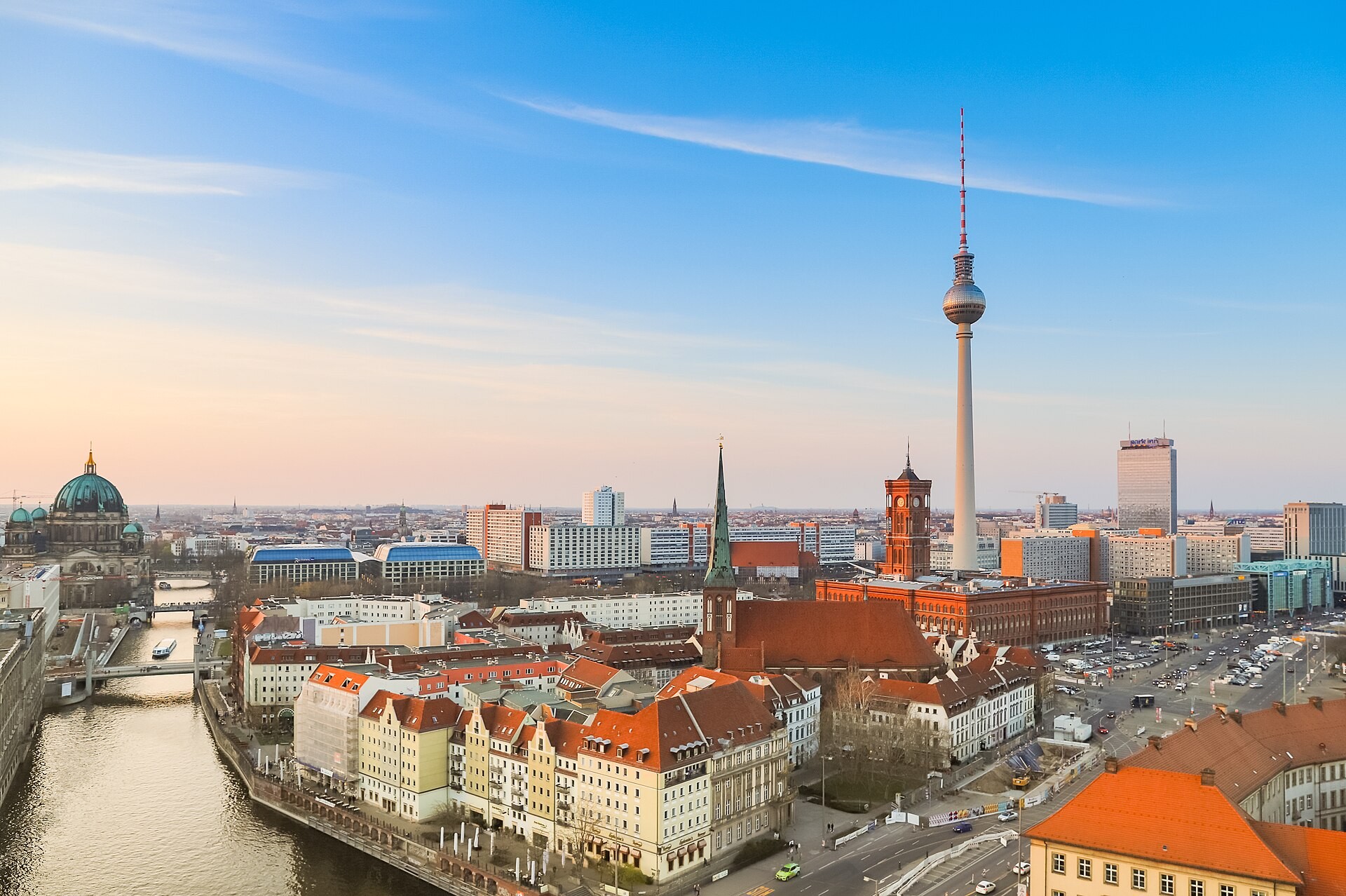
Germany is a federal parliamentary republic in Central Europe, bordering the Baltic Sea and the North Sea, between the Netherlands and Poland, south of Denmark. It covers 357,588 square kilometres and counts 83,467,117 people, making it Europe’s second most populous nation after Russia and its largest economy. Berlin is the capital, German the official language, and the euro the currency. The modern state traces its founding to 23 May 1949, and its current head of state is Frank-Walter Steinmeier.
Key facts
- Capital: Berlin; Berlin
- Continent: Europe
- Population: 83,467,117
- Area: 357,588 km²
- Official language: German
- Currency: euro
- Head of state: Frank-Walter Steinmeier
- ISO code: DE
- Founded: 23 May 1949
Geography and climate
Germany shares land borders with nine countries, among them Austria (801 km), Czechia (704 km), France (418 km), Poland (447 km) and Switzerland (348 km). Its major rivers, the Rhine, Weser, Oder and Elbe, flow northward, while the Danube, which rises in the Black Forest, flows eastward. The climate is temperate and marine, bringing cool, cloudy, wet winters and summers along with an occasional warm mountain foehn wind. Natural resources include coal, lignite, natural gas, iron ore, copper, nickel, uranium, potash, salt, construction materials, timber and arable land.
Besides German, the state recognizes Danish, Frisian, Sorbian and Romani as official minority languages, and Low German and others as regional languages under the European Charter for Regional or Minority Languages.
Reunification and the path to Berlin
East Germany held its first free parliamentary elections on 18 March 1990, producing a clear majority for the Alliance for Germany. The unification treaty between East and West Germany, running to more than 1,000 pages, was approved by large majorities in both the Bundestag and the Volkskammer on 20 September 1990. On 20 June 1991, the Bundestag voted by just 338 to 320 to move parliament and government from Bonn to Berlin, though the move itself did not take place until 1999, nearly a decade after reunification.
Government
Germany is a federal parliamentary republic. Friedrich Merz was elected Chancellor by the Bundestag in a second ballot on 6 May 2025, succeeding Olaf Scholz. His government is a coalition of the CDU/CSU bloc and the center-left Social Democrats, formed after CDU/CSU won the February 2025 election with 28.5% of the vote while the far-right AfD came second. Lars Klingbeil of the SPD serves as Vice Chancellor and Finance Minister.
Economy
Germany is a leading diversified, export-driven economy and a core member of the EU and the eurozone, with key industries in automotive manufacturing, chemicals, engineering, finance and green energy. As of a 2023 estimate, the economy faced disruptions tied to the cessation of Russian gas supplies, alongside rising defense spending and increased debt.
World Heritage and culture
Germany was among the first countries to list sites on the UNESCO World Heritage List, with Aachen Cathedral its only entry when the list was established in 1978 among twelve sites worldwide. As of 2026, Germany has 55 UNESCO World Heritage Sites, 52 cultural and 3 natural, placing it third worldwide after Italy and China. Classical Weimar, including Goethe’s residence and the Duchess Anna Amalia Library, has been on the list since 1998. Germany is also represented by 28 entries in UNESCO’s Memory of the World documentary heritage register, including the Gutenberg Bible, Goethe’s literary estate and Beethoven’s Ninth Symphony.
Standing in Europe
As a key member of continental organizations, Germany sits at the center of Europe’s economic, political and defense institutions, holding the position of Europe’s largest economy and second most populous nation after Russia.
Did you know
- The unification treaty between East and West Germany ran to more than 1,000 pages and was approved by large majorities in the Bundestag and the Volkskammer on September 20, 1990. (germanculture.com.ua)
- The decision to move Germany’s parliament and government from Bonn to Berlin was approved by just 338 votes to 320 on June 20, 1991. (thelocal.de)
- Former Chancellor Angela Merkel worked for the last East German government until October 3, 1990. (thelocal.de)
- The Bundestag and Chancellery only actually moved from Bonn to Berlin in 1999, nearly a decade after reunification. (thelocal.de)
- Friedrich Merz was elected Germany’s 10th chancellor since World War II when the Bundestag met on May 6, 2025. (globalnews.ca)
- Merz’s governing coalition held a relatively modest majority of 328 of the Bundestag’s 630 seats. (globalnews.ca)
- The Zeche Zollverein coal mine in Essen, a UNESCO World Heritage site since 2001, was once the largest coal-producing mine in the world. (deutschland.de)
Data sources
Where it appears
- HMHS Llandovery Castle and the 1921 trials that let her killers go free November 17, 2026
Data updated: 2026-11-12