
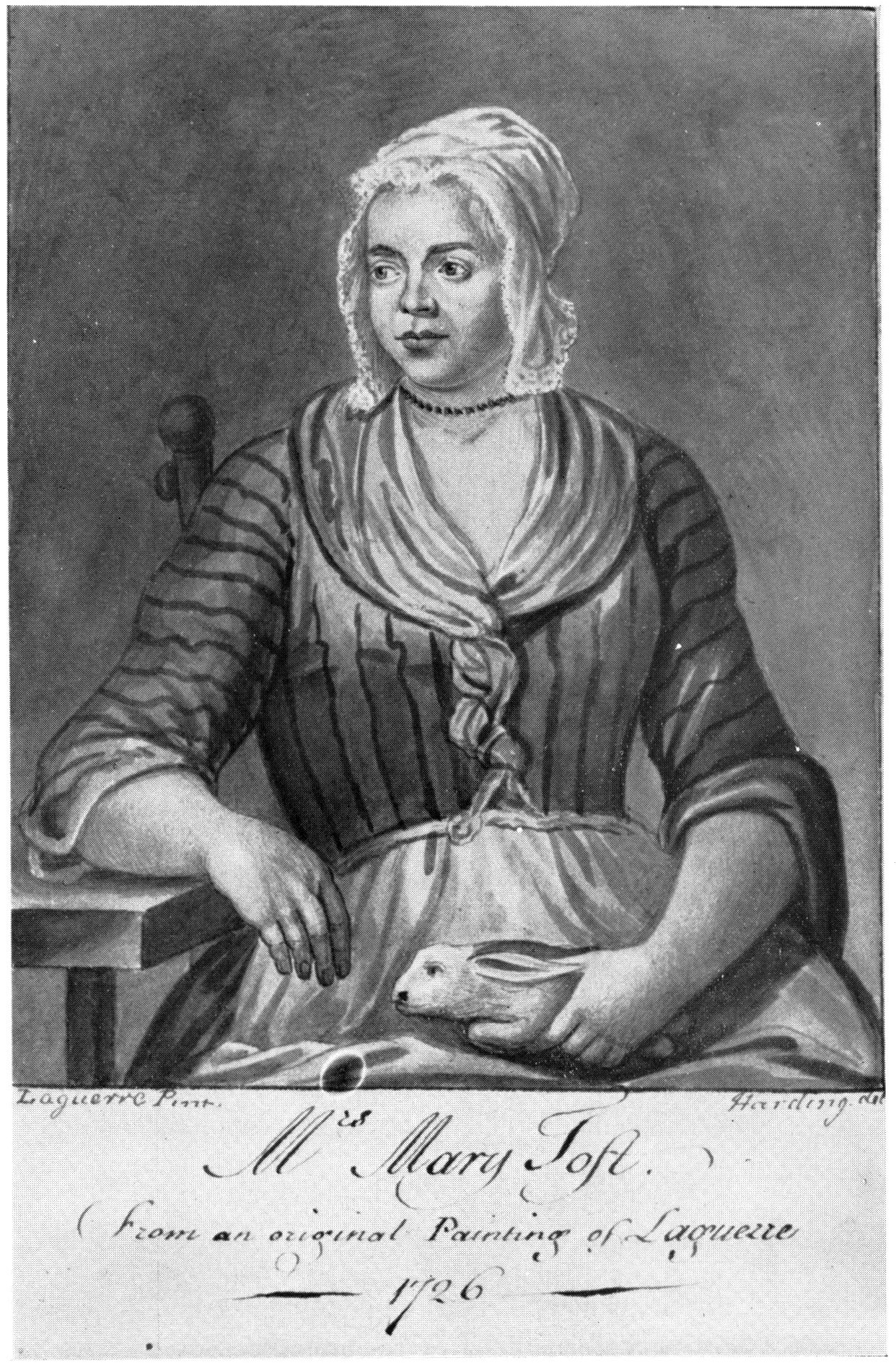
Mary Toft was an English woman from Godalming who, in 1726, convinced a string of physicians and surgeons that she was giving birth to rabbits. Born on 21 February 1703, she was 25 years old and illiterate when the hoax began. Her case drew in surgeon John Howard, royal anatomist Nathaniel St André, and eventually King George I’s household, before a porter was caught smuggling a rabbit into her room and she confessed, on 7 December 1726, to having inserted the animals herself. She died in Godalming in 1763.
Key facts
- Born: 21 February 1703
- Birthplace: Godalming
- Died: 1763
- Place of death: Godalming
The deliveries in Guildford
Toft suffered a miscarriage in August 1726. She later said that in April 1726, while working in a field, she had been startled by a rabbit, and used this to explain what followed. Local Guildford surgeon and man-midwife John Howard was called in to investigate and attended her deliveries. At the height of the hoax she was reportedly delivering a rabbit at a rate of one a day.
On 15 November 1726, St André and Samuel Molyneux, secretary to the Prince of Wales, arrived at Howard’s house in Guildford, where Toft delivered a rabbit’s torso within hours. St André concluded that the rabbits had been bred in her Fallopian tubes and published his findings. Ahlers, another physician brought in to examine her, reported to the king on 21 November 1726 that he suspected a hoax involving collusion between Toft and Howard.
Exposure in London
Toft was taken to Lacy’s Bagnio, a bathhouse in Leicester Fields, London, arriving on 29 November 1726 for closer observation. Despite mounting doubts, St André published A Short Narrative of an Extraordinary Delivery of Rabbets on 3 December 1726, defending her claims. The following day, on 4 December 1726, a porter was caught smuggling a rabbit into her room at the bagnio, exposing the trick.
Toft had been attended in total by at least six different doctors, some members of the Royal College of Physicians or attached to the royal court. On 7 December 1726 she confessed that she had manually inserted dead rabbits and animal parts into her body. Her sister-in-law Margaret Toft later said the idea for the hoax came from a tale of a Sooterkin monster-birth in John Maubray’s book The Female Physician. In her various confessions, Toft implicated a mysterious stranger, the wife of an organ grinder, her mother-in-law Ann Toft, and John Howard as accomplices.
Aftermath
Following her confession, Toft was arrested for being a Notorious and Vile Cheat and imprisoned in Bridewell prison. She was eventually released without charge, as it was unclear what offense could be prosecuted, and returned home. Surgeon John Howard was fined 800 pounds, equivalent to roughly 107,000 pounds in modern terms, over his role in the affair. He returned to practice in Surrey and died in 1755.
Nathaniel St André lost favor with the court, lost his position in the royal household, and his patients deserted him as his reputation plummeted. Satirist William Hogarth lampooned the affair in a 1726 print titled Cunicularii, depicting Toft duping assembled surgeons and physicians. Five months after the hoax was exposed, physician James Blondel published The Strength of Imagination in Pregnant Women Examin’d, challenging the belief in maternal imagination affecting fetal development. The hoax had exploited an 18th-century medical belief that a pregnant woman’s emotional experiences and imagination could physically alter her unborn child.
Did you know
- According to her attending doctor, Mary Toft reportedly delivered as many as seventeen rabbits in total over the course of the hoax. (daily.jstor.org)
- By the time St André and Molyneux arrived in Guildford on 15 November 1726, Toft had already supposedly given birth to her fifteenth rabbit. (historicmysteries.com)
- Toft was lodged at Lacy’s Bagnio, a bathhouse in Leicester Fields near modern-day Leicester Square, for her final examinations in London. (ianvisits.co.uk)
- The episode inspired a satirical twelve-stanza illustrated poem, The Doctors in Labour; or a new Whim Wham from Guildford, published in 1726. (publicdomainreview.org)
- Later historical analysis notes that, with no antisepsis or anesthesia available in the 18th century, Toft underwent extremely painful procedures to sustain the hoax. (juliamartins.co.uk)
Data sources
Where it appears
Data updated: 2026-11-13