
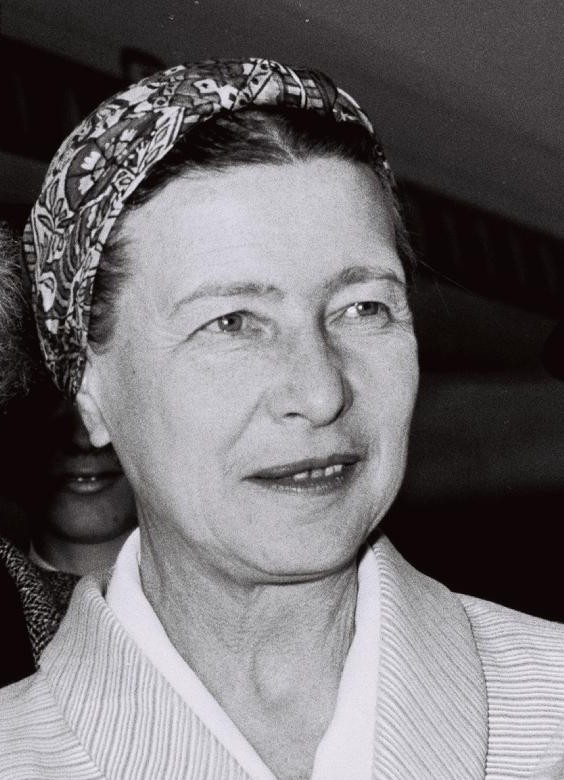
Simone de Beauvoir was a French philosopher, social theorist and activist, born on 9 January 1908 in the 6th arrondissement of Paris and dead on 14 April 1986 in the 14th arrondissement of the same city. She wrote across philosophy, essay, autobiography and the novel, and is best known for The Second Sex, published in two volumes in 1949, “Facts and Myths” and “Lived Experience.” The book argued that one is not born a woman but becomes one through societal conditioning, a claim built on interviews with dozens of women combined with existentialist philosophy. It has since been translated into more than 40 languages. Beauvoir studied at the Lycée Fénelon in Paris, the Catholic University of Paris, the Sorbonne and the University of Paris, and received the Prix Goncourt, the Jerusalem Prize, the Austrian State Prize for European Literature and an honorary doctorate from Concordia University.
Key facts
- Born: 9 January 1908
- Birthplace: 6th arrondissement of Paris
- Died: 14 April 1986
- Place of death: 14th arrondissement of Paris
- Country: France
- Occupation: political philosopher; journalist; novelist; autobiographer
- Field: philosophy; essay; autobiography; novel
- Education: University of Paris; Lycée Fénelon, Paris; Sorbonne; Catholic University of Paris
- Awards: Prix Goncourt; Jerusalem Prize; Austrian State Prize for European Literature; honorary doctorate of Concordia University
Education and partnership with Sartre
Beauvoir trained in philosophy at the Lycée Fénelon in Paris, the Catholic University of Paris, the Sorbonne and the University of Paris, moving through institutions that together formed her grounding in philosophy as a field and in the essay as a form. At 21 she met Jean-Paul Sartre, which began a lifelong intellectual and romantic partnership that shaped both their public lives and their writing. The two remained linked in work and in life until her death, and she was later buried beside him.
The Second Sex
Le Deuxième Sexe appeared in 1949 in two volumes. It examined women’s historical and social status and argued that womanhood is produced by social conditioning rather than given at birth. Beauvoir based the work on interviews with dozens of women, fused with existentialist philosophy, to build a theory of sex and gender.
The book provoked immediate hostility: the Vatican placed it on its List of Prohibited Books over its attack on traditional marriage roles and what it judged explicit content. The English translation appeared in 1959 and was retranslated in 2009. Over 40 languages have carried the text since, and it continues to inform feminist thought and gender studies as both a philosophical and a political work.
Critics have also debated parts of the book. Some have argued Beauvoir depicted pregnancy and motherhood mainly as burdens rather than as varied experiences, and later queer theorists have read her treatment of lesbianism as marginalizing or pathologizing it. For decades, some critics also dismissed her as a thinker who merely applied Sartre’s ideas, a reading that the book’s later influence on feminist and gender studies has complicated.
Nelson Algren and The Mandarins
In 1947 Beauvoir traveled to the United States and met the Chicago novelist Nelson Algren at the Palmer House hotel, starting an affair. Before she returned to France, Algren gave her a ring, and she wore it for the rest of her life. Her novel The Mandarins was dedicated to him, and she later wrote in her memoirs that its character Lewis Brogan was based on him. The affair ran alongside her partnership with Sartre, and in her own writing about it Algren held a place of lasting importance to her.
Death and burial
Beauvoir died at age 78 of pneumonia at Cochin Hospital in Paris on 14 April 1986. A crowd of 5,000 admirers accompanied her coffin to Montparnasse Cemetery, where she was buried next to Sartre, wearing the ring Algren had given her decades before. Her occupations as political philosopher, journalist, novelist and autobiographer, and her standing in philosophy, essay, autobiography and the novel, were recognized through the Prix Goncourt, the Jerusalem Prize, the Austrian State Prize for European Literature and an honorary doctorate from Concordia University.
Did you know
- In various personal writings, Nelson Algren appears to occupy the place of an “essential love” for Beauvoir even more than Sartre did. (plato.stanford.edu)
- Algren was introduced to Beauvoir by his friend Studs Terkel, who in 1960 interviewed her about her upbringing and influences as an existentialist writer. (chicagohistory.org)
- Beauvoir denied that The Mandarins was a “roman a clef,” even though the character of Nadine was apparently based on her own young female lover at the time. (anokatony.blog)
- Algren disliked The Mandarins despite having inspired its male protagonist. (historynet.com)
- Nelson Algren’s own novel A Walk on the Wild Side later inspired the Lou Reed song of the same title. (spectator.com.au)
- Beauvoir’s grave lies only a stone’s throw from where she had lived in Paris. (spectator.com.au)
Data sources
Data updated: 2026-11-19