
The Relay in the Canvas Tepee
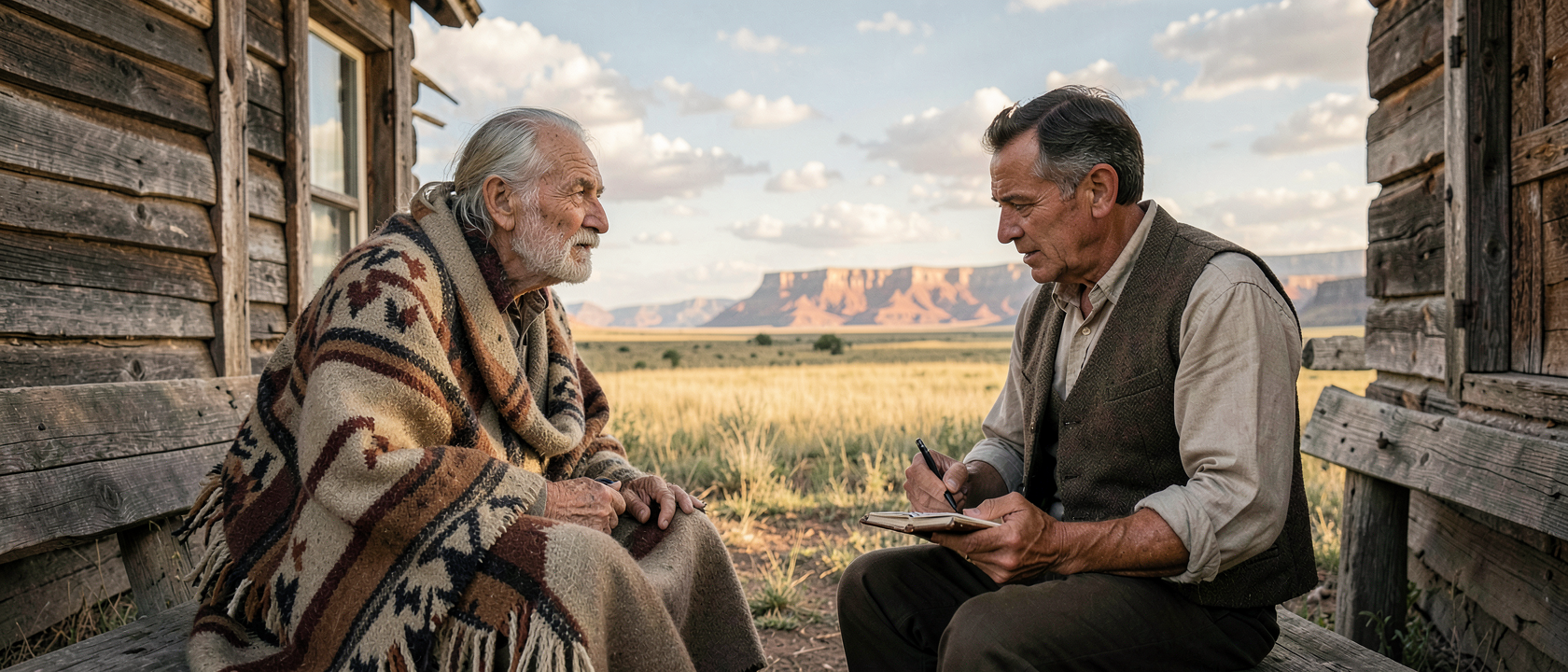
In May 1931, a canvas tepee stood near the small community of Manderson, on South Dakota’s Pine Ridge Reservation. Inside it sat Black Elk, an Oglala Lakota holy man (wičháša wakȟáŋ in Lakota), then sixty-seven years old. For roughly fourteen days he spoke his life story in Lakota. His son, Ben Black Elk, translated each sentence into English as it came. Beside Ben sat Enid Neihardt, twenty years old, the daughter of Nebraska’s poet laureate John Neihardt; she wrote down the translated words in shorthand as fast as they were spoken. Neihardt sat nearby, asking the questions and taking his own notes; he had promised to turn what Black Elk called his boyhood vision of the people’s survival into a published book.
The Price of Breaking Silence
Forty years earlier, on December 29, 1890, Black Elk had ridden toward Wounded Knee Creek as soldiers of the U.S. 7th Cavalry killed an estimated 250 to 300 Lakota men, women, and children, among them many from Spotted Elk’s band. He survived the massacre and spent the decades after it on a reservation where federal policy had pushed traditional ceremony underground. By 1904, Black Elk had been baptized Catholic and was serving as a catechist, instructing others in the faith. Agreeing, in 1931, to dictate the visionary core of his earlier life to a white poet carried real risk: it could draw open disapproval from missionaries and from Christian Lakota who saw the old rites as something better left buried. Black Elk took that risk anyway. He believed the vision he had received as a boy, of a sacred hoop that bound his people together, had not yet come to anything, and he wanted its promise recorded before he died.
The Poet’s Final Edit
Neihardt had first met Black Elk in August 1930, while gathering material at Pine Ridge for “Song of the Messiah,” the closing poem of his long project A Cycle of the West. He came back in May 1931 for the dictation itself. Writing the manuscript afterward for publication by William Morrow & Company in 1932, he reshaped what he had been given. Black Elk’s ongoing life as a Catholic catechist disappeared from the pages, along with the specific prayers in which he had asked the Great Spirit to let his nation live and flourish again. In their place, Neihardt wrote his own closing paragraph, ending the book at Wounded Knee with the line that “the nation’s hoop is broken and scattered” and “the tree is dead.” A man still active in his own community, decades past the massacre, was presented to readers as the last voice of a people already gone.
The Lost Layer of Translation
No audio recording of the 1931 sessions exists. What survives is Enid Neihardt’s handwritten shorthand of Ben Black Elk’s spoken English, the only trace of a chain that ran from Lakota to English to paper. That gap means it is impossible to separate what Ben smoothed or altered in translating his father’s words from what Neihardt rewrote afterward at his desk. Neihardt never hid that he had changed wording and added passages of his own; he argued that he was acting as a kind of literary medium, giving modern form to truths Black Elk could sense but could not phrase for an English-reading audience. Historians and linguists have disputed that defense ever since: it leaves the reader unable to know, sentence by sentence, whose voice is actually speaking.
The Ghost of a Manufactured Ending
Black Elk died on August 19, 1950, at eighty-six, without seeing his people’s continuing life acknowledged in the book that carried his name. A 1961 reissue turned Black Elk Speaks into a touchstone for the era’s search for Native spirituality, and it made Neihardt, who died on November 3, 1973, into a celebrated interpreter of Lakota belief. Only in 1985 did the gap become visible to the wider public, when anthropologist Raymond DeMallie published The Sixth Grandfather, setting the 1931 shorthand transcripts beside Neihardt’s 1932 text. The comparison showed that the transcripts recorded a man still asking that his nation’s circle be made whole again, prayers Neihardt had cut from the finished book. For more than fifty years, readers had mourned an ending that Black Elk himself never gave them.