
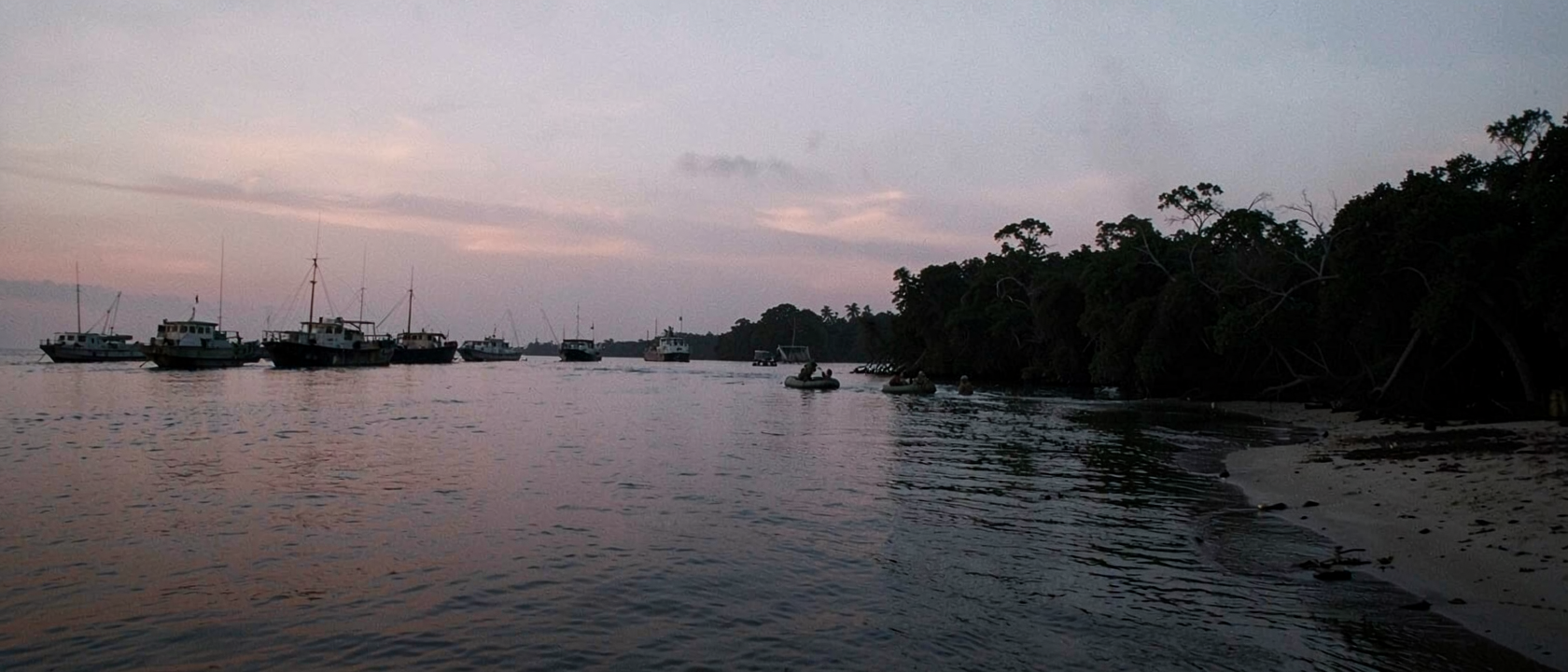
The Coastline They Came To
On the night of April 16–17, 1961, a flotilla of small boats and landing craft moved toward the southern coast of Cuba, making for the Bahía de Cochinos (Bay of Pigs), a marshy, remote inlet on the Zapata Peninsula. The men aboard were organized under the designation Brigade 2506, or Brigada Asalto 2506 in Spanish. Their total number is disputed, approximately 1,400 by the most common figure, closer to 1,474 when airborne elements are included. The great majority were Cuban exiles. A smaller contingent held US citizenship. All of them had been organized, trained in Guatemala, and transported under the direction of the Central Intelligence Agency, in an operation the CIA designated Operation Zapata.
The location had been chosen for its distance from Havana and its thin population. The method, a seaborne landing by an armed exile force, had been chosen for a different reason. Cuba had received armed expeditions from the sea before, repeatedly, across nearly a century of conflict. Those landings had, with remarkable consistency, achieved what they set out to achieve. The men of Brigade 2506 had every reason to expect this one would do the same.
Every Invader Before Them
In April 1895, forces aligned with José Julián Martí y Pérez came ashore on Cuba’s eastern coast. Martí, poet, journalist, and the figure most closely identified with Cuban nationalism, had organized the expedition to ignite a second war of independence against Spain. He was killed in battle on May 19, 1895, weeks after the landing. The war ran until 1898, when Spain relinquished Cuba through the Treaty of Paris. The expedition had done what it came to do.
The precedent that weighed most heavily on CIA planning, though, was the one closest in time. On December 2, 1956, Fidel Castro landed at Playa Las Coloradas, near Niquero in eastern Cuba, from the diesel yacht Granma, with 82 armed men. Batista’s forces caught up with them within days. Roughly 67 of the landing party were killed; an estimated 15 to 20 survivors retreated into the Sierra Maestra mountains. As a military event, the landing had been nearly eliminated. Even so, after two years of guerrilla warfare from those mountains, Fulgencio Batista y Zaldívar fled Cuba on January 1, 1959, and Castro’s government took power.
The logic this produced was straightforward. A force that landed with 82 fighters, lost the majority within a week, and still toppled a US-backed government in approximately 27 months made a CIA-equipped brigade of roughly 1,400 look like a rational instrument of policy. Reach the shore, and the rest would come.
Three Days
The landing at the Bay of Pigs began on April 17, 1961. Within three days, it was finished. The brigade ran out of ammunition and ceased fighting. An estimated 114 members were dead; approximately 1,183 were in Cuban government custody. Together, those two figures account for well over three-quarters of everyone who had come ashore. Castro had directed roughly 20,000 Cuban troops against the beachhead. Brigade aircraft were outmatched by Cuban fighters. Two of the brigade’s supply and escort ships were sunk by Cuban planes. No reinforcements arrived.
What distinguished this outcome from anything in the island’s prior record was not the defeat alone, but its completeness and pace. Brigade 2506 had no sequel, no regrouping, no guerrilla campaign, no second act of any kind. Within seventy-two hours of the first men stepping onto Cuban soil, the operation was over as a military enterprise, its participants dead, captured, or fleeing into terrain that offered no refuge.
Who Paid, and What Was Not Counted
The cost fell almost entirely on the men of Brigade 2506. The plan had been authorized by President Dwight D. Eisenhower in early 1960 and inherited and approved by President John F. Kennedy after the November 1960 election. Neither government bore any of the immediate physical consequences. The sources reviewed here contain no accounting of Cuban government or militia casualties, and no financial reckoning was published in the immediate aftermath of the invasion.
The captured brigade members remained in Cuban custody for close to twenty months. Their release began December 23, 1962, negotiated in exchange for $53 million worth of food and medicine. On December 29, 1962, President Kennedy received the returning veterans at the Orange Bowl in Miami. Beyond the human cost to the brigade, the failed invasion strengthened Castro’s political position domestically and internationally, a consequence borne by none of those who designed the operation.
What the Record Leaves Open
Several questions the operation raised remain unresolved. The sources reviewed here do not reconstruct CIA planning decisions in full, do not account for Kennedy administration choices in the final days before the landing, and do not examine whether Cuban or Soviet foreknowledge played a role in the speed of the defeat. Historians have weighed those factors against each other for decades, and this article makes no attempt to adjudicate between their conclusions.
What the record does establish is where the pattern broke. Every armed seaborne expedition to Cuba in the preceding century had found some path beyond the beachhead. Brigade 2506 did not, and the question of why it ended that way, rather than the way every prior landing had ended, remains contested among those who have studied it in detail.