
What the Knife Was Not Allowed to Touch
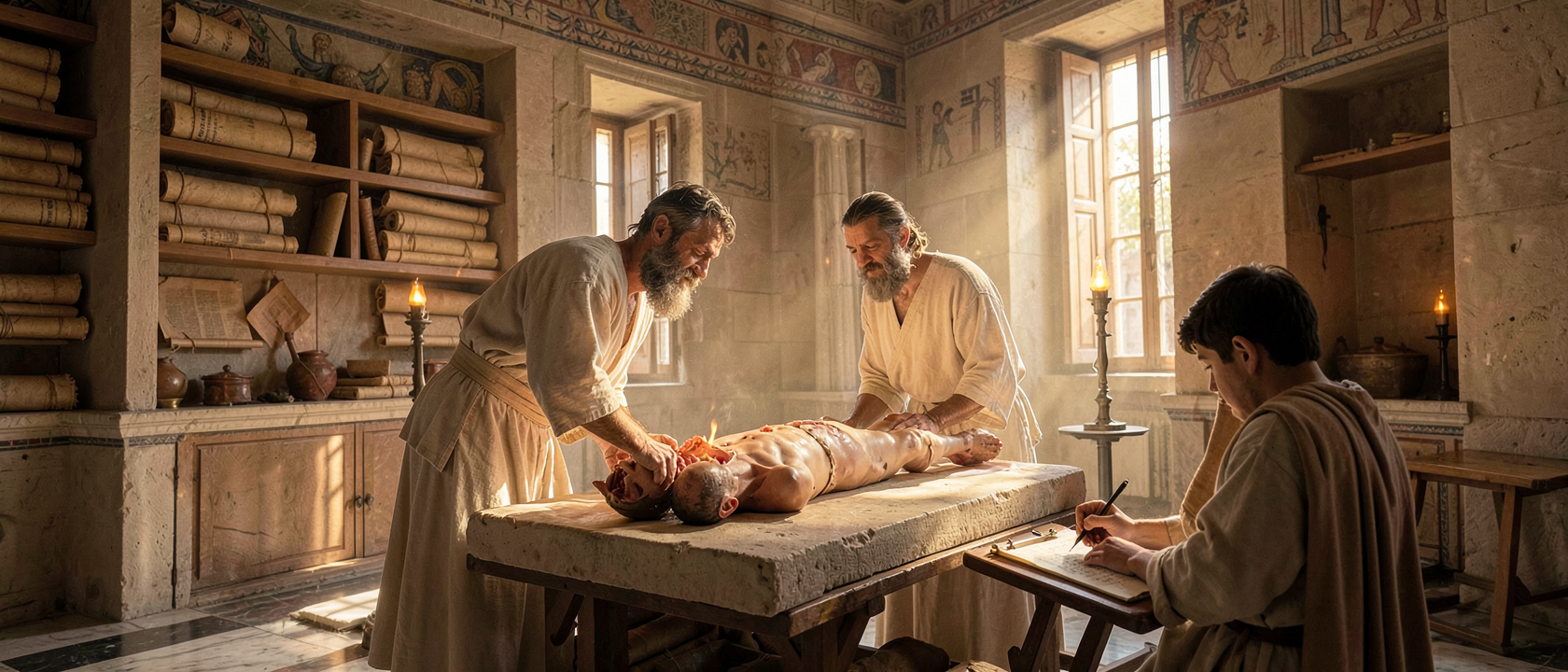
Every ophthalmologist uses the word “retina.” It comes from the Latin for net. Before that Latin rendering, it was the Greek word amphiblestroides, coined by a physician named Herophilus, born around 330 BCE in Chalcedon (today: Kadıköy, Istanbul, Turkey), who thought the membrane lining the back of the eye resembled a fishing net. He knew that because he had looked at one inside a human body, which placed him outside everything his profession had ever permitted.
Before the third century BCE, Greek physicians worked under a prohibition against opening the dead. The restriction was embedded in funerary religion, in the obligation to preserve the body for proper burial, and in the identity of the physician as someone who restored the living. The Hippocratic tradition that Herophilus trained in, on the island of Cos, built its anatomy from animal dissection, surface inspection of wounds, and reasoning by analogy. His teacher Praxagoras of Cos worked entirely within that framework.
The practical results were consequential errors. Physicians could not clearly separate nerves from tendons or blood vessels. Whether the brain or the heart governed intelligence was an open dispute. The paths by which sensation and voluntary movement traveled through the body were unknown. These were structural limits on what medicine could diagnose, explain, or treat.
A Dynasty That Needed to Be Impressive
When Alexander the Great died on June 10 or 11, 323 BCE in Babylon, his generals divided an empire. Ptolemy secured Egypt, declared himself king in 305 BCE, and set about making Alexandria, founded in 332 BCE, the dominant intellectual center of the Greek-speaking world. The Library and the Mouseion, established in the early third century BCE, were instruments of that ambition. The Ptolemies recruited scholars and funded their work; the scholars made the dynasty’s city the address where knowledge was produced.
This was a different political environment from the city-states where Hippocratic medicine had developed. The Ptolemies ruled as authoritarian monarchs. Decisions about who could be handed over to scholars, and in what condition, were theirs to make. According to later ancient sources, they acted on that authority.
The Work Itself
Herophilus (c. 330–260 BCE) and Erasistratus (c. 304–250 BCE) worked in Alexandria under Ptolemaic patronage, conducting systematic dissection of human bodies, the first such program in the Greek tradition, over an estimated 30 to 50 years.
What Herophilus found in the brain alone was substantial. He studied its ventricles, traced the sinuses of the tough outer membrane to their junction, a point anatomical tradition afterward called the torcular Herophili, and contributed to distinguishing the cerebrum from the cerebellum, a distinction ancient sources attribute variously to him and to Erasistratus. He classified nerve trunks as motor or sensory, separating them clearly from tendons and blood vessels, and described the paths of at least seven pairs of cranial nerves. His dissection of the eye identified the optic nerve and several coats, including the one he named amphiblestroides, later rendered into Latin as retina. He also named the duodenum, salivary glands, pancreas, liver, genital organs of both sexes, and the prostate gland.
Erasistratus described the valves of the heart, concluded it functioned as a pump, and distinguished between arteries and veins. He retained, however, the older theory that arteries carried pneuma (a vital air) rather than blood. That error would stand for centuries.
What the Sources Say About the Living
The Roman encyclopedist Cornelius Celsus, writing roughly 250 years after Herophilus’s death, stated that condemned criminals from the royal prisons had been transferred to the anatomists and dissected while still alive. Celsus acknowledged he was recording earlier accounts, not witnessing events. The Christian writer Tertullian (c. 155–220 CE) called Herophilus a butcher and repeated the charge in sharper terms.
The modern British historian James Longrigg, in his 1993 study Greek Rational Medicine (Routledge), argued these allegations deserve serious historical weight. The Ptolemies had both the authority and the evident will to fund aggressive scholarship; the anatomists had professional motivation; and the charges are specific rather than vague. Longrigg also noted that philosophical shifts associated with Plato and Aristotle, which created a clearer conceptual separation between a person and their corpse, may have eased the moral resistance that would have blocked such work in earlier Greek settings.
The critical problem is the source base. Every account of the vivisections reaches us through writers who were hostile to the practice or composing their accounts long after the events. No document from Ptolemaic Alexandria confirms that living prisoners were handed over. The situation is not a charge met by a denial; it is a charge met by silence, and silence is not the same as innocence or absence.
What Survived, and Through Whom
The original texts of Herophilus did not survive. Galen of Pergamon (c. 129–216 CE), working roughly four centuries later, became the principal means by which their findings reached later medicine. He worked exclusively with animals, Barbary apes, pigs, sheep, goats, and knew the Alexandrian work through available texts. To refute Erasistratus’s pneuma theory, Galen isolated a section of artery between two ligatures and cut it open; the blood inside could only have come from the artery itself. Even so, he modified rather than abandoned the broader framework, arguing that arteries carried both blood and pneuma rather than air alone. Almost everything now known about Herophilus and Erasistratus survives through writers who came after them, in some cases through writers who condemned them.
The Limits of the Record
Systematic human dissection in Alexandria lasted, by best estimate, between 30 and 50 years. After the deaths of Herophilus and Erasistratus, the practice ended as abruptly as it had begun. Whether the Ptolemies withdrew permission, whether no successors of comparable standing emerged, or whether other pressures closed the program is not recorded in surviving sources.
Human dissection would not become standard practice again for somewhere between 1,500 and 1,800 years, when anatomists in Renaissance Europe resumed systematic study of cadavers. Whether the Ptolemies formally authorized the vivisection of prisoners, or whether those accounts represent elaboration by hostile writers, cannot be resolved from surviving evidence. What can be stated is that the knowledge Herophilus and Erasistratus produced remained the ceiling of what medicine could verify for more than a millennium, built inside a brief window, under one authoritarian dynasty, and then sealed.