Twelve Nights at the Fire
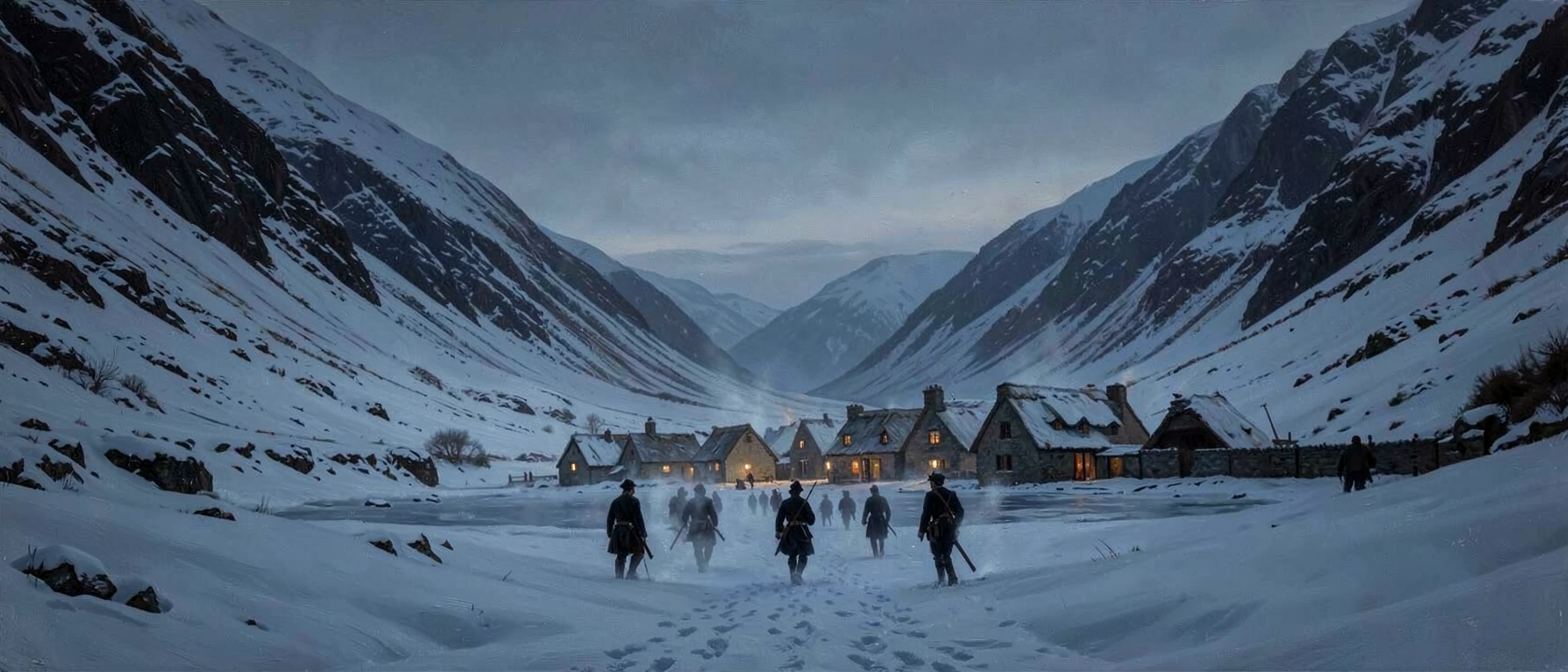
On February 1, 1692, about 120 soldiers of the Earl of Argyll’s Regiment of Foot marched into Glencoe, then commonly written Glen Coe, a valley in the Argyll region of Scotland’s western Highlands. Captain Robert Campbell of Glenlyon commanded them. Their stated business was ordinary: collecting arrears of tax owed by the local clans, the kind of assignment government troops had carried out across the Highlands since the Jacobite rising of 1689.
Highland custom, known as dualchas, obliged the Macdonalds of Glencoe to take the soldiers in regardless of any doubts they held about them. A guest under that code was fed, housed, and protected, and a host did not ask too closely what business had really brought him. MacIain, the clan’s elderly chief, was wary all the same. He sent unmarried young women away from the glen and had the clan’s weapons hidden, in case the soldiers meant to disarm them.
So the Macdonalds opened their homes, and for close to two weeks the two groups lived under the same roofs, eating at the same tables and sleeping by the same fires. None of it looked unusual. Billeting soldiers on Highland households was routine government practice by 1692, and nothing marked this detachment as different from any other that had passed through the glen before.
The regiment carried Argyll’s name because its colonel was Archibald Campbell, 10th Earl of Argyll, and later accounts often told the story as a Campbell feud against the Macdonalds. In the ranks that actually marched into Glencoe, only about a dozen men were Campbells. The real motive lay elsewhere, with a government official who had decided the clan should be made an example of.
A Deadline Missed by a Locked Gate
The reason that hospitality carried such weight went back two months. In August 1691, William III’s government had offered indemnity to any Highland chief who swore an oath of allegiance before January 1, 1692. MacIain set out to take that oath at the very end of December 1691, ahead of the deadline.
He went first to Fort William, only to be told that no one there had the authority to receive it. He had to travel on to Inveraray, arriving January 2 and finally swearing the oath on January 6, six days late, through no fault but the government’s own bureaucracy.
That gap mattered. Sir John Dalrymple, Master of Stair and Joint Secretary of State for Scotland, had already marked the Macdonalds out. In December 1691 he had written that theirs was the one Catholic clan left in the kingdom, and that dealing with them severely would be popular. MacIain’s late oath gave him the pretext he wanted.
Under Seventy, By the Sword
On the evening of February 12, 1692, Glenlyon and his fellow officers received written orders. They were to fall on the Macdonalds of Glencoe and, in the order’s own phrase, put all to the sword under seventy.
The killing began at 5 a.m. on February 13, in the settlements of Invercoe, Inverrigan, and Achnacon at once, though it spread across the whole glen as families fled. MacIain was shot as he rose from his bed. His wife was stripped of her rings, her fingers reportedly bitten to get them off, and she died the following day, whether from the assault or from exposure in the freezing hills is not entirely clear from the record.
How many died is disputed. The most commonly cited figure is 38 killed outright, a count that includes MacIain himself; other estimates put the number closer to 30. Beyond those killed directly, an unknown number of Macdonalds who fled into the mountains in midwinter died later of exposure, a toll no source manages to fix with any confidence. Whatever the exact count, it stands as a stark case of what contemporaries called murder under trust: killing men who had been received and fed as guests.
An Inquiry That Named No One
News of the massacre became a scandal across Scotland, and public pressure forced William III to order a royal commission of enquiry. It was issued in April 1695, and the commission’s report was signed on June 20 of that year. Its verdict was blunt: the killing of the Glencoe men was murder.
But blame and punishment did not travel together. The commission accepted the king’s account of his own order, in which he had written that if the Glencoe men could be cut off from the rest, it would serve justice to extirpate them. The commissioners chose to read that as meaning legal prosecution only, not a kill order, and William was cleared.
Dalrymple fared little better in appearance and far better in practice. Named as the man most responsible, he was forced to resign as Secretary of State for Scotland in 1695. That was the whole of his punishment. By 1700 his standing had recovered enough that he was made a member of the Privy Council of Scotland. The historian Lord Macaulay later called William’s shielding of him a serious dereliction of duty.
So the ledger closed. Roughly three dozen members of a clan that had done exactly what custom demanded of it were dead, killed by men they had fed and sheltered. The chief responsible was sent home in disgrace and welcomed back within five years. No one was ever punished for what the Scottish Parliament itself had called murder.