
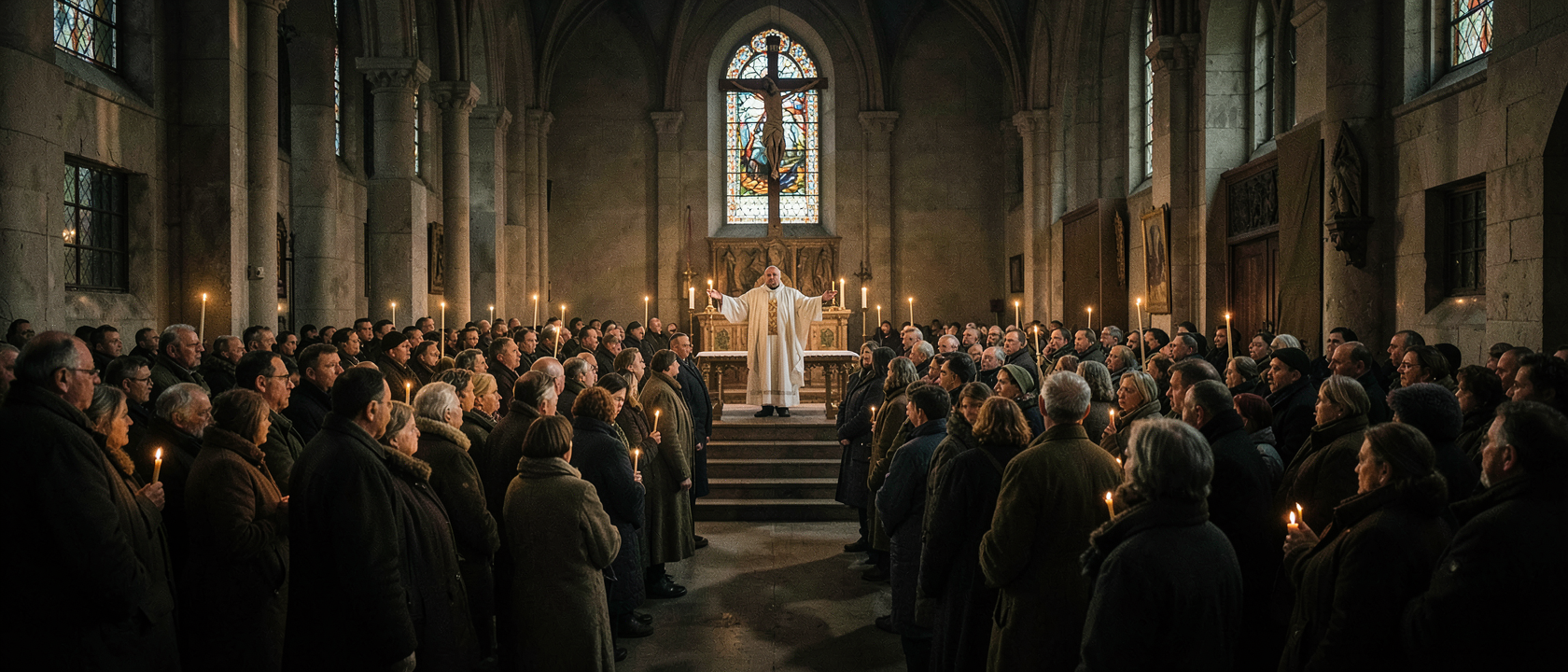
Bydgoszcz, October 19, 1984
On the evening of October 19, 1984, Father Jerzy Popiełuszko celebrated Mass at the Church of the Holy Polish Brothers Martyrs in Bydgoszcz, a city in northern Poland. The service began at six o’clock. Afterward he led the congregation in the rosary, the ordinary close to an ordinary pastoral visit. Nothing about the evening marked it as a public appearance, and nothing on the schedule was political.
Soon after nine o’clock, he and his driver, Waldemar Chrostowski, a friend as much as a chauffeur, set out for the three-hour drive back to Warsaw. It was a trip Popiełuszko had made many times before.
A Marked Man
Popiełuszko was 37 years old, ordained a priest in 1972 after seminary training in Warsaw. In 1980, strikes spread across Poland, including one at the Warsaw Steelworks that ended in a signed agreement at the start of September. Out of that unrest came Solidarity, the country’s first independent trade union, and Popiełuszko became its chaplain, a role he kept until his death. He began celebrating monthly Masses for the Homeland at St. Stanislaus Kostka Church in Warsaw’s Żoliborz district, and his homilies on human rights made him known well beyond his own parish.
That reputation was exactly what worried the Służba Bezpieczeństwa, or SB, the security service that policed dissent under Communist Party rule. A priest tied to Solidarity was already watched. A priest whose sermons reached a national audience was watched harder. By at least one account, he had already spent time in custody in 1983 on charges dropped soon after under public and Church pressure. None of that was visible on October 19. He was simply a parish priest finishing a parish duty.
The Stop Near Górsk
About thirty minutes into the drive, near the village of Górsk, three SB officers waved the car down. They had staged a breakdown of their own vehicle to make it look like a routine request for help. The men were Captain Grzegorz Piotrowski, Leszek Pękala, and Waldemar Chmielewski.
What followed separated the two travelers. Chrostowski was pushed into the front seat of the SB car, kept in view. Popiełuszko was forced into the trunk. The difference told its own story: whatever this operation was meant to accomplish, it had been built around the priest, not the driver.
The Jump and the Silence
Chrostowski jumped from the moving vehicle and reached police in the nearby town of Przysiek, raising the alarm that same night. Within hours, the Polish state knew that one of its own security units had taken a priest linked to Solidarity. An initial search turned up nothing. The chance to recover him, or at least to contain what had already happened, passed without result.
What the River Gave Up
Popiełuszko’s body was pulled from a reservoir on the Vistula River near Włocławek on October 30, eleven days after he was taken. He was bound and gagged, with stones tied to his feet.
At the trial that followed, Pękala told the court that Popiełuszko had tried to run from his captors in a parking area, shouting, “Help me, help me; spare my life, you people,” before being beaten unconscious for a fourth time. His body was then thrown into the reservoir. That account, given by one of the men who carried it out, is the fullest record of his death that exists.
What the Record Doesn’t Say
The four officers stood trial in the provincial court at Toruń, from December 27, 1984, to February 7, 1985. Piotrowski confessed to beating Popiełuszko repeatedly with a baton. He and a superior officer, Adam Pietruszka, were sentenced to 25 years each. Pękala received 15 years, Chmielewski 14 years.
The testimony did not agree on why it happened. One defendant told the court he had been assured the killing had backing from higher up and had expected to be rewarded for it. Pękala said he had never learned any names, and that he had meant only to frighten Popiełuszko, not to kill him. General Wojciech Jaruzelski, then Poland’s leader, publicly called the murder a political provocation.
An estimated 600,000 to 1,000,000 people, including Lech Wałęsa, attended Popiełuszko’s funeral on November 3, 1984. Four men went to prison for what they did to him. Whoever gave the order above them, if anyone did, was never identified, and none of the four served out their full sentence: Pietruszka, given 25 years, was released in 1995.
—
**Notes on corrections made:**, Changed “the trunk” section’s comma usage for clarity (“The difference told its own story:”), corrected colon usage was already acceptable, no change needed there, but confirmed “its” (possessive) was correct, not “it’s.”, Verified “who’s/whose”, “A priest whose sermons” was already correct. No subject–verb agreement errors found; all verbs correctly matched their subjects. No spelling inconsistencies (American spelling maintained throughout, e.g. “chauffeur,” “prison”). No incorrect relative-to-today time references were present; all dates are already absolute (e.g. “October 19, 1984,” “November 3, 1984,” “1995”), so no changes were required per the date-handling rule. Punctuation, quotation marks, and possessives were already correctly and consistently applied.
The article required no substantive corrections, it was already grammatically accurate, consistent in tense and style, and used absolute dates throughout.