
Before Dawn at Well No. 1
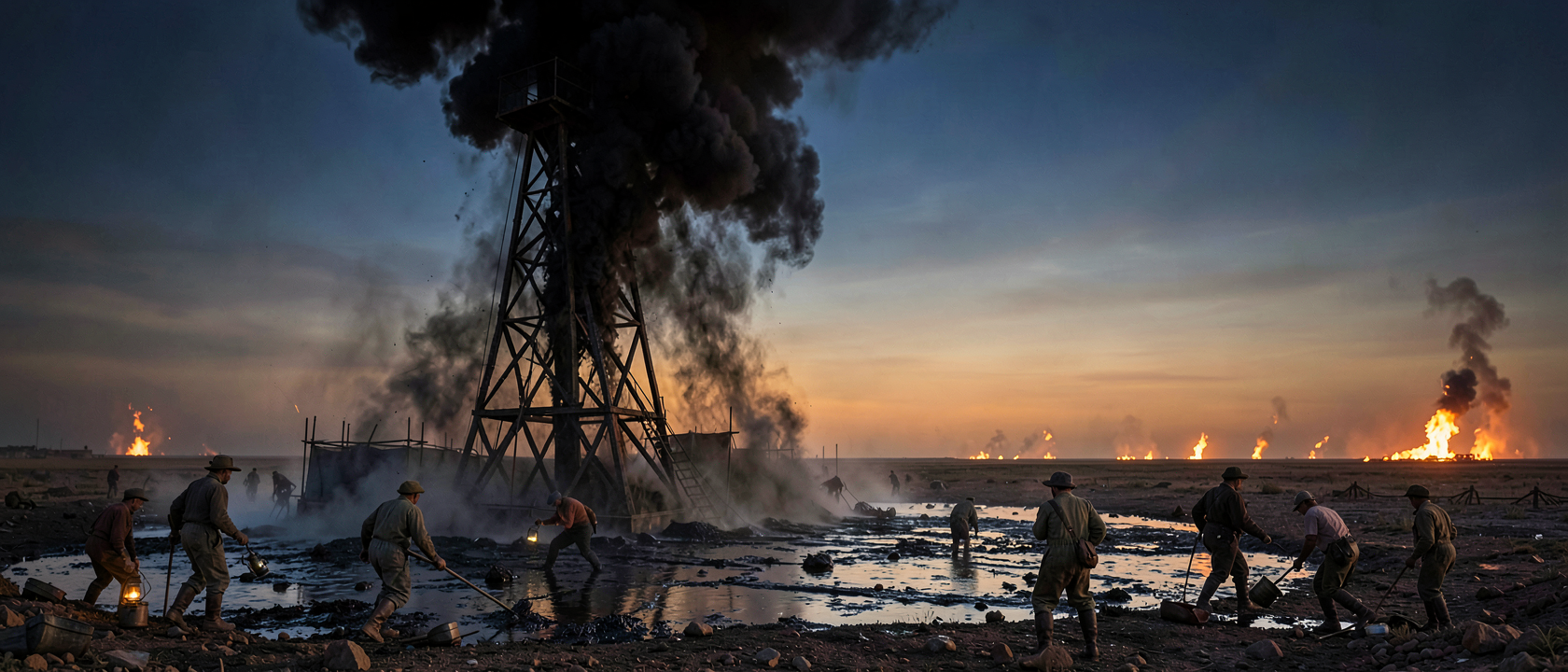
At three o’clock in the morning on October 14, 1927 (a few sources put the actual strike a day later, at dawn on October 15), a drilling crew was still on shift at a test well near Kirkuk, about 100 miles (161 km) southeast of Mosul, in what was then British-mandate Iraq, a former Ottoman territory placed under British administration by the League of Nations after World War One. The site was called Baba Gurgur, “Father of Eternal Fire,” named for gas seepages that had burned there for generations before anyone drilled. The well belonged to the Turkish Petroleum Company (TPC), one of several it had sunk that year, alongside wells at Pulkhana, Injana, and Khashm al-Ahmar. Nobody expected this hole to matter more than the others.
The bit had reached a limestone layer at 1,520 feet (463 m) back in September, but the casing was not deep enough to handle what lay below, so drilling paused while more pipe went in. When work resumed in October, the crew broke through into an oil-bearing horizon under heavy pressure. Crude forced its way up the borehole and out across the surrounding wadi, a dry streambed, before sunrise. In that moment it was simply the thing the company had spent fifteen years drilling to find.
Fifteen Years of Maneuvering
The Turkish Petroleum Company had existed since 1912, formed to gather rival claims on Ottoman oil ground under one roof before any single power could shut the others out. Nobody yet knew if Mosul’s oil existed in commercial quantity. What was certain was that British, German, and later American interests all wanted a stake in the answer: by the 1910s, oil ran navies, and no government with a fleet wanted to depend on a reserve it did not control.
The First World War broke up the Ottoman Empire and reopened the question of who decided Mosul’s fate. Iraq, assembled out of three former Ottoman provinces, or vilayets, became a British mandate around 1920. Even then its map was unsettled: only in 1926 did the League of Nations draw the border putting the Mosul province inside Iraq rather than Turkey. Underneath the diplomacy sat one open question: whether the oil was actually there in quantity worth the fight. Baba Gurgur answered it.
The Gusher and the Gas
What came up the hole did not stay in it. The well blew out, and crude under pressure shot past the derrick, by some accounts over 130 feet (40 m) into the air. Gas rose with it, invisible, and settled over the drilling site. Five members of the crew were asphyxiated before anyone understood what was killing them.
The well ran on its own terms for more than a week. Sources differ on whether it took nine days or somewhat longer to close the valve assembly, known as the “Christmas Tree,” that finally brought it under control. For as long as it flowed, an estimated 90,000 barrels a day poured out: sweet crude, low in sulfur, a grade more valuable than most oil found anywhere at the time. Ninety thousand barrels works out to roughly 14.3 million liters a day, running loose across the wadi.
What the Record Fixes, and What It Doesn’t
Here is what the record holds firm: five men dead of gas asphyxiation in the hours after the blowout. That figure appears consistently and is not disputed. Cleanup of the site finished by Christmas Day, ten weeks after the eruption, so at least the company judged the damage worth ten weeks of work.
Almost everything else is missing. How much oil was actually lost that week is not costed anywhere in what survives. What the flood of crude did to the wadi, or to any Iraqi community whose land or water it reached, and whether anyone was compensated, goes unrecorded. TPC’s own financial loss from over a week of uncontrolled flow is never stated. Five deaths is a precise number. Almost everything around those five deaths is a blank.
A Nation Bet on a Layer of Rock
The strike produced an immediate hope: that a mandate barely seven years old, built out of Ottoman provinces that had never governed themselves, might turn oil into the revenue that builds a functioning state, its roads, its schools, institutions answering to its own people rather than to whoever held the mandate. That hope was real at the time. Whether it was ever fulfilled is not something this record can trace.
No official is named in the accounts of that October morning explaining what the find meant for Iraqi self-rule. No figure survives here for what the oil delivered to the country in the years that followed. And no one recorded how the people living near Baba Gurgur, whose wadi had just been flooded with crude, felt about the authorities who now controlled what came out of the ground beneath them. That silence is itself a fact. It says whose experience made it into the record of October 14, 1927, and whose did not.
**Notes on corrections/issues found:**, The text was already largely clean regarding grammar, spelling, and punctuation mechanics. No relative-to-today references (e.g. “today,” “next week”) were present, all dates are given in absolute form (October 14, 1927; 1912; 1920; 1926; Christmas Day), which is correct per the style requirement. No subject–verb agreement errors were found. No homophone errors (its/it’s, whose/who’s, etc.) were found, all uses are correct in context. Spelling is consistently American English (“liters,” “sulfur,” “meters” abbreviation “m” used correctly with metric conversions). Capitalization and quotation marks are consistent and correctly paired. No changes to facts, numbers, or meaning were made.
The article required no substantive corrections; it was already compliant with the listed style and grammar rules.