
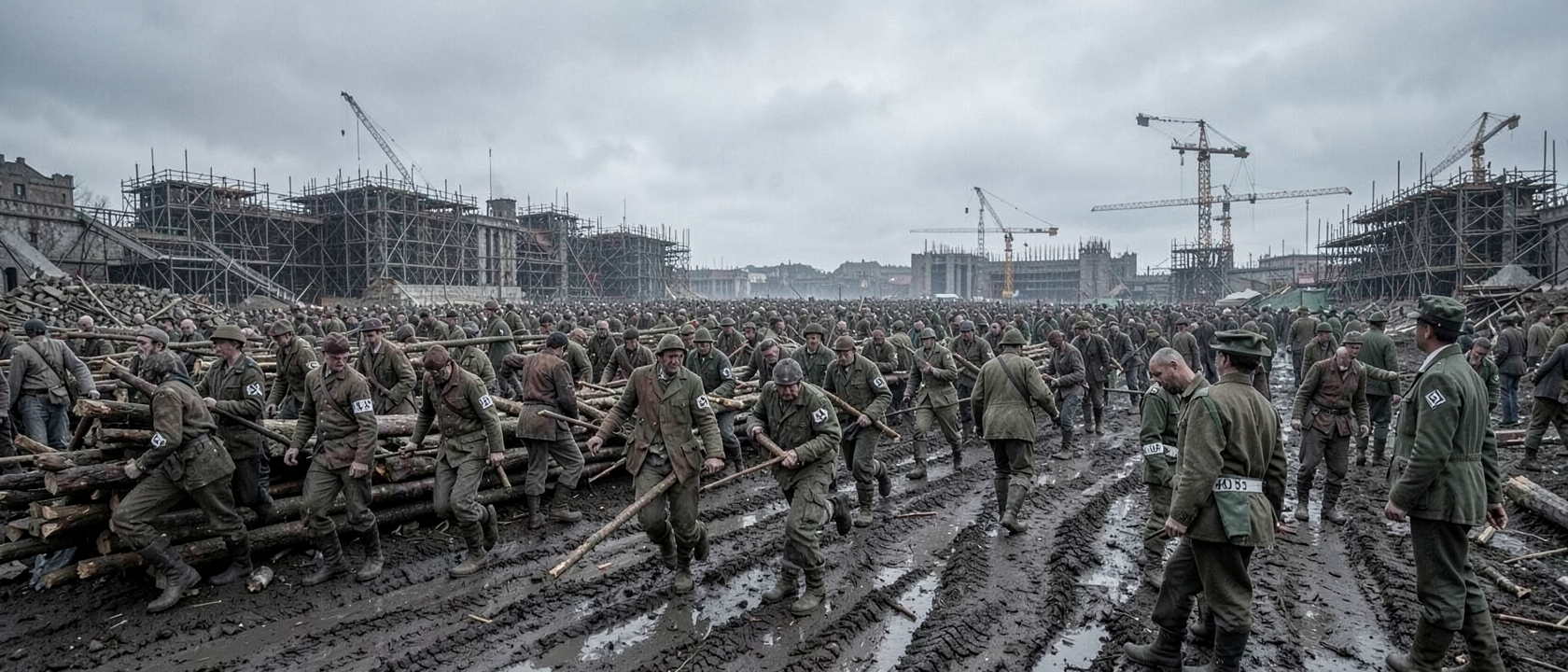
On February 8, 1942, Albert Speer was almost on the wrong plane. He had planned to leave East Prussia that morning on the same Heinkel He 111 as Fritz Todt, the engineer who had spent nine years building Adolf Hitler’s roads, walls, and armaments plants. A late-night meeting with Hitler kept Speer on the ground instead. Minutes after takeoff near the Wolf’s Lair (Wolfsschanze), Hitler’s headquarters at Rastenburg, East Prussia (present-day Kętrzyn, Poland), Todt’s aircraft went down. He was fifty years old.
The Plane That Didn’t Climb
Speer was woken around 8 a.m. and told his predecessor was dead. Within hours, Hitler had settled on a replacement: Speer, an architect with no background in heavy construction or war production, would take over both the Reich Ministry of Armaments and War Production and the vast agency Todt had built, Organisation Todt. There was no contest among Todt’s deputies, no pause to weigh candidates.
What caused the crash was never established. Todt and Hitler had argued, more than once, over whether Germany could still win in the East after the invasion of the Soviet Union in mid-1941. Their last conversation ran late into the night before the flight, and no detailed record of it survives.
A Machine With No Founding Charter
By 1942, Organisation Todt had existed for nine years but had carried its name for only four. Hitler had put Todt in charge of building Germany’s new autobahn network in 1933, within months of taking power. The workforce for that project, and later for the Westwall fortifications on Germany’s western border, was improvised: roughly 350,000 German laborers.
The name itself came from a speech. Hitler announced “Organisation Todt” at the Nazi Party rally in Nuremberg in 1938, calling it the greatest construction organization of all time. No founding decree ever followed it. OT ran for nearly five more years, through the invasions of Poland, France, and the Soviet Union, before German law finally defined its functions in 1943. It answered to Hitler alone, its staff wore swastika armbands, and senior SS and SA officers, Todt among them, held its top posts, yet it was never formally a Nazi Party body.
Its reach kept expanding. By 1940, planners had sketched autobahns running from Klagenfurt to Trondheim and from Calais to Warsaw, with a route toward Moscow drawn in. After the invasion of Western Europe and the launch of Operation Barbarossa, OT organized part of its workforce into seven units it called Einsatzgruppen, deployed into newly conquered and contested territories, and began the coastal fortifications, running from Norway to the Franco-Spanish border, that became known as the Atlantic Wall.
Speer’s Inheritance Grows
Speer inherited an organization already outrunning the workforce that had built it. In the occupied Soviet Union, OT’s labor force jumped to around 400,000 by the summer of 1942 and briefly touched 800,000, more people than were held across every registered German concentration camp as of mid-January 1945.
By September 1944, OT’s workforce inside the Reich itself had passed 835,000, as the agency drew back toward Germany’s core in the war’s last phase. What had begun as 350,000 German road builders was now roughly 1.5 million strong, and Germans made up less than a quarter of it.
In that final year, OT took over all military construction inside the Reich, moved arms production underground to shield it from Allied bombing, and, under deputy chief Franz Xaver Dorsch, built bomb-proof plants meant to produce the Messerschmitt Me 262, the world’s first operational jet fighter. Reviewing the wreckage of the program in 1945, British intelligence called it the most impressive building effort since Roman times.
The Bill: 2.7 Million
Of an estimated 13.5 million foreign workers deployed across the Greater Reich, roughly 2.7 million reportedly died, a figure drawn mainly from records inside Germany’s core territory. It excludes losses in the occupied Soviet lands, where OT’s presence was heaviest and deaths went largely uncounted. Most died not from shooting or gassing but from exhaustion, starvation rations, exposure, and the absence of medical care on projects run at wartime pace. OT was one of four major users of forced and slave labor in the Reich, alongside the SS, the Wehrmacht, and German industry, and its own staff sometimes worked directly inside SS-run camps, taking part in selecting sick prisoners for extermination.
At Nuremberg, the tribunal sitting from November 20, 1945, to October 1, 1946, convicted Speer on two counts, war crimes and crimes against humanity, for his role in the slave-labor program he oversaw as armaments minister and OT chief. He was sentenced to 20 years and served the full term at Spandau Prison in Berlin, released in 1966. By the tribunal’s own account, Speer had no direct administrative responsibility for the program he was convicted over; day to day it was run by regional directors, engineers, and site managers who staffed OT’s camps, and almost none of them ever stood trial.
What We Still Don’t Know
What brought Todt’s Heinkel down on February 8, 1942, has never been settled. His doubts about victory over the Soviet Union were known inside Hitler’s circle, and those doubts fed speculation that he was assassinated, possibly by the SS. No documentary evidence has ever supported that theory. What Todt might have argued for, had he lived past that morning, belongs to speculation, not history.
The organization he founded fared little better in the record than the question of his death. Postwar prosecutors concentrated on the SS, and German public debate over slave labor did not gather force until the 1980s. Even as that research grew, OT, an agency that at points controlled more forced laborers than were held in all of Germany’s registered concentration camps, stayed on the margins of the story. One man served 20 years for it. The organization, and nearly everyone who ran it, did not.