
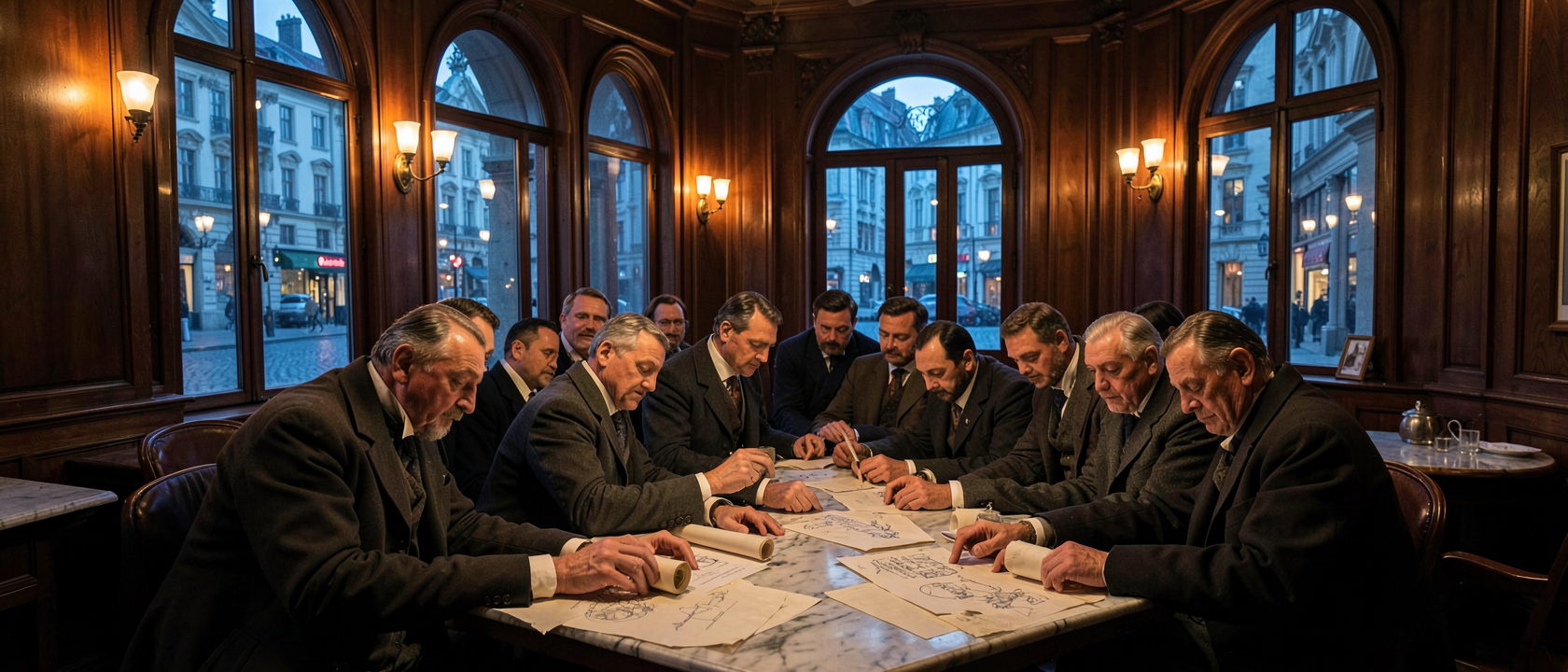
Before the Walkout
On April 3, 1897, nineteen artists sat down in a Viennese coffee house and agreed to break away from Vienna’s official art establishment. What they built afterward, a magazine, a building, a name borrowed from ancient Rome, outlasted the unity that had founded it by less than a decade.
The Coffee House, April 3, 1897
The nineteen met at a coffee house in Vienna and voted to leave the Künstlerhaus, the city’s official Association of Austrian Artists. They named their new body the Vereinigung Bildender Künstler, though it became known at once by another name: the Secession. The word came from Roman history, from the secessio plebis, the withdrawal of Rome’s common citizens from the city to force concessions from the ruling patrician class. The choice made the point plainly: a revolt of the excluded against an entrenched elite.
Only a handful of the nineteen appear by name in the record: Klimt, the designer Koloman Moser, and the architects Josef Hoffmann and Joseph Maria Olbrich among them. Most of their fellow founders are not named at all. The group elected Klimt its first president, Carl Moll vice-president, and gave the honorary presidency to Rudolf von Alt, then 85. Two days later, on April 5, they wrote to the Künstlerhaus to announce what they had done, and told the city’s newspapers the same day.
What the Künstlerhaus Actually Controlled
The stakes behind the walkout had little to do with taste. The Künstlerhaus had formed in 1861 through a merger with another artists’ society, Eintracht, and had occupied its own building since 1868. By 1897 it was Vienna’s gatekeeper for exhibitions, at home and abroad: it decided whose paintings the public, and buyers, would ever see. By some accounts, the nineteen had first asked its leadership to loosen that control and were refused, resigning only once the request failed.
To leave the Künstlerhaus meant losing access to the only exhibition network Vienna’s artists had, with no promise that anything would replace it. The gamble was financial and professional before it was ever a matter of style.
Building an Alternative: Ver Sacrum and the Exhibition Hall
The new group moved quickly to build a life of its own. In January 1898 it launched a magazine, Ver Sacrum, Latin for “sacred spring,” its title pointing to an old ritual of renewal that suited a movement chasing what its members called stilkunst: a complete remaking of aesthetics, not a change of style. Koloman Moser had first floated the idea at a meeting in June 1897; Klimt, Max Kurzweil, and the critic Ludwig Hevesi turned it into the Secession’s own magazine.
The group also wanted a building of its own. Early in 1897 the City of Vienna had granted it a plot of land, and unpaid volunteers helped raise a hall there to a design by the architect Joseph Maria Olbrich. It opened on November 18, 1898, with a line from Hevesi set above the entrance: “To every age its art, to every art its freedom.” Hevesi wrote elsewhere that the building heralded what he called a “Great Vienna.”
The Magazine Stops, December 1903
The unity behind all of it did not last. Ver Sacrum published its final issue in December 1903 (other sources confirm only the year), closing a run of nearly six years that had produced 120 regular issues and 471 original drawings, and had carried the Secession’s ideas across Europe. No cause for the closure appears in the record. It is simply the first visible sign that the founding group was coming apart.
Klimt Walks Out Again, June 1905
On June 14, 1905, Klimt did what he had done eight years earlier: he walked out. This time he was leaving the Secession itself, taking a faction of artists with him, remembered afterward as the Klimt Group. The immediate flashpoint was a proposal from Carl Moll, an adviser to the Galerie Miethke, that the Secession buy the gallery outright as an outlet for its members’ work. Klimt, Otto Wagner, Josef Hoffmann, and Koloman Moser backed the plan. What exactly divided the two camps beyond that dispute is not spelled out in the record. Left behind was a smaller, more conservative group of realist painters, still holding the Secession’s name and its building.
The Bill: Independence Bought, Coherence Lost
Add it up. Between 1897 and 1905, the Secession won a permanent exhibition hall built on land the city had granted for that purpose, a magazine read across Europe while it lasted, and full independence from an institution that had once decided who got to show work in Vienna. What it paid for that independence was its own coherence. Within eight years of the coffee house meeting that founded it, the movement had lost its magazine, then lost the founder who had led the original walkout. What remained, still operating under the Vereinigung Bildender Künstler’s name and inside Olbrich’s hall, was smaller and more traditional than the group nineteen artists had set out to build.