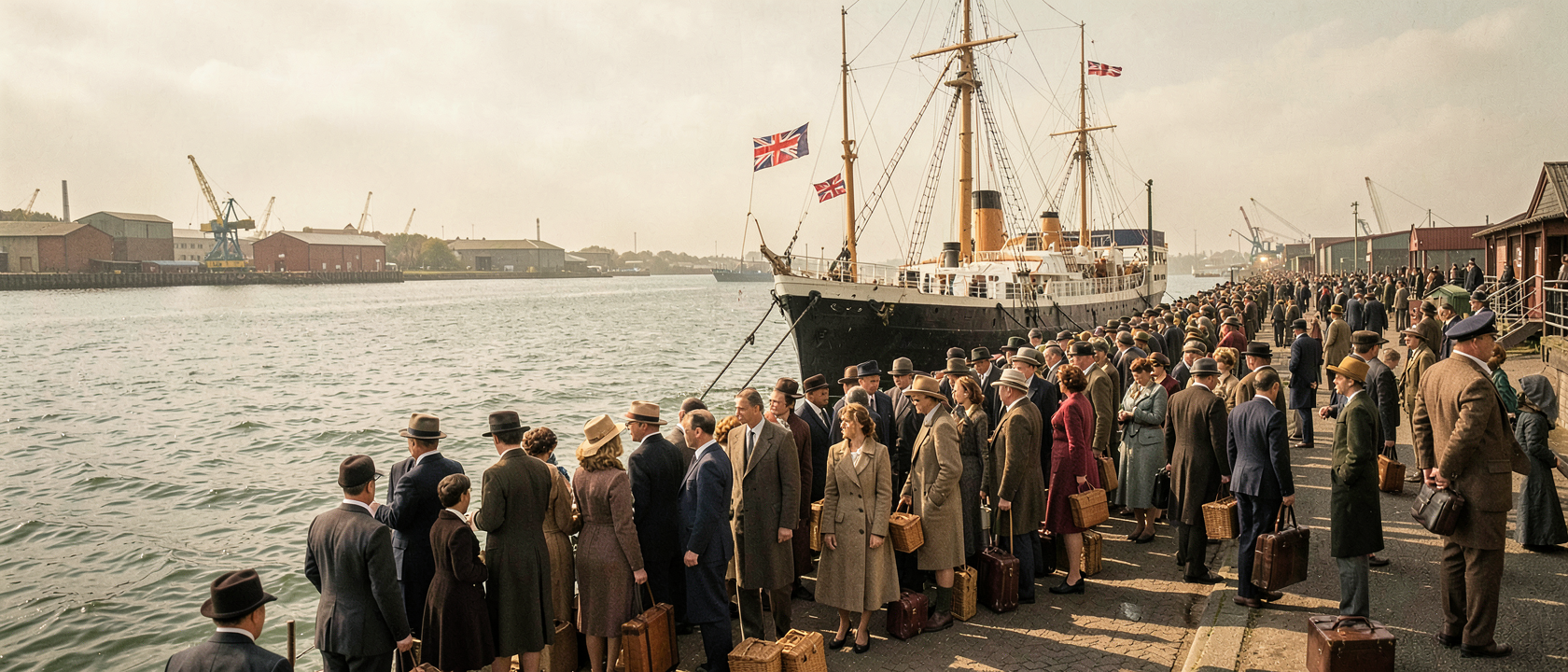
Tilbury, June 22, 1948
On the morning of June 22, 1948, the troopship HMT Empire Windrush tied up at Tilbury Docks on the Thames east of London. Built in Germany and seized by Britain during the war, it had, as late as 1936, still carried holiday passengers between Hamburg and London, more than 20 such package cruises, according to historian Paul Arnott. This time it carried something else.
Of the 1,027 people aboard, 802 gave a Caribbean country as their last address, Jamaica the largest single group with 539 people, the rest from Bermuda, Trinidad, British Guiana, and other territories. British newspapers reported only “500 Jamaican men,” a figure that stuck in public memory even though it left out the women, children, and a group of about 66 passengers who had boarded not in Jamaica but in Mexico, displaced Polish refugees from the war just ended. Among the Caribbean arrivals was Sam King, who had already crossed the Atlantic once with the RAF during the war and was now sailing back for work. He later became mayor of the London borough of Southwark and is credited by at least one source with helping found the Notting Hill Carnival. None of these passengers needed a visa. Under the British Nationality Act, passed that same year, colonial subjects from the Caribbean were legally Citizens of the United Kingdom and Colonies, entitled to live and work in Britain. No border was crossed illegally.
A Labor Shortage, a Cold Welcome
Postwar Britain needed hands it did not have. British Rail, the newly founded National Health Service, and public transport in London and other cities were all short-staffed, and Caribbean workers filled jobs the country could not fill on its own. The Windrush passenger list alone shows mechanics, tailors, carpenters, engineers, and domestic workers.
The welcome did not match the paperwork. Migrants met landlords with signs reading “No Blacks, No Irish, No Dogs,” and groups known as Teddy Boys carried out racially motivated attacks, including the Notting Hill riots. Years later, politician Enoch Powell gave hostility toward Caribbean immigration a national stage in his “rivers of blood” speech. Citizenship on paper and citizenship in daily life were two different things.
Building the Country, Then the Doors Close
Between 1948 and the early 1970s, more than 500,000 people made the same crossing from the Caribbean, a wave that came to be known as the Windrush Generation. They staffed hospital wards, drove trains and buses, and kept public services running through the decades Britain spent rebuilding. Parliament tightened immigration rules in 1962, and by the early 1970s further restrictions had effectively closed this chapter of Caribbean migration.
The ship that gave the generation its name did not last to see any of it. In 1954, a fire broke out aboard the Empire Windrush in the Mediterranean and the ship sank, killing four crew members. The name kept sailing long after the vessel did not.
The Paperwork That Was Never Required
In 2010, the Home Office destroyed the original landing cards from ships like the Windrush, the very documents recording when and how migrants had arrived. In 2014, new immigration enforcement rules began requiring long-settled residents to prove their right to be in Britain, with paperwork the Windrush generation had never been asked to keep, because they had arrived as citizens, not applicants.
The consequences surfaced publicly in 2018. At least 83 people were wrongly deported. According to diplomats Guy Hewitt and Kevin M. Isaac, nearly 60,000 people who had arrived before 1972 were left exposed to demands for documents no one had ever issued them. People who had lived and worked in Britain for fifty or sixty years, some of them former NHS employees, were denied jobs, bank accounts, housing, pensions, and medical treatment, asked to prove a status the law had granted them decades before.
What It Cost
The scandal cost a home secretary the job and forced a prime ministerial apology. An independent Lessons Learned Review, led by Wendy Williams, condemned the Home Office for what it called “ignorance and thoughtlessness.” A compensation scheme followed, but at least two dozen elderly claimants died before any payment reached them.
Critics did not soften their language. Journalist Gary Younge called the policy “cruelty by design.” Reverend Wilfred Wood, the first Black bishop in the Church of England, went further, describing it as close to “a crime against humanity”, one clergyman’s judgment, not a legal finding, but a measure of how far the government’s treatment of its own citizens had strayed from the 1948 Act.
What We Don’t Know
Windrush is a symbolic start, not a literal one. Black and Caribbean people had lived in Britain long before 1948, so the ship marks a turning point in scale and public attention, not the beginning of a presence that already existed.
The record has other gaps that matter more to the people they concern. No published figure accounts for everyone caught up in the scandal beyond the 83 confirmed wrongful deportations, and no total sum exists for what the compensation scheme has paid or still owes. That is not a simplification for a cleaner story, it is a hole in the paperwork itself, the same kind that caused the scandal in the first place.
June 22, Now a Day of Its Own
The idea for a national day of recognition came from activist Patrick Vernon in 2013. It took five years for the government to act: in November 2018, officials announced that Windrush Day would fall every June 22, chosen to mark the 70th anniversary of the ship’s arrival. A National Windrush Monument, designed by Jamaican sculptor Basil Watson, was unveiled at Waterloo Station on June 22, 2022.
On June 22, 2023, the date carried a double weight: the 75th anniversary of the landing at Tilbury, and another round of government grants, $750,000 (£750,000) spread across 45 community projects, up from $500,000 (£500,000) the year before. The date that once marked an arrival now marks both a contribution and a debt still being settled.