
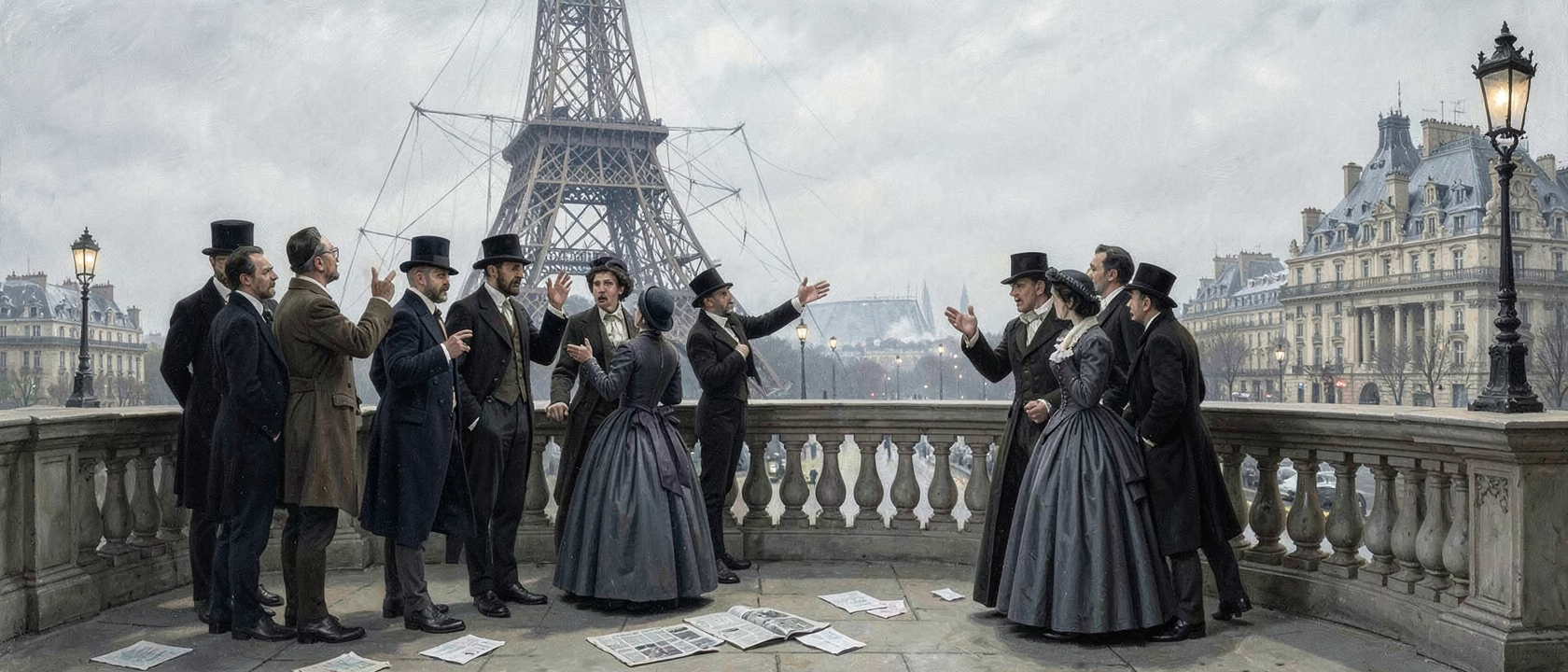
In February 1887, a roll call of Paris’s most decorated painters, architects, poets, and composers signed a public letter calling Gustave Eiffel’s half-finished tower a disgrace to their city. They lost the argument almost as soon as they made it. Within two years the tower stood complete on the Champ de Mars, and within a couple of generations it had become the very symbol of the Paris they said they were protecting.
Iron Over Stone
Construction on the Champ de Mars began on January 28, 1887, three weeks after Eiffel signed the building contract on January 8. By July 1, ironworkers had the tower’s legs rising above the ground. Paris in 1887 was a city of pale stone facades, mansard roofs, and matched cornice lines; nothing in it resembled an exposed iron lattice climbing where no structure had ever stood.
The tower was being raised for the Exposition Universelle of 1889, marking the hundredth anniversary of the French Revolution. More than 100 designs had been submitted for the fair’s centerpiece before organizers chose Eiffel’s. The structural design came from his engineers, Maurice Koechlin and Émile Nouguier, with decorative arches added by architect Stephen Sauvestre. From the day the foundations went in, Parisians walking past the site said, plainly, that the thing did not belong to their city.
The Artists Sign Their Names
On February 14, 1887, a protest letter ran on the front page of Le Temps, addressed to Adolphe Alphand, curator of the 1889 exhibition. How many people signed it is disputed: some accounts put the number at 47, tied to this letter, while others describe a broader “Committee of Three Hundred,” one name per meter of the tower’s planned height, organized around the same protest. Neither figure is confirmed against a surviving archival copy, but the names attached are not in question.
Among them were Charles Garnier, architect of the Paris Opera; Ernest Meissonier, first president of the Société Nationale des Beaux-Arts; academic painter William-Adolphe Bouguereau; composer Charles Gounod; poets Sully Prudhomme and Leconte de Lisle; and novelist Guy de Maupassant. These were not fringe critics but figures holding Academy seats, prizes, and institutional titles that carried real weight in 1887 France.
The letter denounced “the useless and monstrous Eiffel Tower,” warning it would brand the city with vulgar commercial taste just as France wanted to present itself to the world. It noted, with some satisfaction, that public mockery had already given the half-built structure a nickname: the “Tower of Babel.”
Eiffel’s Answer
Eiffel replied the same day, in an interview with Le Temps. His argument was less about beauty than timing: no one, he said, could fairly judge the appearance of a structure not yet finished. He also turned the artists’ authority back on them, asking what qualified painters and poets to judge an engineering problem before it existed in final form.
The protest went nowhere procedurally: no vote, no injunction, no halt to the work. Construction ran on schedule, and the tower was finished on March 31, 1889, opening to the public on May 15 as the entrance arch to the Exposition Universelle. At 984 feet (300 meters), it stood taller than anything built before it, a record it held until New York’s Chrysler Building topped out in 1929.
Maupassant’s Quiet Grudge
Maupassant had signed the 1887 letter along with the others, and by most accounts he never let go of the objection the way his co-signers did. According to writer Roland Barthes, Maupassant dined regularly in one of the tower’s restaurants after it opened in 1889, not because he had warmed to the place but because it was the one spot in Paris where he did not have to look at it.
Scholar William Thompson has argued Maupassant carried the same distaste into his fiction, folding scathing, indirect descriptions of the tower into his writing without naming it outright. Neither claim comes from Maupassant’s own hand: the dining story traces to Barthes, writing later, and the fiction reading is Thompson’s interpretation. Told as documented fact, both go further than the record allows; told as a measure of how deep the grudge ran, they still make the point.
What the Fight Actually Cost
Add up what the protest itself cost, and the ledger is empty: no money changed hands, no land was seized, nobody was hurt. The entire fight was conducted in newsprint and open letters. What the signatories were defending was reputation, a shared anxiety, running through the Academy and the salons, that exposed iron would tell the world Paris had traded its taste for spectacle.
The tower itself was expensive and heavy in ways the letter never mentioned. It weighed an estimated 11,000 to 11,100 short tons (10,000 to 10,100 metric tons) of iron, at a total construction cost later recorded at 7,799,401.31 gold francs. Eiffel’s own contract covered only 1.5 million francs of that, less than a quarter of the roughly 6.5 million francs the project needed; he carried the rest of the financial risk himself.
It nearly did not survive its own paperwork. The original permit ran twenty years, and in 1909 the tower was scheduled for demolition. It stayed standing because it had become useful as a radio antenna, not because Paris had changed its mind about how it looked. The shift from tolerated eyesore to civic symbol had no single turning point: the structure was declared a monument historique in 1964 and folded into the UNESCO World Heritage listing for the banks of the Seine in 1991. Thompson would later call it “the acknowledged foremost universal symbol of Paris and France”, close to the opposite of what forty-seven, or three hundred, signatures had tried to prevent in 1887.
What We Don’t Actually Know
Several pieces of this story rest on sources that don’t fully agree. The signatory count is one: 47 is attached to the letter in some accounts, while others describe a separate three-hundred-name committee assembled around the same protest, and no surviving primary document settles which is right.
The move from public scorn to public affection is even harder to pin down, nothing marks a single date or moment of change, only the fact that a couple of generations passed between the letter and the tower’s arrival as an emblem of the city. And the two Maupassant details, the dinners taken to avoid the view and the tower supposedly hidden in his fiction, come down to us through Barthes and Thompson rather than through anything Maupassant wrote himself. They are worth telling. They are not the same as being confirmed.