
The Firm of Delattre and Worth
In 1870, wine merchants Delattre and Worth ran their business the way many small firms trading across the English Channel did: one partner in each capital, ledgers and letters crossing the water more often than the partners themselves. Frederick Gonner Worth, the junior partner, handled the London side from an office on Cannon Street. Monsieur Delattre, the senior partner, managed the Paris house. Nothing about selling wine suggested the firm needed to think about politics.
July 19, 1870
That changed on paper on July 19, 1870, when France declared war on Prussia. The conflict that followed, later called the Franco-Prussian War, set France against Prussia and the North German Confederation, the coalition of German states then under Prussian leadership. A firm split between London and Paris was now exposed in a way it had never been: one partner was a foreign national with money tied up inside a country about to fight for its capital. In practice, little changed at first. Trade kept moving through the war’s opening weeks, and the risk built into the firm’s structure stayed invisible to the men running it.
Shortly Before September 15, 1870
That invisibility ended when Delattre was conscripted. Sometime before the middle of September, he was ordered to report to the French National Guard, the reserve force France was mobilizing as Prussian troops closed on Paris. His call-up left the Paris office with no one to run it. Worth crossed the Channel to take over, a decision that made sound business sense at the time and that any partner in his place might have made. It was the last ordinary decision Worth would get to make.
September 15, 1870: Von Moltke’s Order
On September 15, 1870, the Prussian general Helmuth von Moltke ordered Paris encircled. Within days, Prussian forces had closed the roads and rail lines around the city, cutting the routes that a traveler with no stake in the fighting might have used to leave. Worth had come to Paris only to keep a wine business running. A single order issued at Prussian headquarters had just turned into a personal trap for an Englishman who had arrived weeks earlier expecting nothing more than ledgers and correspondence.
Paris to Cologne: A Gap in the Record
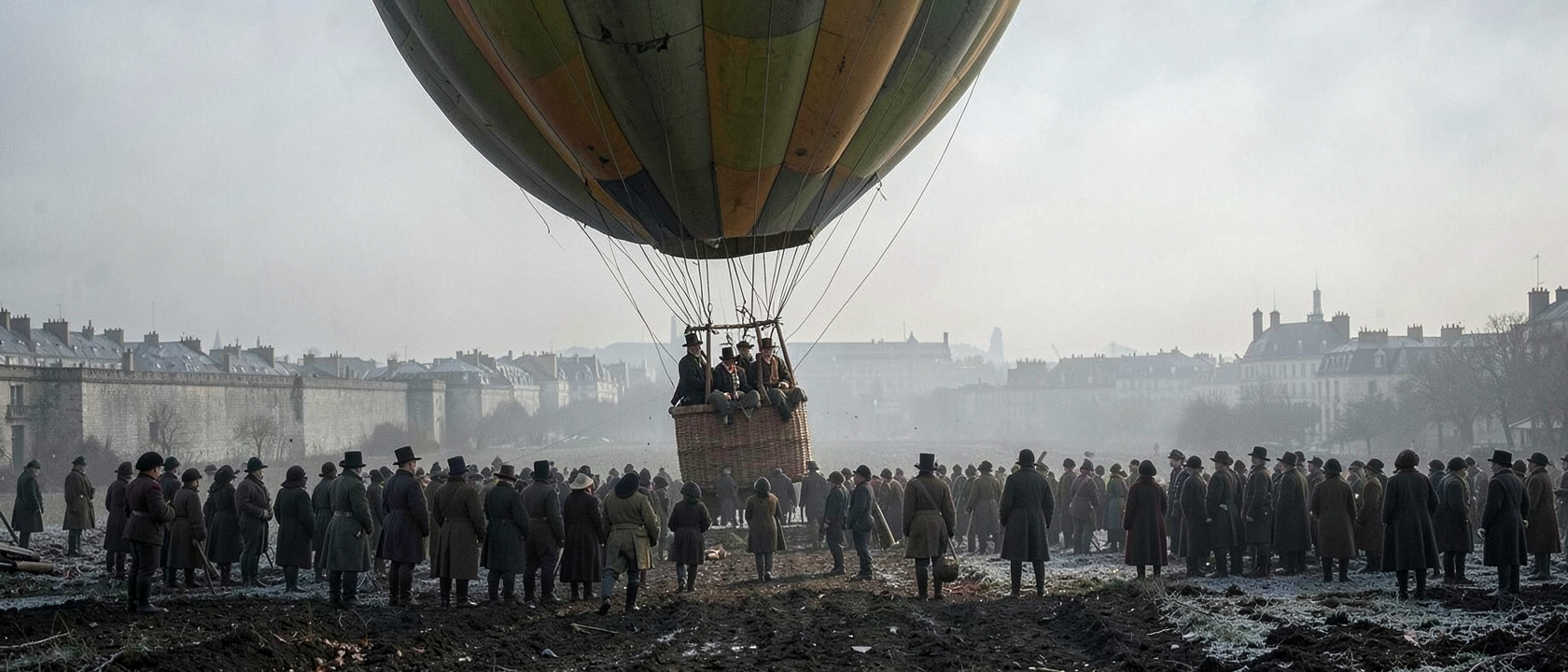
In a letter later printed in The Times, Worth wrote that he left Paris by balloon on Thursday, October 27, 1870, along with three other passengers. Balloon flight was one of the few ways left to move in or out of a city cut off from telegraph and rail. It did not carry him to safety. Prussian forces captured him at Verdun the same day. What happened between that capture and his arrival in a jail cell in Cologne, then part of the Kingdom of Prussia within the North German Confederation and known today simply as Cologne, Germany, is not in the surviving material. No document explains how he was moved, what he was told, or what turned a captured traveler into a suspected spy. It is possible the balloon flight itself caused the suspicion: a passage over enemy lines could look, to whoever brought it down, like reconnaissance. No surviving paper in Worth’s case confirms that this is what happened, so it stays a guess rather than a fact.
Imprisonment and Its Costs
Worth was held from his capture at Verdun on October 27, 1870, until a military court in Cologne acquitted him on February 16, 1871. He was released four days later, on February 20. The war itself had already ended on January 28, which means Worth spent nearly three weeks in custody after the fighting had stopped. That stretch of dates is one of the few figures the record actually gives. What it does not give is any accounting of the cost: no ledger entry for lost trade at Delattre and Worth, no figure for legal expenses, no note of what it took to run a business with both partners away from their posts for months. What survives instead is evidence that Worth’s case became known in Britain and that public opinion pressed the government to act. A dispatch from the British Embassy, dated Cologne, January 20, 1871, shows officials engaged with his situation, part of a wider effort by British diplomats to look after British and French interests inside a country still at war. What that dispatch requested, or achieved, is preserved only in fragments.
The Unanswered Question
Two facts about Frederick Gonner Worth are solid: a Prussian military court acquitted him, and Prussian authorities released him. Almost everything around those two facts is missing. No surviving document names the charge that put him before that court instead of a French one. No account describes what the British government could actually deliver for a citizen held on suspicion of spying by a wartime power under no obligation to explain itself to London. Dispatches could be written and demands could be raised in Parliament and the press, but neither guaranteed a result on any particular date. Whether Worth had done anything a Prussian officer might reasonably call espionage, or was simply a wine merchant caught in the wrong balloon over the wrong stretch of ground, is a question the record leaves open. The court cleared him. It never wrote down, in anything that survives, what it had accused him of in the first place.
—
**Corrections made:**
1. “Canon Street” → “Cannon Street” (spelling of proper noun, real London street name).
2. No relative-to-today time references were found (all dates are absolute), so no changes were needed there.
3. No subject–verb agreement, article, tense, pronoun/homophone, or capitalization errors were found beyond the item above; punctuation and quotation marks are already consistent.